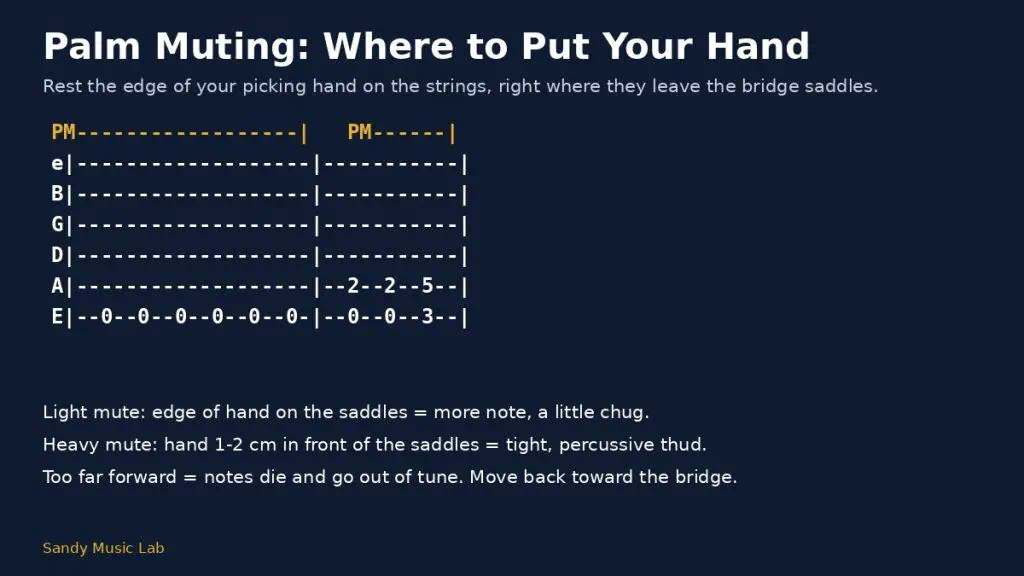
Palm muting is resting the edge of your picking hand lightly on the strings, right where they leave the bridge, while you pick. The strings still sound a pitch, but they ring for a shorter time, giving the tight chug of rock and metal rhythm and the soft pulse of many pop and country parts. If your palm muting sounds like a dull thud, your hand is too far from the bridge or pressing too hard. Slide it back toward the saddles and ease off.
Quick answer: rest the fleshy outer edge of your picking hand (below the little finger) on the strings just in front of the bridge saddles, then pick normally. On the saddles gives a light mute; 1 to 2 cm toward the neck gives a heavier, tighter chug. If notes thud or go sharp, move back toward the bridge and press less. Tabs mark it as PM with a dashed line.
What is palm muting on guitar?
Palm muting is a picking-hand technique that dampens the strings near the bridge so notes sound shorter and more percussive. Despite the name, you use the edge of your hand, not your palm. Wikipedia’s palm mute article notes it is behind the “chugging” sound of distorted rock and metal guitar, and it is used on clean guitar and bass too.
| Style | How palm muting is used |
|---|---|
| Metal and hard rock | Heavy chugs on low power chords between accents |
| Punk and pop punk | Fast down-picked eighth notes, opening up for choruses |
| Country and rockabilly | Light mutes on bass-note patterns |
| Pop and worship | Soft muted eighths on electric under verses |
| Funk and disco | Scratchy muted strums, often with wah |
In tab, it is marked PM with a dashed line over the notes, as covered in how to read guitar tab.
How do you palm mute? Step by step
To palm mute, rest the outer edge of your picking hand on the strings right at the bridge saddles, then pick the note while keeping your hand in place. Start light, with the hand almost on the saddles, and move forward only until you hear the chug you want.
- Find the spot: lay the edge of your hand, below the little finger, across the low strings where they leave the saddles.
- Use light weight: let the hand rest, do not press. The strings should still give a clear pitch.
- Pick from the wrist: keep the hand anchored and pick with small wrist movements, mostly downstrokes at first.
- Adjust the amount: move 1 cm toward the neck for a tighter mute; move back to let more note through.
- Lift to accent: raise the hand slightly to let a chord ring, then drop it back for the next chugs.
Many metal players play these parts with all downstrokes, known as downpicking. Practise on the open low E string with a clean sound first, so you can hear exactly how much note you are keeping. Then add gain.
Why does palm muting sound bad?
It usually sounds bad for one of four reasons: the hand is too far from the bridge, it presses too hard, it only covers some strings, or the gain is set too high. Each one has a quick fix.
| Problem | Likely cause | Fix |
|---|---|---|
| Dull thud, no pitch | Hand too far toward the neck | Slide back onto the saddles |
| Notes go sharp | Pressing down too hard | Rest the hand, do not push |
| Some strings ring out | Hand not covering every string you pick | Angle the hand to cover the low three or four strings |
| Mushy, no definition | Too much gain or bass | Lower gain slightly and add a little mids |
| Clicks but no chug | Picking too lightly | Dig in with firmer downstrokes |
For amp settings that help muted parts cut through, see guitar amp settings and the best guitar amps for metal.
Palm muting exercises (with tab)
These four exercises build control from single notes to chords and accents. Play each at a slow tempo on the free online metronome, starting around 80 BPM in eighth notes, and raise it by 5 BPM once it feels even.
Exercise 1: muted open E eighths. All downstrokes, steady and even.
PM------------------------
e|------------------------|
B|------------------------|
G|------------------------|
D|------------------------|
A|------------------------|
E|--0--0--0--0--0--0--0--0-|
Exercise 2: mute then open. Three muted notes, then let the power chord ring.
PM--------           PM--------
e|---------------------|---------------------|
B|---------------------|---------------------|
G|---------------------|---------------------|
D|-----------------2---|-----------------4---|
A|-----------------2---|-----------------4---|
E|--0--0--0--------0---|--0--0--0--------2---|
Exercise 3: moving power chords. Keep the mute on as you shift between E5, G5 and A5. If you are new to these shapes, see how to play power chords.
PM-------------------------------------
e|-------------------------------------|
B|-------------------------------------|
G|-------------------------------------|
D|-------------------------------------|
A|--2--2--2--2--5--5--5--5--7--7--7--7--|
E|--0--0--0--0--3--3--3--3--5--5--5--5--|
Exercise 4: gallop. One eighth note and two sixteenths (down, down-up), the classic metal gallop rhythm. Count “one, and-a”.
PM----------------------------
e|----------------------------|
B|----------------------------|
G|----------------------------|
D|----------------------------|
A|----------------------------|
E|--0---00--0---00--0---00----|
    1   +a  2   +a  3   +a
What gear helps palm muting with distortion?
The technique works with any guitar and amp, but a medium to high gain sound, a tight low end and a noise gate make heavy chugs clearer. Too much gain or bass turns muted notes into mush, so set the gain lower than you think and boost the mids slightly.
- Pedals: a distortion or a boosted overdrive tightens the low end. See the best pedals for metal and overdrive vs distortion vs fuzz.
- Strings: heavier low strings keep chugs tight in drop tunings; see the best strings for drop D and drop C.
- Practice: a 5-minute muting block fits straight into the guitar practice routine.
Palm muting vs fret-hand muting: what is the difference?
Palm muting uses the picking hand at the bridge and keeps some pitch, while fret-hand muting uses the fretting fingers resting lightly on the strings to kill them completely. Use a palm mute for chugs that still have a note, and fret-hand muting for silent gaps, scratchy rhythm and stopping unwanted strings from ringing.
| Picking-hand mute | Fret-hand mute | |
|---|---|---|
| Hand | Picking hand, at the bridge | Fretting hand, anywhere on the neck |
| Sound | Short note with pitch, chug | No pitch, a click or scratch |
| Tab marking | PM—- | x |
| Typical use | Metal, punk, pop rhythm | Funk, reggae, string noise control |
Most players use both at once: the picking hand mutes the low strings while the fretting hand stops any string it is not playing. That combination is what makes high-gain rhythm parts sound clean. Wikipedia’s muting article covers other muting techniques across instruments.
How this guide was made
Technique details were checked against Wikipedia’s palm mute article and standard teaching methods, and all exercises were written for this guide. Sandy Music Lab is written by David Sandy, and the editorial policy explains how guides are researched. Spotted an error? Tell us.
Palm muting FAQs
What part of the hand do you use to palm mute?
The fleshy outer edge of the picking hand, below the little finger. Despite the name, the palm itself barely touches the strings.
Where should your hand be when palm muting?
Right where the strings leave the bridge saddles for a light mute, or up to about 2 cm toward the neck for a heavier mute.
Why does muting put the guitar out of tune?
You are pressing too hard and bending the strings sharp. Rest the hand lightly instead of pushing down.
How is palm muting written in tab?
As PM followed by a dashed line over the notes that should be muted.
Can you palm mute on an acoustic guitar?
Yes. It gives a soft, percussive pulse that suits pop, folk and country rhythm parts.
Should you use downstrokes for muted parts?
Downstrokes give the tightest, most even chug, especially in metal. Alternate picking works for faster parts once your mute is consistent.
How long does it take to learn to palm mute?
Most players get a usable palm mute in a few practice sessions. Keeping it even at fast tempos takes a few weeks.