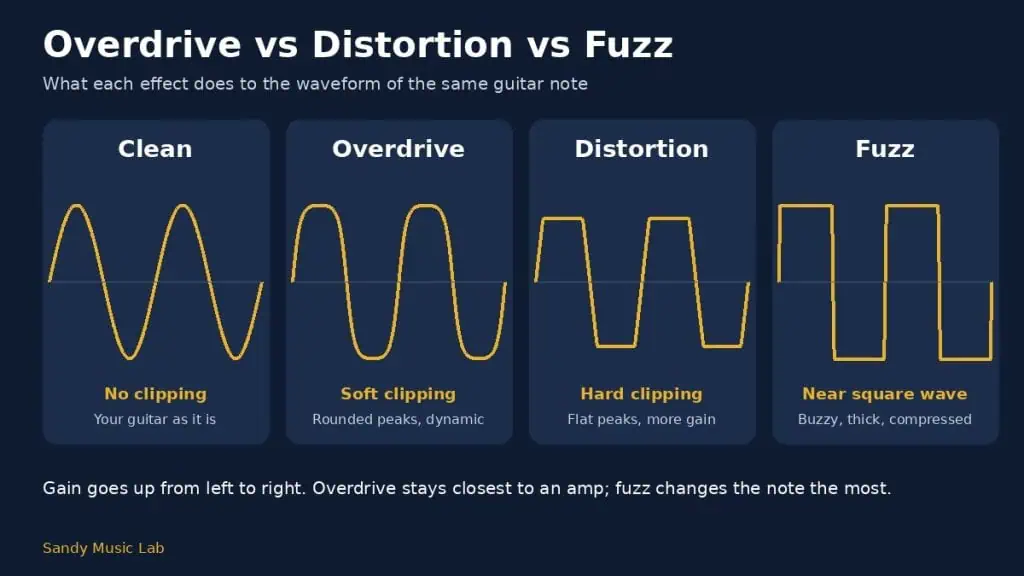
Overdrive vs distortion vs fuzz comes down to how hard each pedal clips your guitar signal. Overdrive clips gently (soft clipping), so it sounds like a pushed tube amp and still reacts to how hard you pick. Distortion clips harder for more gain, sustain and a tighter, more compressed sound. Fuzz clips so hard the wave turns almost square, giving a thick, buzzy tone. A boost adds volume without much clipping at all.
Quick answer: overdrive is mild, amp-like soft clipping that keeps your dynamics (Ibanez Tube Screamer, Boss Blues Driver). Distortion is harder clipping with more gain and sustain for rock and metal (Boss DS-1, ProCo RAT). Fuzz squares off the wave for a thick, buzzy, vintage sound (Fuzz Face, Big Muff). A boost mostly adds volume to push your amp. Start with overdrive if you play blues, classic rock or worship, distortion for heavier rock, and fuzz for vintage or doom tones.
Overdrive vs distortion vs fuzz: what is the difference?
In overdrive vs distortion vs fuzz, the difference is how much the pedal clips (flattens) the peaks of your guitar signal. Overdrive rounds the peaks slightly, distortion flattens them, and fuzz squares them off almost completely. More clipping means more gain, sustain and compression, and less of your guitar’s original character.
| Boost | Overdrive | Distortion | Fuzz | |
|---|---|---|---|---|
| Clipping | Little or none | Soft | Hard | Extreme, near square wave |
| Gain | Low | Low to medium | Medium to high | High |
| Dynamics | Full | Cleans up when you pick softly | Compressed | Very compressed, cleans up with guitar volume on many designs |
| Sound | Louder, same tone | Warm, amp-like grit | Thick, saturated, sustaining | Buzzy, woolly, thick |
| Classic examples | Clean boost pedals | Ibanez Tube Screamer, Boss BD-2 Blues Driver | Boss DS-1, ProCo RAT | Dunlop Fuzz Face, Electro-Harmonix Big Muff |
| Typical genres | Any, to push an amp | Blues, classic rock, country, worship | Hard rock, punk, metal | 60s rock, garage, stoner, doom |
The distortion (music) entry on Wikipedia explains that tube overdrive is a form of soft limiting, while transistor clipping resembles hard clipping, and that heavy clipping pushes a note toward a square wave with harsh odd harmonics. Boss’s guide to overdrive and distortion draws the same line between amp-like overdrive and heavier distortion.
What does overdrive sound like?
Overdrive sounds like a tube amp turned up until it starts to break up: warm, slightly gritty and touch-sensitive. Pick softly and it cleans up; dig in and it growls. Most overdrive pedals also boost the mids, which helps a guitar cut through a band mix without much extra volume.
Overdrive pedals use soft clipping, often with diodes in the feedback loop of an op-amp, which rounds the wave rather than chopping it flat. That is why overdrive stacks well with an already driven amp and is the usual choice for blues, classic rock, country and worship guitar. Popular choices are compared in the best overdrive pedals guide.
What does distortion sound like?
Distortion sounds thicker, louder and more sustained than overdrive, with a tighter, more compressed attack. Notes ring longer, palm mutes chug, and the pedal sounds similar whether you pick lightly or hard. It is the core sound of hard rock, punk and metal.
Distortion pedals usually use hard clipping, often with diodes that clip the signal to ground, so the wave is cut flat at the top and bottom. That creates more harmonics and the saturated tone that works for power chords. See the best distortion pedals for options, and the best pedals for metal for high-gain rigs.
What does fuzz sound like?
Fuzz sounds buzzy, thick and woolly, like a blown speaker in the best way. It clips so hard that a single note turns into something close to a square wave, which gives huge sustain and a raspy edge. Many fuzz pedals clean up surprisingly well when you roll back the guitar’s volume knob.
Fuzz was the first mass-produced drive effect: Gibson introduced the Maestro FZ-1 Fuzz-Tone in 1962, and it sold out after Keith Richards used it on “(I Can’t Get No) Satisfaction” in 1965, according to the Maestro FZ-1 entry on Wikipedia. The FZ-1 used three germanium transistors. Germanium fuzz tends to sound smoother and react to temperature, while silicon fuzz sounds brighter and more aggressive. Explore models in the best fuzz pedals.
Boost vs overdrive: what is the difference?
A boost raises your signal’s volume with little or no clipping of its own, while an overdrive adds its own soft clipping and a mid-range bump. Use a boost to push an already driven amp harder or to lift a solo; use an overdrive when you want the pedal itself to supply the grit.
| Goal | Better choice |
|---|---|
| Louder solos without changing tone | Boost |
| Grit from a clean amp | Overdrive |
| Tighten a high-gain amp | Overdrive with gain low, level high |
| Push a tube amp into breakup | Boost or overdrive |
The best boost pedals guide covers clean boosts. Many players run a low-gain overdrive as a boost in front of a distortion or high-gain amp to tighten the low end.
Which drive pedal should you get first?
When choosing between overdrive vs distortion vs fuzz, get an overdrive first if you play blues, classic rock, country or worship, a distortion first if you play hard rock, punk or metal, and a fuzz first only if you want vintage 60s or stoner tones. Overdrive is the most versatile first pedal because it works as both a light drive and a boost.
| Your music | First pick | Why |
|---|---|---|
| Blues, classic rock, worship | Overdrive | Amp-like, dynamic, stacks well |
| Hard rock, punk | Distortion | More gain and sustain |
| Metal | Distortion, or overdrive into a high-gain amp | Tight and saturated |
| 60s rock, garage, doom | Fuzz | Thick, vintage character |
| Already have a driven amp | Boost | Pushes the amp further |