How to use the chord transposer
- Paste your chords, or a whole song with chords above the lyrics.
- Set From key to the song’s current key and To key to the key you want, or tap the ½-step buttons.
- Copy the result. Want to keep your open shapes instead? Pick a capo option under the result.
The tool reads triads, minor and seventh chords, maj7, sus, add9, dim, aug and slash chords like D/F#. Both the root and the bass note move. Lines that are mostly words are left alone, and each chord keeps its column, so it still sits above the right syllable when G becomes G# or Bb.
Worked example: a song in G for a singer who needs A
Your chart is G – D/F# – Em7 – Cadd9 and the singer wants it a whole step higher. A is two half steps above G, so every root moves up two: G → A, D/F# → E/G#, Em7 → F#m7, Cadd9 → Dadd9. Every chord type stays the same, only the letters change.
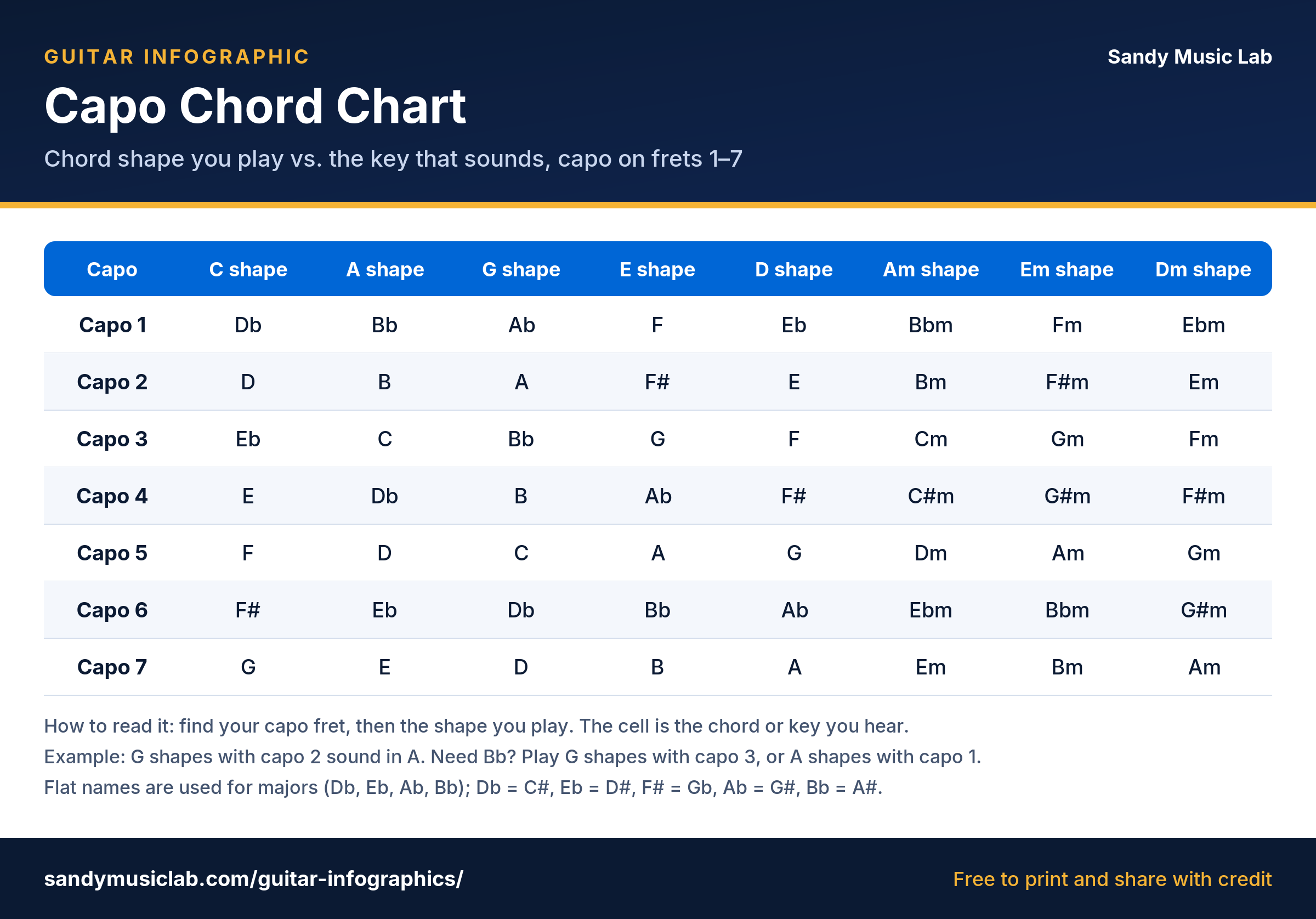
Don’t fancy new shapes? Keep the G shapes and put a capo on fret 2. It sounds in A, and your hands do exactly what they did before. That’s what the capo options in the tool show for any key.
Capo chord chart
Find the open shape you play, then read across to see which chord actually sounds with the capo on that fret.
| Capo | C shape | A shape | G shape | E shape | D shape |
|---|---|---|---|---|---|
| Fret 1 | C# | Bb | Ab | F | Eb |
| Fret 2 | D | B | A | F# | E |
| Fret 3 | Eb | C | Bb | G | F |
| Fret 4 | E | C# | B | Ab | F# |
| Fret 5 | F | D | C | A | G |
| Fret 6 | F# | Eb | C# | Bb | Ab |
| Fret 7 | G | E | D | B | A |
Half steps between keys
| Move | Half steps | Example |
|---|---|---|
| Up a half step | +1 | G → Ab |
| Up a whole step | +2 | G → A |
| Up a minor third | +3 | G → Bb |
| Up a fourth | +5 | G → C |
| Up a fifth (or down a fourth) | +7 / −5 | G → D |
| Down a whole step | −2 | G → F |
Tips for transposing chords
- Pick the key for the voice first. If the high note feels strained, drop 1–2 half steps; if it’s mumbly, raise it.
- Prefer guitar-friendly keys. G, C, D, A and E use open chords. For anything else, transpose to one of those and add a capo.
- Keep the bass note in slash chords. D/F# up two is E/G#, not E/F#.
- Flat keys get flats. A chart in Eb reads Ab and Bb, not G# and A#. Auto spelling handles that for you.
- Practice the theory too. Our guides on how to transpose guitar chords and how chords change with a capo explain the why.