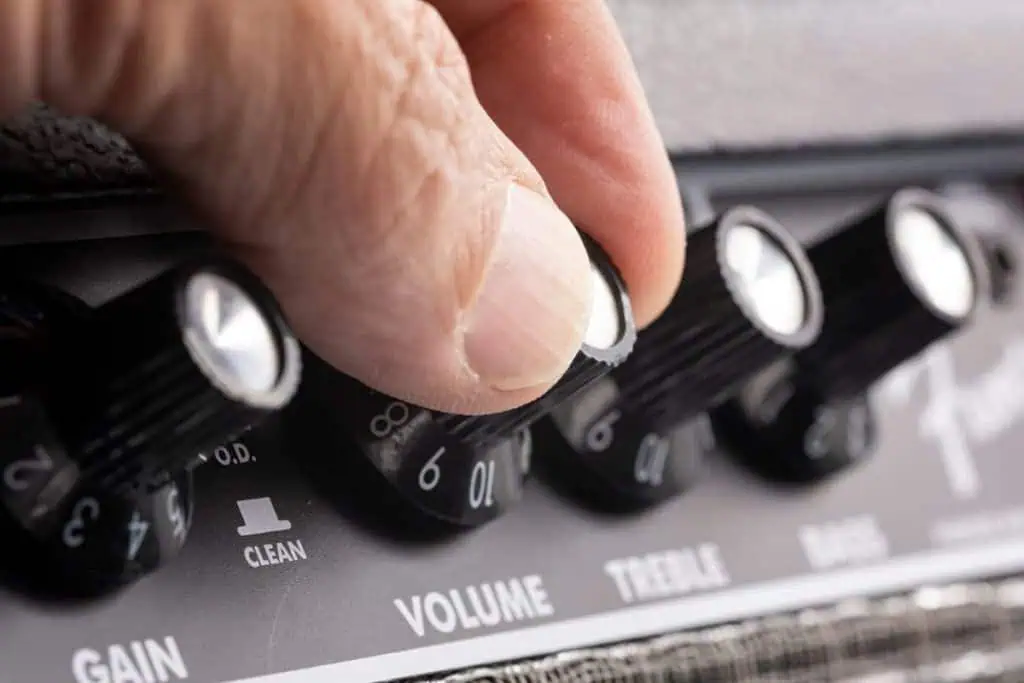
Start every amp with gain, bass, middle and treble at 12 o’clock (5 on a 1–10 dial), then adjust one knob at a time. For clean tones, keep gain low and mids around 5. For rock, raise gain to 6–7 and mids to 6. For metal, use high gain but less than you think, with tight bass.
Every amp is different, but the way its knobs interact is surprisingly consistent. The same principles apply to a tube combo, a solid-state practice amp and the virtual amps we cover in our guitar amp modeling guide.
Below you’ll find guitar amp settings for six common styles, a reference chart you can save, and a simple method for dialing in any amp in five minutes. If you play through captures, the same moves work in Neural Amp Modeler and on amp modeler pedals like the TONEX One.
🎸 Free download
Not sure which guitar is right for you?
Get the free Guitar Gear Cheat Sheet: match your style, budget and hands to the right guitar in 2 minutes. You’ll also get my 30-Day Practice Plan as a bonus.
Send My Cheat Sheet →Table of Contents
What Each Amp Knob Actually Does
Before you copy anyone’s guitar amp settings, it helps to know what each control changes. Here’s the plain-English version.
- Gain (or Drive). How hard the preamp is pushed. Low gain is clean, medium gain is crunch, and high gain is distortion. Gain changes the character of the sound, not just the loudness.
- Volume or Master. The overall loudness. On a single-volume tube amp, turning it up also adds natural breakup.
- Bass. Low end and warmth. Too much makes chords muddy, especially with distortion.
- Middle. The body of your tone and the range that cuts through a band. Mids matter more than most beginners think.
- Treble. Brightness and pick attack. Too much sounds harsh, and too little sounds dull.
- Presence. Upper treble in the power amp. Adds air and clarity.
- Reverb. Adds space. A little goes a long way.
On many amps, the tone controls interact. Raising the middle on a Fender-style amp, for example, also changes how the bass and treble behave. That’s why you should always move one knob at a time. Marshall’s beginner guide to amp EQ has a good visual breakdown of each band.
Guitar Amp Settings Chart for 6 Styles
Use these guitar amp settings as starting points on a 1–10 scale, where 5 is 12 o’clock. Your guitar, pickups, speaker and room will change the result, so treat the chart as a map, not a rule.
| Style | Gain | Bass | Middle | Treble | Presence | Reverb |
|---|---|---|---|---|---|---|
| Sparkling clean | 2–3 | 5 | 5 | 6 | 5 | 3 |
| Blues (edge of breakup) | 4–5 | 5 | 6 | 5 | 5 | 2–3 |
| Classic rock crunch | 6 | 5 | 6–7 | 6 | 5 | 2 |
| Hard rock lead | 7–8 | 5 | 7 | 6 | 6 | 2–3 |
| Modern metal rhythm | 7–8 | 4–5 | 5 | 6 | 6 | 0–1 |
| Jazz | 1–2 | 6 | 5 | 3–4 | 3 | 2 |
Notice that none of these guitar amp settings use extreme values. Most great tones live between 3 and 7 on every knob. If you need to max something, the problem is usually elsewhere in the chain, such as your guitar’s tone knob, your pickup height or a pedal.
Clean and Blues Guitar Amp Settings
For a clean tone, set gain low and use the master volume for loudness. Raise the treble slightly for sparkle, and add a touch of reverb. Single-coil guitars sound glassy here, and humbuckers sound warm and round.
For blues, push gain until the amp just starts to break up when you dig in, and clean up when you play softly. That edge-of-breakup sweet spot responds to your picking and your guitar’s volume knob. Lift the mids a little for that vocal quality. For more tips, read how to get a warm electric guitar tone.
Best Amp Settings for Rock
The best amp settings for rock start with mids. Classic rock tones, from AC/DC to Led Zeppelin, are mid-heavy and not especially high in gain. Here’s a reliable approach:
- Set gain to 6, bass 5, middle 6–7, treble 6 and presence 5.
- Play a big open chord. If the notes blur together, lower the gain until each string rings clearly.
- Play a single-note riff on the low strings. If it booms, lower the bass. If it sounds thin, add mids before you add bass.
- For leads, add gain to 7–8 or use a boost pedal, and raise the mids again so solos sing.
A common mistake is using too much gain for rhythm parts. Recorded rock guitars often have less distortion than you think, layered across several tracks. If your amp is clean-only, see how to get distortion without a pedal for other ways to get crunch.
Metal Guitar Amp Settings That Stay Tight
High-gain tones fall apart fastest with poor guitar amp settings. Keep these points in mind:
- Use less gain than you think. Start around 7 and only go higher if notes still sound clear.
- Tighten the low end. Keep bass at 4–5 and use a tube-screamer-style boost with the drive at zero in front of the amp. It cuts flab and adds focus.
- Don’t scoop the mids too far. A deep ‘smiley face’ EQ sounds big alone but disappears in a band mix.
- Use a noise gate. High gain amplifies hum and hiss. A gate keeps stops clean.
Amp EQ Settings: How to Dial In Any Amp in 5 Minutes
These amp EQ settings steps work on any amp, pedal or plugin. They’re also the steps I teach students who want guitar amp settings that work with any guitar.
- Reset. Turn every tone knob to 5, gain low, and switch off all effects.
- Set the volume first. Play at the level