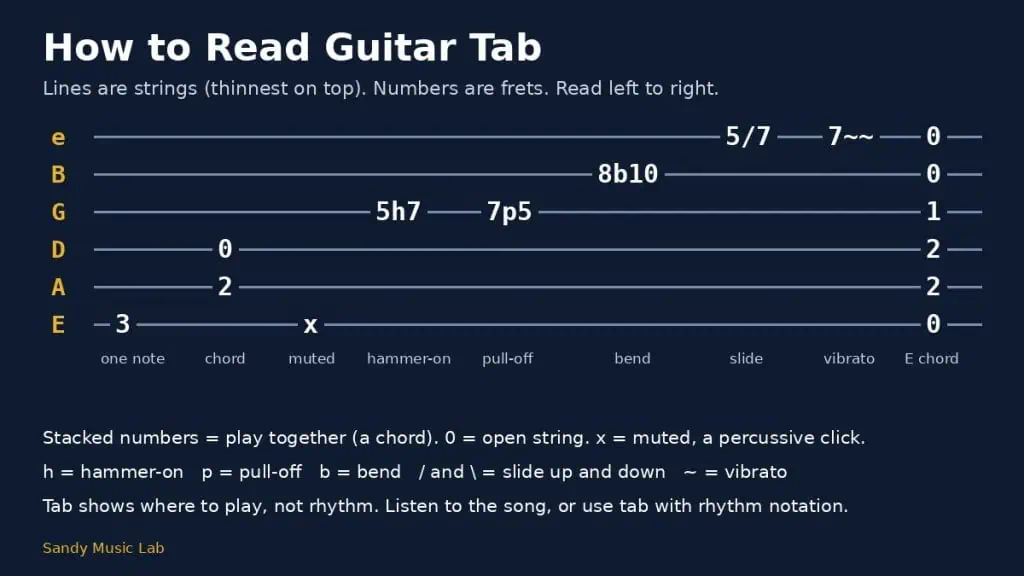
Here is how to read guitar tab: the six horizontal lines are the six strings, with the thinnest high E string on top, and each number tells you which fret to press on that string. Read from left to right, and numbers stacked on top of each other are played at the same time as a chord. A 0 means play the string open. Letters and symbols between numbers, such as h, p, b and /, tell you how to move from one note to the next.
Quick answer: tab has six lines, one per string, with the high E on top and the low E at the bottom. A number is the fret to press on that line (0 = open), you read left to right, and stacked numbers are a chord. The most common symbols are h (hammer-on), p (pull-off), b (bend), / and \ (slides), x (muted) and ~ (vibrato). Tab does not show rhythm, so listen to the song as you read.
How to read guitar tab: what do the lines and numbers mean?
In guitar tab, each of the six lines is a string and each number is a fret. The top line is the thinnest string (high E) and the bottom line is the thickest (low E), so tab looks like the guitar’s strings seen from above as you hold it. Many tabs label the lines e B G D A E at the left.
| Tab line | String | Note in standard tuning |
|---|---|---|
| Top (e) | 1st, thinnest | High E |
| 2nd (B) | 2nd | B |
| 3rd (G) | 3rd | G |
| 4th (D) | 4th | D |
| 5th (A) | 5th | A |
| Bottom (E) | 6th, thickest | Low E |
Beginners often expect the low string on top, because it is physically on top when you play. Tab flips it so the high notes sit high on the page; why guitar tabs are drawn upside down explains the history. Wikipedia’s tablature article traces tab back centuries, to lute music.
How to read guitar tab notes and chords
Read tab from left to right, one column at a time. A single number on a line is one note: play that string at that fret. Numbers stacked in the same column are played together as a chord, and an x in that column means mute that string.
Here is a single-note line, then the same notes as a chord. The first line says: play the open low E, then the low E at the 3rd fret, then the A string at the 2nd fret.
e|-----------------|-----|
B|-----------------|--0--|
G|-----------------|--0--|
D|-----------------|--2--|
A|---------2-------|--2--|
E|--0---3----------|--0--|
     single notes    E minor chord
The second bar is an E minor chord: the A and D strings at the 2nd fret, everything else open, all strummed together. For chord charts with finger numbers instead, see how to read a chord chart, and for the most common shapes, beginner guitar chords.
What are the guitar tab symbols?
Guitar tab symbols sit between or after the fret numbers and tell you how to play the note. The most common are h for hammer-on, p for pull-off, b for bend, / and \ for slides, ~ for vibrato and x for a muted note. Some tabs add PM for palm muting, the chugging sound of rock and metal rhythm.
| Symbol | Name | How to play it | Example |
|---|---|---|---|
| h | Hammer-on | Pick the first note, then press the higher fret without picking | 5h7 |
| p | Pull-off | Pick the first note, then lift off to the lower fret | 7p5 |
| b | Bend | Push the string until it sounds like the second fret number | 7b9 |
| r | Release | Let a bent string back down | 7b9r7 |
| / | Slide up | Slide along the string to the higher fret | 5/7 |
| \ | Slide down | Slide to the lower fret | 7\5 |
| ~ | Vibrato | Wobble the pitch by moving the string | 7~~ |
| x | Muted note | Rest a finger on the string and pick for a click | x |
| PM | Palm mute | Rest the picking hand near the bridge | PM—- |
| ( ) | Ghost or optional note | Play quietly, or a note held from before | (7) |
| < > | Natural harmonic | Touch the string lightly above the fret | <12> |
Symbols can vary slightly between tab writers, so check the legend at the top of a tab if there is one. Hammer-ons and pull-offs are the most common; the best guitar exercises include drills for both.
Does guitar tab show rhythm?
Basic guitar tab does not show rhythm, which is its biggest weakness. Spacing between numbers can hint at timing, but you will not know exactly how long each note lasts unless the tab includes rhythm stems or you listen to the recording. Software and app tabs often add rhythm and playback.
| Format | Shows where to play | Shows rhythm | Best for |
|---|---|---|---|
| Plain text tab | Yes | Only roughly | Quick riffs and songs you already know |
| Tab with rhythm notation | Yes | Yes | Learning new songs accurately |
| Standard notation | Pitch only, not position | Yes | Reading any instrument’s music |
| Chord chart | Chords only | Sometimes, with slashes | Strumming songs |
The practical approach: listen to the song first, then use tab to find the notes. Practise with the free online metronome so your timing is steady. Whether tab is a shortcut or a valid tool is a common debate; are guitar tabs considered cheating and do professional guitarists use tabs cover both sides.
Practice example: read a melody in tab
Try this tab of the opening of Beethoven’s “Ode to Joy”, a public-domain melody that only uses the top two strings. Say the fret numbers out loud as you play, then play it at a slow, steady tempo.
e|--0--0--1--3--3--1--0----------------------0--0----------|
B|----------------------3--1--1--3----------------3--3-----|
G|---------------------------------------------------------|
D|---------------------------------------------------------|
A|---------------------------------------------------------|
E|---------------------------------------------------------|
   E  E  F  G  G  F  E  D  C  C  D        E  E  D  D
Next, try this short exercise that uses three tab symbols: a hammer-on, a pull-off and a slide on the G string.
e|-----------------------------|
B|-----------------------------|
G|--5h7--7p5--5/7--7~~---------|
D|-----------------------------|
A|-----------------------------|
E|-----------------------------|
A 5-minute drill: how to read guitar tab faster
Add this drill to the guitar practice routine for a week and tab will start to feel automatic. It builds the habit of reading ahead and connecting lines to strings without looking.
- Minute 1: name the strings from the top tab line down (e B G D A E) while touching each string.
- Minutes 2 to 3: play the “Ode to Joy” tab above slowly, then at 60 BPM.
- Minute 4: play the symbol exercise, focusing on clean hammer-ons and pull-offs.
- Minute 5: open a tab of any easy song and play the first line.
For songs to read next, try the easy guitar songs for beginners, most of which include tab. For riffs built from power chords, the how to play power chords guide shows them in tab too.
How this guide was made
Tab conventions were checked against Wikipedia’s tablature article and common tab legends, and all examples were written for this guide. The melody example is Beethoven’s “Ode to Joy”, which is in the public domain. Sandy Music Lab is written by David Sandy, and the editorial policy explains how guides are researched. Spotted an error? Tell us.
Guitar tab FAQs
Which line is the low E in guitar tab?
The bottom line is the low E (thickest string), and the top line is the high E (thinnest string).
What does 0 mean in guitar tab?
A 0 means play the string open, without pressing any fret.
What does x mean in guitar tab?
An x means a muted or dead note. Rest a fretting finger lightly on the string and pick it for a percussive click.
What does h and p mean in guitar tab?
h is a hammer-on: pick a note, then press a higher fret without picking. p is a pull-off: pick a note, then lift off to a lower fret.
How do you read chords in tab?
Numbers stacked in the same column are played together. Fret every number shown and strum those strings at once.
Is tab easier than sheet music?
Yes for guitar, because it shows exactly where to put your fingers. Standard notation shows rhythm better and works for any instrument.
How long does it take to learn to read tab?
Most beginners can read simple tab in a day. Reading it quickly takes a few weeks of regular practice.