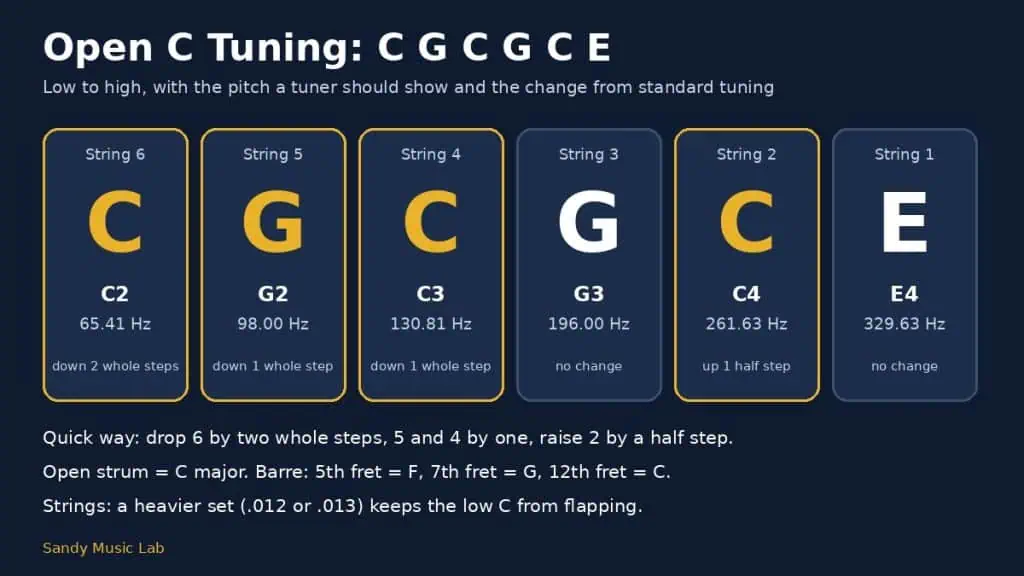
Open C tuning is C G C G C E, low to high. From standard, you drop the 6th string two whole steps to C, the 5th and 4th strings one whole step to G and C, and raise the 2nd string a half step to C, while the G and high E stay put. Strummed open, it rings out a huge, deep C major chord. It is the deepest of the common open tunings, so most players use a slightly heavier set to keep the low C from flapping.
Quick answer: open C tuning is C G C G C E (low to high). Lower string 6 from E to C (two whole steps), string 5 from A to G and string 4 from D to C (one whole step each), and raise string 2 from B to C (a half step). Strum open for C, barre the 5th fret for F and the 7th for G. On acoustic, a .013 set (or at least a heavier 6th string) keeps the low C clean.
What notes are in open C tuning?
It uses only C, E and G, the notes of a C major chord, laid out as C G C G C E. Four strings change from standard, more than in open G or DADGAD, which is why open C feels so different under the fingers. The Wikipedia article on open C lists this as one of several open C versions.
| String | Standard | Open C | Change | Tuner pitch |
|---|---|---|---|---|
| 6 (thickest) | E2 | C2 | Down 2 whole steps | 65.41 Hz |
| 5 | A2 | G2 | Down 1 whole step | 98.00 Hz |
| 4 | D3 | C3 | Down 1 whole step | 130.81 Hz |
| 3 | G3 | G3 | None | 196.00 Hz |
| 2 | B3 | C4 | Up 1 half step | 261.63 Hz |
| 1 (thinnest) | E4 | E4 | None | 329.63 Hz |
William Sethares’ alternate tuning guide from the University of Wisconsin covers open C and its variants in more depth.
How do you tune to open C?
To tune to open C, lower the 6th string two whole steps to C, lower the 5th string to G and the 4th string to C, then raise the 2nd string a half step to C. Use a tuner, because the low C is a long way from E, and retune everything once more at the end.
- 6th string (E to C): lower it a long way, until it sounds two octaves below the 2nd string’s new C. On the free online guitar tuner it should read C2.
- 5th string (A to G): lower it until it matches the open 3rd string (G) an octave down. It should read G2.
- 4th string (D to C): lower it one whole step. It should read C3.
- 2nd string (B to C): raise it one half step, the same as fretting the 1st fret in standard tuning. It should read C4.
- Retune all six: big tension changes pull the others, so check again until the open strum is a clean C major.
Lowering a string two whole steps makes it very slack, so tune up to C from below and stretch the string gently before the final tune. Going back to standard is the same steps in reverse.
What chords can you play in open C tuning?
In open C tuning a full barre gives a major chord on every fret: open is C, the 5th fret is F and the 7th fret is G. Those three chords cover the 1, 4 and 5 of the key of C, and the 12th fret repeats C an octave up.
| Fret (full barre) | Chord | Role in the key of C |
|---|---|---|
| Open | C | 1 |
| 2 | D | 2 (as a major chord) |
| 3 | Eb | b3, blues and rock |
| 5 | F | 4 |
| 7 | G | 5 |
| 10 | Bb | b7 |
| 12 | C | 1 (an octave up) |
Two easy colours from the open chord, both checked note by note:
- Cadd9: fret the 2nd string at the 2nd fret (C becomes D). Notes C G C G D E.
- C6: fret the 3rd string at the 2nd fret (G becomes A). Notes C G C A C E.
Minor chords need partial shapes, so many open C pieces stay in major and lean on these colours. The diatonic chords guide shows which chords belong in C if you want to build your own shapes.
What string gauge is best for open C tuning?
The best string gauge for open C is one step heavier than you normally use, for example a .013 to .056 set on acoustic or .011 to .052 on electric. The 6th string drops two whole steps to C, and on a light set it can feel floppy, buzz and play sharp when you strum hard.
| Guitar | Light use | Full-time open C |
|---|---|---|
| Acoustic, 25.4 in scale | .012 to .053, with a heavier 6th string | .013 to .056 |
| Electric, 25.5 in scale | .011 to .049 | .011 to .052 or .012 to .056 |
| Electric, 24.75 in scale | .011 to .052 | .012 to .056 |
Check your set with the string gauge finder or the guitar string tension calculator. For heavier down-tuning sets, the best guitar strings for metal and down tuning guide lists suitable options. A heavier set may need a nut and truss rod check; guitar setup cost explains what that involves.
What are the other open C tunings?
There are several open C tunings, and C G C G C E is the most common. Others keep the deep low C but rearrange the top strings, such as the C G C G G E version used by Soundgarden, the overtones version C C G C E G, and the C G C D G A tuning folk guitarist Martin Carthy uses.
| Version | Notes (low to high) | Used by (per Wikipedia) |
|---|---|---|
| Common open C | C G C G C E | William Ackerman, John Fahey, Jimmy Page on “Friends”, Devin Townsend |
| C5 variant | C G C G G E | Soundgarden (“Pretty Noose”, “Burden in My Hand”) |
| Overtones | C C G C E G | Built from the harmonic series of C |
| High C variant | C C G C E C | Mick Ralphs on Bad Company’s “Can’t Get Enough” |
| Carthy tuning | C G C D G A | Martin Carthy (related to DADGAD) |
Song tunings follow the Wikipedia open C and DADGAD articles. The C G C D G A tuning is close to DADGAD moved down a whole step.
Open C vs open G vs drop C: which should you use?
Use open C for big, ringing solo and fingerstyle arrangements, open G for rock rhythm and slide, and drop C for heavy riffs with standard chord shapes on the top strings. Open C has the lowest bass note and the most retuning; drop C keeps most shapes familiar.
| Tuning | Notes (low to high) | Strings changed | Best for |
|---|---|---|---|
| Open C | C G C G C E | 4 | Solo acoustic, ambient, deep drones |
| Open G | D G D G B D | 3 | Rock rhythm, slide, blues |
| Open E | E B E G# B E | 3 (tuned up) | Bright slide |
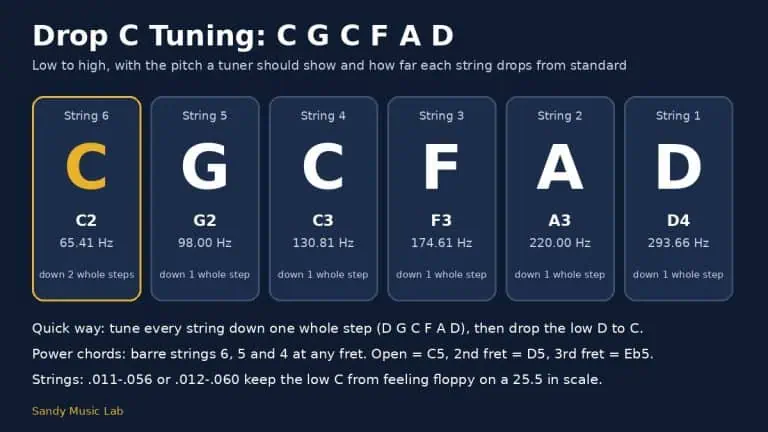
| Drop C | C G C F A D | 6 | Metal and hard rock riffs |
See open G tuning, open E tuning and drop C tuning for full guides. If open C pieces are your goal, a guitar with a full low end helps; the best fingerstyle guitars guide is a good starting point.
How this guide was made
Notes, frequencies and tuning variants were checked against the Wikipedia open C article and the Sethares alternate tuning guide, with frequencies at standard A440 pitch. Chord shapes were worked out note by note from the open strings. Sandy Music Lab is written by David Sandy, and the editorial policy explains how guides are researched. Spotted an error? Tell us.
Open C tuning FAQs
What are the notes of open C tuning?
The common version is C G C G C E from the thickest string to the thinnest. Strummed open it makes a C major chord.
How do you get to open C from standard?
Lower the 6th string two whole steps to C, the 5th to G and the 4th to C, then raise the 2nd string a half step to C. The 3rd and 1st strings stay the same.
Do you need heavier strings for open C?
Usually yes. The low C is two whole steps below E, so a .013 acoustic set or .011 to .052 electric set keeps it from flapping.
What songs use open C tuning?
Examples include Led Zeppelin’s “Friends”, William Ackerman’s “Townshend Shuffle” and much of Devin Townsend’s work. Soundgarden used a C G C G G E variant.
Is open C good for beginners?
It is fine for experimenting, but the big retune and slack low string make it harder than open G. Try open G first.
Can open C damage a guitar?
No. Most strings get looser, and only the 2nd string goes up a half step. A guitar kept in open C for weeks may need a small truss rod adjustment.
What is the difference between open C and C standard?
C standard (C F Bb Eb G C) lowers every string two whole steps and keeps standard chord shapes. Open C retunes to a C major chord.