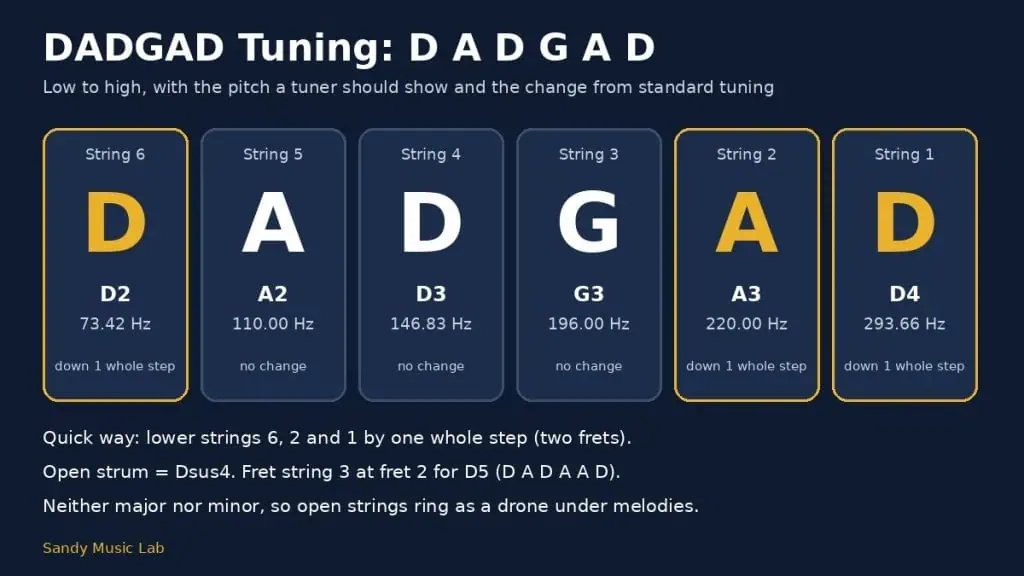
DADGAD tuning is D A D G A D, low to high. To get there from standard tuning, lower the 6th, 2nd and 1st strings by one whole step (two frets) and leave the A, D and G strings alone. Strummed open, it makes a Dsus4 chord, which is neither major nor minor, so the open strings ring like a drone under almost any melody in D. That ringing quality is why it is called Celtic tuning, and why fingerstyle players love it.
Quick answer: DADGAD tuning is D A D G A D (low to high). Tune string 6 from E down to D, string 2 from B down to A, and string 1 from E down to D. Strings 5, 4 and 3 stay at A, D and G. Start with three shapes: open strings (Dsus4), the 3rd string at the 2nd fret (D5), and the 6th string at the 5th fret with the 5th muted (Gsus2). Those cover a lot of songs in D.
What notes are in DADGAD tuning?
The notes are D, A and G, spread across six strings as D A D G A D. Three strings drop from standard and three stay where they are, and the Wikipedia article on DADGAD describes the open chord as D suspended fourth.
| String | Standard | DADGAD | Change | Tuner pitch |
|---|---|---|---|---|
| 6 (thickest) | E2 | D2 | Down 1 whole step | 73.42 Hz |
| 5 | A2 | A2 | None | 110.00 Hz |
| 4 | D3 | D3 | None | 146.83 Hz |
| 3 | G3 | G3 | None | 196.00 Hz |
| 2 | B3 | A3 | Down 1 whole step | 220.00 Hz |
| 1 (thinnest) | E4 | D4 | Down 1 whole step | 293.66 Hz |
Because there is no third (F# or F) in the open strings, the tuning works for both major and minor songs in D. William Sethares’ alternate tuning guide from the University of Wisconsin covers it alongside other open and modal tunings.
How do you tune to DADGAD?
To tune to DADGAD, lower three strings by a whole step: the 6th string to D, the 2nd string to A and the 1st string to D. Check each one with a tuner or against the strings that stay put, then retune all six, because dropping tension on three strings can nudge the others sharp.
- 6th string (E to D): lower it until it sounds one octave below the open 4th string. On the free online guitar tuner it should read D2.
- 2nd string (B to A): lower it until it matches the open 5th string an octave up, or the 2nd fret of the 3rd string. It should read A3.
- 1st string (E to D): lower it until it matches the 5th fret of the 2nd string (now A, so the 5th fret is D). It should read D4.
- Check the open strum: you should hear a ringing, unresolved Dsus4.
Tune up to each note from slightly below so the string holds pitch. If you switch tunings during a set, a pedal or clip-on tuner is quicker than tuning by ear; see the best clip-on tuners.
What are the easiest DADGAD chords?
The easiest DADGAD chords use one or two fingers and let the other strings ring. Start with the open Dsus4, then D5 (3rd string, 2nd fret) and Gsus2 (6th string, 5th fret, 5th string muted). Those three cover a huge amount of folk and Celtic playing in the key of D.
| Chord | Frets (strings 6 to 1) | Notes | Sound |
|---|---|---|---|
| Dsus4 | 0 0 0 0 0 0 | D A D G A D | Open, unresolved |
| D5 | 0 0 0 2 0 0 | D A D A A D | Strong, neither major nor minor |
| D major | 0 0 4 2 0 0 | D A F# A A D | Bright, full major |
| Gsus2 | 5 x 0 0 0 0 | G D G A D | Open G sound with a ringing top |
| Asus4 | x 0 2 2 0 0 | A E A A D | Pulls back to D |
| Bm7 | x 2 0 2 0 0 | B D A A D | Soft minor colour |
| Em11 | x 2 2 0 0 0 | B E G A D | Moody, works in D and G |
An x means mute or skip that string. All the shapes above were checked note by note. Keep open strings ringing wherever you can: the drone is the point of the tuning. To see how these chord functions fit the key, the diatonic chords guide shows every chord in D, and how to read a chord chart explains the fret notation.
Why does DADGAD sound Celtic?
DADGAD sounds Celtic because the open D and A strings act as a drone, like the drones on Scottish and Irish bagpipes. Melodies played on the top strings ring against those low notes, and moveable shapes keep open strings sounding as the chords change, which copies the voicings of traditional pipe and fiddle music.
British folk guitarist Davey Graham popularised the tuning in the 1960s, after hearing an oud player in Morocco. It spread through Irish traditional music and into rock, folk and modern fingerstyle. Today it is a go-to tuning for fingerstyle and percussive acoustic players, and it fits the best fingerstyle guitars such as concert and parlor bodies very well.
What songs use DADGAD tuning?
The most famous DADGAD songs are Led Zeppelin’s “Kashmir” and “Black Mountain Side”, both by Jimmy Page, who also used it on the Yardbirds’ “White Summer”. Beyond Zeppelin, it is the tuning of choice for Celtic guitar and for modern acoustic players such as Pierre Bensusan, Andy McKee and Ben Howard.
| Song or style | Artist | Notes |
|---|---|---|
| Kashmir | Led Zeppelin | Jimmy Page, DADGAD |
| Black Mountain Side | Led Zeppelin | Acoustic instrumental, DADGAD |
| White Summer | The Yardbirds | Jimmy Page, DADGAD |
| Irish and Scottish tunes | Mícheál Ó Domhnaill, Dáithí Sproule, Tony McManus | Early and modern Celtic DADGAD |
| Modern fingerstyle | Pierre Bensusan, Andy McKee, Mike Dawes | Percussive and solo guitar |
| Songwriting | Ben Howard, John Martyn, Richard Thompson | Folk and singer-songwriter |
Song and artist details follow the Wikipedia DADGAD article. For more fingerstyle repertoire, see the fingerpicking songs list, and try any song in D with a strong drone feel. Simple hymns in D also arrange well here; hymns on guitar is a good source of melodies.
Do you need different strings for DADGAD?
You do not need different strings for DADGAD. Three strings are lowered by a whole step, so your usual set works. If the low D feels floppy or buzzes when you dig in, move up one gauge on the 6th string or try a medium set on acoustic.
| Situation | String choice |
|---|---|
| Occasional DADGAD on acoustic | Your usual .012 to .053 light set |
| Full-time DADGAD, strong right hand | .013 to .056 medium set |
| Occasional DADGAD on electric | Your usual .010 to .046 set |
| Low D buzzes | Heavier 6th string or a small setup tweak |
The guitar string tension calculator shows how much tension each string loses, and the best strings for acoust