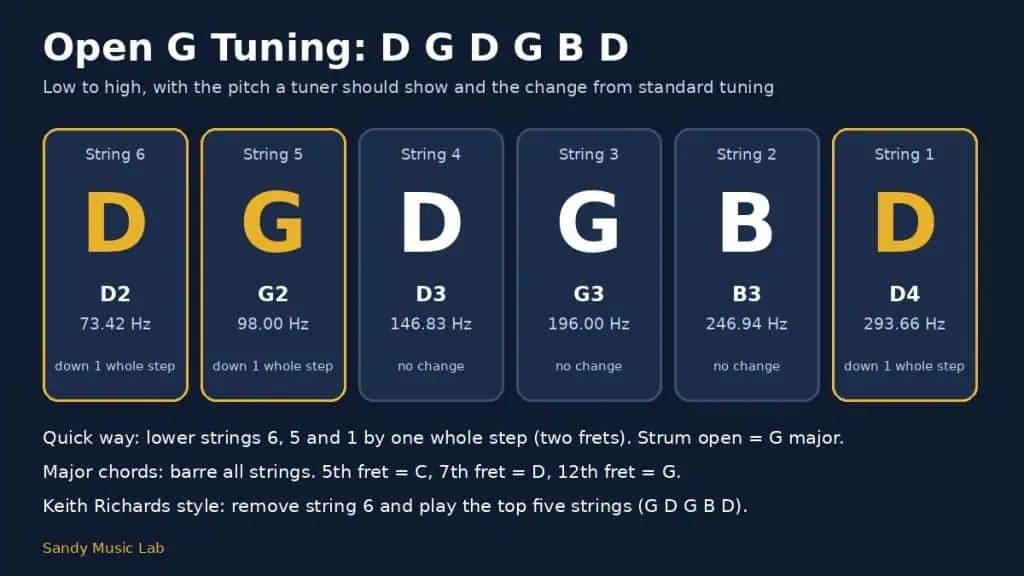
Open G tuning is D G D G B D, low to high. To get there from standard tuning, lower the 6th, 5th and 1st strings by one whole step (two frets) and leave the middle three alone. Strum the open strings and you hear a G major chord, so one finger across any fret gives you another major chord. That is why open G is a favourite for slide guitar, blues, Hawaiian slack-key and the Keith Richards style of rock rhythm.
Quick answer: open G tuning is D G D G B D (low to high). Tune string 6 from E down to D, string 5 from A down to G, and string 1 from E down to D. Strings 4, 3 and 2 stay at D, G and B. Strum open for G, barre the 5th fret for C and the 7th fret for D. You do not need new strings, though the low D will feel a little looser.
What notes are in open G tuning?
It uses the notes D, G and B, the three notes of a G major chord, spread across six strings as D G D G B D. Three strings change from standard tuning and three stay put, so it is one of the quickest open tunings to reach and to undo.
| String | Standard | Open G | Change | Tuner pitch |
|---|---|---|---|---|
| 6 (thickest) | E2 | D2 | Down 1 whole step | 73.42 Hz |
| 5 | A2 | G2 | Down 1 whole step | 98.00 Hz |
| 4 | D3 | D3 | None | 146.83 Hz |
| 3 | G3 | G3 | None | 196.00 Hz |
| 2 | B3 | B3 | None | 246.94 Hz |
| 1 (thinnest) | E4 | D4 | Down 1 whole step | 293.66 Hz |
The Wikipedia article on open G lists D G D G B D as the most popular version and covers the variants below. William Sethares’ alternate tuning guide from the University of Wisconsin is a deeper reference for open tunings.
How do you tune to open G?
To tune to open G, lower three strings by a whole step: the 6th string to D, the 5th string to G and the 1st string to D. Use a tuner, or tune by ear against the strings that do not move, then check all six again, because lowering tension can pull the others slightly sharp.
- 6th string (E to D): turn it down until it matches the open 4th string an octave lower. On the free online guitar tuner it should read D2.
- 5th string (A to G): lower it until the 5th fret matches the open 4th string (D). It should read G2.
- 1st string (E to D): lower it until it matches the 3rd fret of the 2nd string (D). It should read D4.
- Recheck: tune all six again and strum open. You should hear a clean G major chord.
Always tune up to the note from slightly below, which helps the string stay in pitch. Going back to standard is the same steps in reverse. If you retune often, a clip-on tuner saves time; see the best clip-on tuners.
What chords can you play in open G tuning?
In this tuning, a straight barre across all six strings gives a major chord at every fret: open is G, the 5th fret is C and the 7th fret is D. That covers the 1, 4 and 5 chords of thousands of songs with one finger, and the 12th fret gives G an octave up.
| Fret (full barre) | Chord | Role in the key of G |
|---|---|---|
| Open | G | 1 |
| 2 | A | 2 (as a major chord) |
| 3 | Bb | b3, common in blues rock |
| 5 | C | 4 |
| 7 | D | 5 |
| 10 | F | b7, common in rock |
| 12 | G | 1 (an octave up) |
A few small additions add colour without moving your hand:
- Gsus4: from open G, fret the 2nd string at the 1st fret (B becomes C).
- G6: from open G, fret the 1st string at the 2nd fret (D becomes E).
- The Keith Richards move: from open G, fret the 4th string at the 2nd fret and the 2nd string at the 1st fret. The chord turns into a C-type shape over a G bass, the rocking back-and-forth heard in many Rolling Stones riffs. Move the same shape to the 5th and 7th frets for C and D.
Minor chords take partial shapes on three or four strings, so many open G songs stay with major chords and these sus moves. To see which chords belong in each key, see guitar keys for beginners.
Why is open G good for slide guitar?
It suits slide because the open strings already form a chord, so laying the slide straight across one fret gives a full major chord with no fingering. Play the slide over the fret wire, not between frets, and mute behind it with a trailing finger to stop extra ringing.
- Slide positions: open for G, over the 5th fret for C, over the 7th fret for D.
- Action: a slightly higher action and a heavier set help the slide glide without hitting the frets.
- Next steps: the 12 tips in how to play slide guitar on an acoustic guitar all work in open G.
The tuning also has a long history in Hawaiian music. In slack-key guitar, open G is called Taro Patch tuning. Open E is the other common slide tuning, with a brighter sound and higher tension; it is covered further down.
What songs use open G tuning?
The best-known open G tuning songs are the Rolling Stones’ “Honky Tonk Women”, “Brown Sugar” and “Start Me Up”, played by Keith Richards on a five-string guitar with the low string removed. The tuning also turns up in blues, folk, Hawaiian slack-key and in variants used by Joni Mitchell and Bad Company.
| Song | Artist | Tuning detail |
|---|---|---|
| Honky Tonk Women | The Rolling Stones | 5-string G D G B D (Keith Richards) |
| Brown Sugar | The Rolling Stones | 5-string G D G B D |
| Start Me Up | The Rolling Stones | 5-string G D G B D |
| Electricity | Joni Mitchell | G G D G B D variant |
| Hey Hey | Bad Company | G G D G B D variant (Mick Ralphs) |
| November Song | Stornoway | D G D G B D |