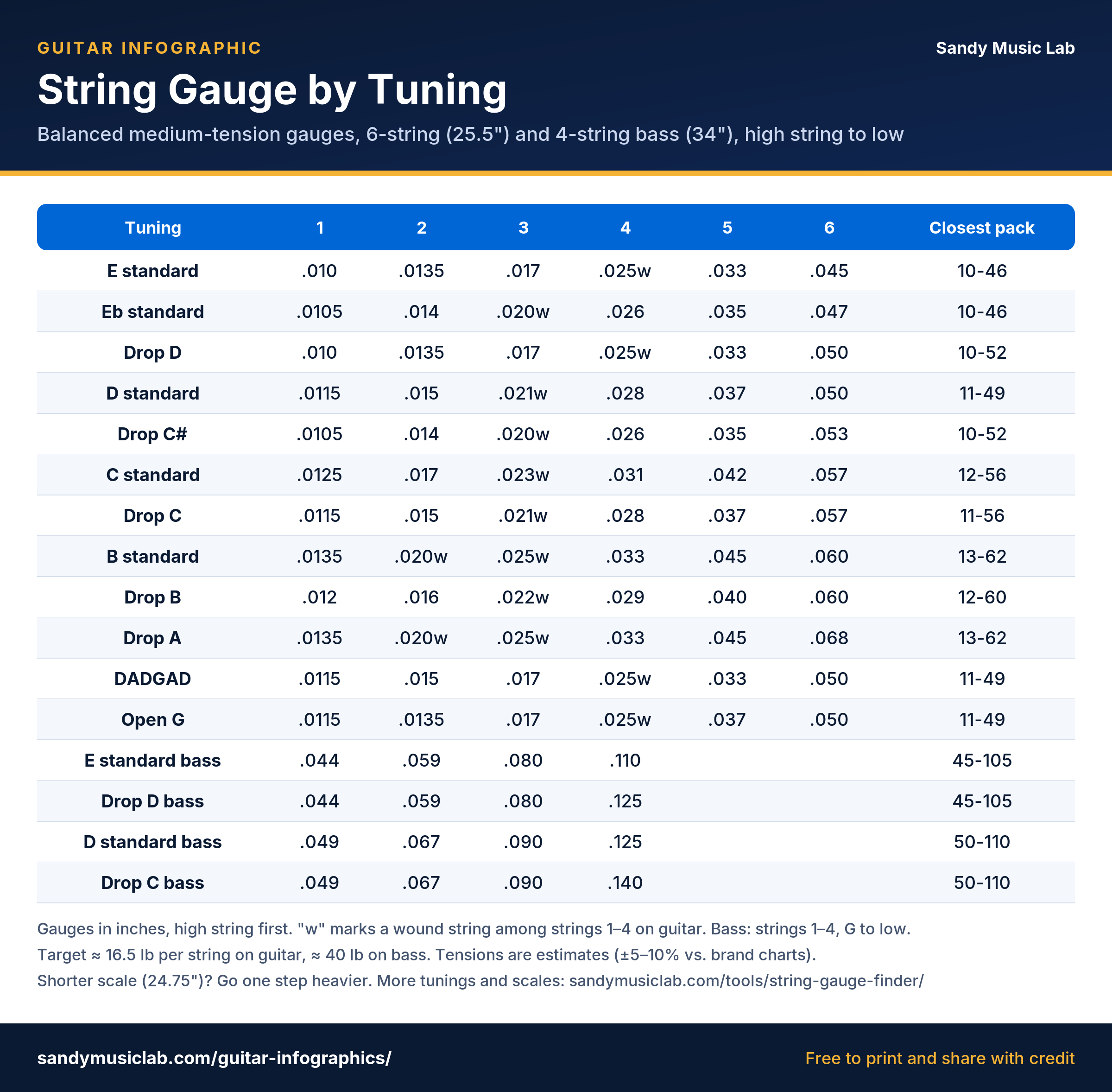
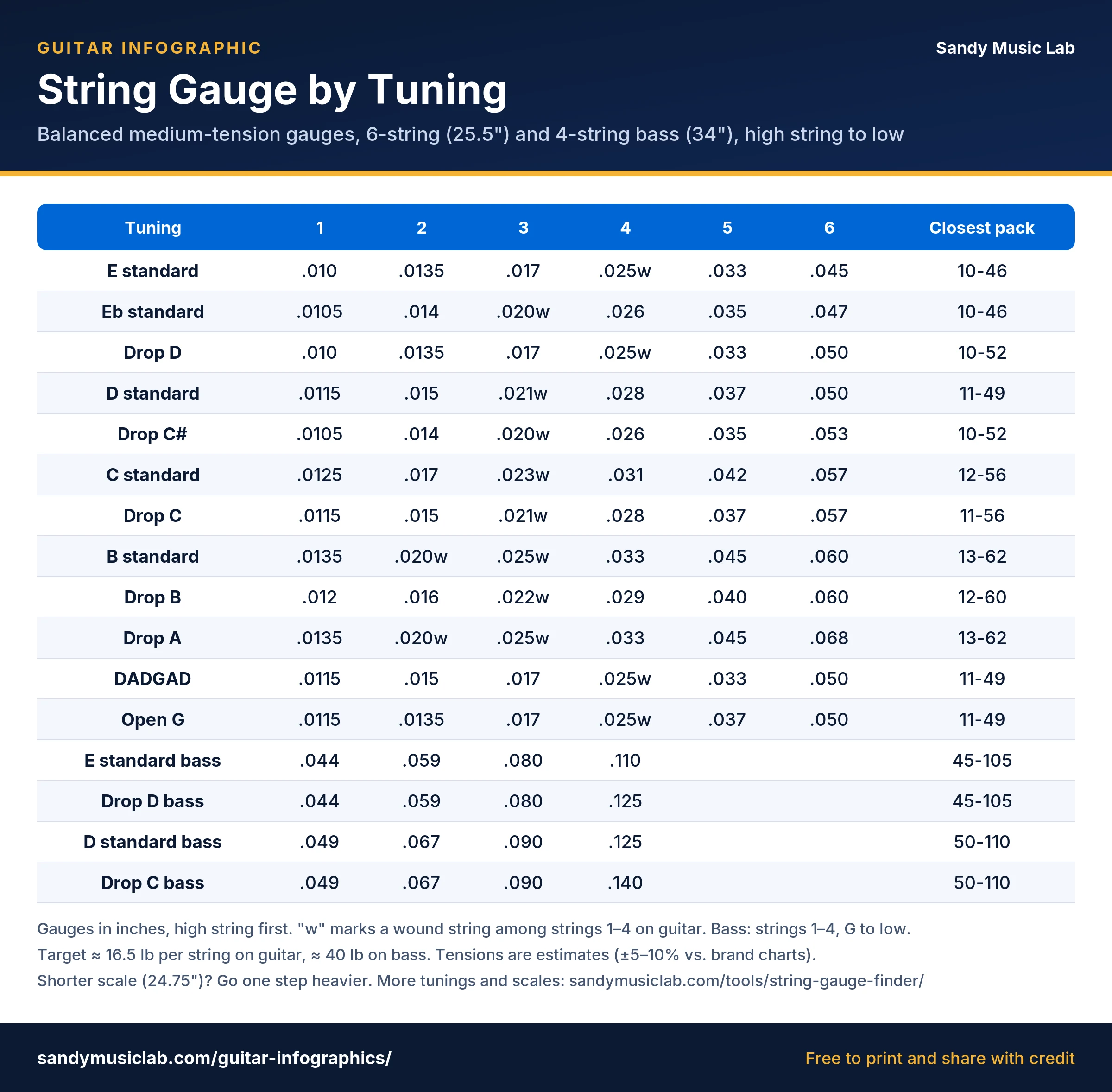
Quick answer: for every half step you tune down, you need about 6% more string mass to keep the same feel. On a 25.5″ scale: E standard 10–46, Drop D 10–52, D standard 11–52, Drop C 12–56, Drop B 13–62.
How to use the string gauge finder
- Choose your instrument: 6-, 7- or 8-string guitar, baritone, or 4/5-string bass.
- Pick the tuning and enter your scale length (Fender 25.5″, Gibson 24.75″, PRS 25″, baritone 27″+, bass 34″).
- Choose a feel. The tool picks the gauge for each string that lands closest to that tension, shows the total, and names the closest standard packs.
String gauge chart by tuning (25.5″ scale)
| Tuning | Balanced set | Lighter option |
|---|---|---|
| E standard | 10–46 | 9–42 |
| Eb standard | 10–52 or 11–49 | 10–46 |
| Drop D | 10–52 | 10–46 |
| D standard | 11–52 | 11–49 |
| Drop C | 12–56 | 11–56 |
| C standard | 12–56 or 13–56 | 12–56 |
| Drop B | 13–62 | 12–60 |
| B standard (7-string, 26.5″) | 10–59 | 10–59 |
| F# standard (8-string, 27″) | 9–80 or 10–74 | — |
Why lower tunings need heavier strings
String tension follows T = unit weight × (2 × scale × frequency)² ÷ 386.4. Frequency is squared, so dropping from E standard to D standard (two half steps) cuts tension by about 21%. That’s why the same 10–46 set feels floppy, buzzes and goes sharp when you pick hard in drop C. Heavier strings add mass, which brings the tension, and the tight feel, back.
Worked example: drop C on a Strat
A 10–46 set in E standard sits around 16–17 lb per string on a 25.5″ scale. Tune it to drop C and the low string falls to about 11 lb. Set the finder to 6-string, Drop C, 25.5″, Medium: it suggests roughly 12–57, and the closest packs are 11–56 or 12–56. After a gauge jump, recheck your intonation and truss rod, and you may need to file the nut slot for the low string.
Tips
- Shorter scale, go heavier. On a 24.75″ Les Paul, use about one gauge step heavier than the chart.
- Baritones and 7/8-strings use longer scales so the low strings stay tight without huge gauges.
- Bass players: 45–105 is the standard 34″ set; a 5-string B usually needs a .125–.135.
- Shopping for strings? See our best strings for metal and best bass strings guides.