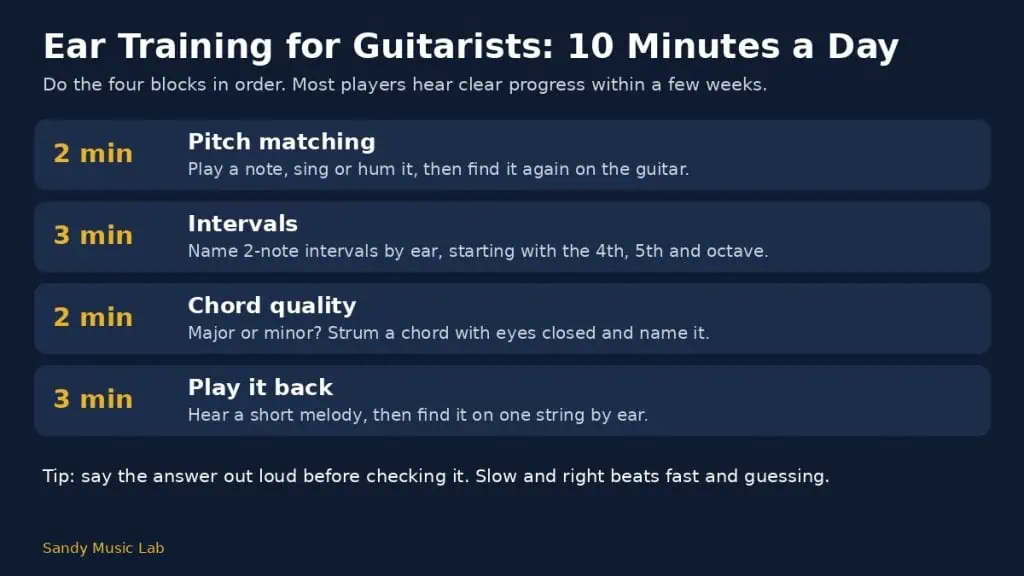
Ear training for guitarists works best as a short daily habit: 10 minutes split into pitch matching, intervals, chord quality and playing melodies back by ear. Each block connects what you hear to where it is on the fretboard, which is the skill that lets you learn songs without tab, tune by ear and improvise with confidence. The plan below uses only your guitar, your voice and the free ear trainer.
Quick answer: practise 10 minutes a day in four blocks: 2 minutes of pitch matching (play a note, sing it, find it again), 3 minutes of intervals on the free ear trainer, 2 minutes naming chords as major or minor, and 3 minutes picking out a short melody on one string. Start with the easiest intervals (perfect 4th, perfect 5th and octave), use reference songs to remember them, and add new intervals only when you get 8 out of 10 right.
Why should guitarists train their ears?
Ear training helps guitarists learn songs faster, play in tune, improvise and play with others without needing a chart for every change. Wikipedia’s ear training article describes it as learning to identify pitches, intervals, chords and rhythms by hearing alone. On guitar, the payoff is linking each sound to a fret.
| Skill | What it lets you do |
|---|---|
| Pitch matching | Tune by ear and sing in tune |
| Intervals | Find melodies and riffs without tab |
| Chord quality | Hear major, minor and 7th chords in songs |
| Melodic recall | Play back what you hear and improvise |
| Rhythm | Lock in with a drummer and other players |
The 10-minute daily plan: ear training for guitarists
Do the four blocks below every day, in order. Keep it to 10 minutes; short daily practice works better than one long session a week. Use the free ear trainer for the interval and chord blocks.
- Pitch matching (2 minutes): play a random note on the guitar, hum or sing it, then try to find it again on a different string.
- Intervals (3 minutes): in the ear trainer, name two-note intervals. Start with the perfect 4th, perfect 5th and octave only.
- Chord quality (2 minutes): have the ear trainer play chords, or strum chords with your eyes closed, and call out major or minor.
- Play it back (3 minutes): listen to a simple melody (a nursery rhyme or hymn tune), then find it on one string by ear.
Add this to the guitar practice routine as a theory block. Say each answer out loud before checking it.
How do you learn intervals by ear?
Learn intervals by linking each one to the first two notes of a song you know, and by playing it on one string so you see the distance in frets. Start with three very different intervals, then add one at a time. The table below shows the distance on a single string and a common reference tune.
| Interval | Frets apart (one string) | Reference tune (first notes) |
|---|---|---|
| Minor 2nd | 1 | “Jaws” theme |
| Major 2nd | 2 | “Happy Birthday” (“Hap-py birth…”) |
| Minor 3rd | 3 | “Greensleeves” |
| Major 3rd | 4 | “When the Saints Go Marching In” |
| Perfect 4th | 5 | “Here Comes the Bride” |
| Tritone | 6 | “Maria” from West Side Story |
| Perfect 5th | 7 | “Twinkle, Twinkle, Little Star” |
| Major 6th | 9 | “My Bonnie Lies over the Ocean” |
| Minor 7th | 10 | “Somewhere” from West Side Story |
| Octave | 12 | “Somewhere Over the Rainbow” |
Use whichever reference songs you know best; your own are easier to recall. The intervals on guitar guide shows the shapes across strings as well.
How do you hear major vs minor chords?
Major chords tend to sound bright and settled, while minor chords sound darker or sadder. The difference is one note: the third. To train it, play the same chord as major then minor (C then Cm, E then Em) and listen for that single note moving down a fret.
| Chord pair | Fret change | What to listen for |
|---|---|---|
| E to Em | G string fret 1 to open | The bright note drops |
| A to Am | B string fret 2 to fret 1 | Same, on the B string |
| D to Dm | High e fret 2 to fret 1 | Same, on the top string |
Next, add dominant 7th chords, which sound bluesy and want to move. The 7th chords on guitar guide has shapes to compare, and guitar triads shows the three-note core of each chord.
How do you learn to play songs by ear?
To play songs by ear, find the key note first, then work out the melody or riff one short phrase at a time, starting on one string. Most songs start and end on or near the key note, and the bass note of each chord usually gives away the chord.
- Find the key: hum the note the song feels like it wants to end on, and find it on the low E or A string.
- Melody first: pick out the first three or four notes on one string, then move to a comfortable position.
- Chords from the bass: follow the bass line, then try a major or minor chord on each bass note.
- Check with the I, IV and V: many songs use the 1, 4 and 5 chords of the key. The diatonic chords guide shows them in every key.
Slow the song down with any slow-down player, and use the chord transposer if you find the shapes in an awkward key.
How long does ear training for guitarists take to work?
Ear training improves gradually. Most players can recognise the perfect 4th, 5th and octave reliably within a couple of weeks of daily practice, and the full set of intervals takes a few months. Progress is uneven, so track your scores rather than how you feel.
| Week | Add | Target |
|---|---|---|
| 1 to 2 | Perfect 4th, perfect 5th, octave | 8 out of 10 correct |
| 3 to 4 | Major and minor 3rd | 8 out of 10 |
| 5 to 6 | Major and minor 2nd, major 6th | 8 out of 10 |
| 7 to 8 | Tritone, minor 7th, major 7th, minor 6th | 7 out of 10 |
Pair ear work with rhythm work on the free online metronome. For the theory side, the music theory for guitar guide ties it together.
How this guide was made
The plan draws on standard ear-training methods and Wikipedia’s ear training article. Interval fret distances follow equal temperament, one fret per semitone. Reference tunes are widely used teaching examples; check that the opening notes match the interval for the version you know. Sandy Music Lab is written by David Sandy, and the editorial policy explains how guides are researched. Spotted an error? Tell us.
Ear training FAQs
How long should guitarists practise ear training each day?
About 10 minutes a day is enough. Short daily sessions work better than long weekly ones.
What should you learn first in ear training?
The perfect 4th, perfect 5th and octave, because they sound very different from each other and appear in many melodies.
Can anyone learn to play guitar by ear?
Most people can improve a lot with regular practice. Start with simple melodies on one string and build up.
Do you need perfect pitch to play by ear?
No. Relative pitch, hearing the distance between notes, is what most musicians use, and it can be trained.
Is singing part of ear training?
Yes. Singing or humming a note before you play it is one of the fastest ways to connect hearing with the fretboard.
How do you tune a guitar by ear?
Match the 5th fret of each string to the next open string (4th fret on the G string). Ear training makes this much easier.
What is the best free ear training tool for guitar?
Any tool that plays intervals and chords and scores your answers works. The Sandy Music Lab ear trainer is free in the browser.