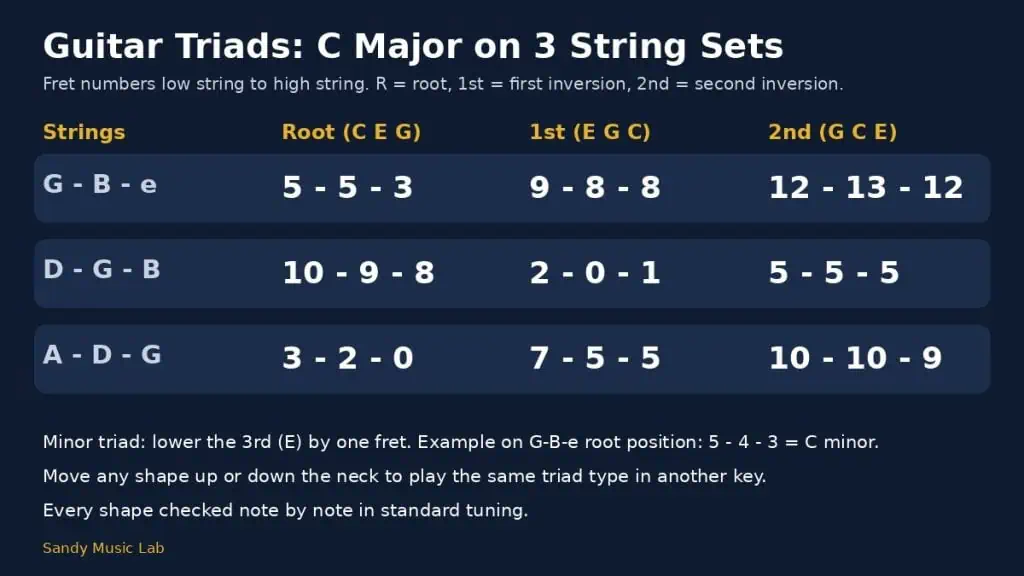
Guitar triads are three-note chords: the root, third and fifth of a chord, played on three adjacent strings. Every major or minor chord you know is built from a triad, and learning the small shapes lets you play any chord anywhere on the neck. Each triad has three shapes, called inversions, depending on which note is lowest. Below are every major and minor C triad on the three most useful string sets, checked note by note, plus drills to connect them.
Quick answer: a major triad is root, major third and fifth (C E G for C major); a minor triad lowers the third by one fret (C Eb G). On the top three strings (G-B-e), the C major shapes are 5-5-3 (root position), 9-8-8 (first inversion) and 12-13-12 (second inversion). Learn these three on one string set first, then move them to D-G-B and A-D-G. Slide any shape to change key.
What is a triad on guitar?
A triad is a chord made of three notes stacked in thirds: the root, the third and the fifth. On guitar, triads are usually played on three neighbouring strings, which makes them small, clear and easy to move. The Wikipedia article on triads covers the four types; major and minor are the two you will use most.
| Triad type | Formula | Notes in C | Sound |
|---|---|---|---|
| Major | 1, 3, 5 | C E G | Bright, stable |
| Minor | 1, b3, 5 | C Eb G | Darker, sad |
| Diminished | 1, b3, b5 | C Eb Gb | Tense |
| Augmented | 1, 3, #5 | C E G# | Unsettled |
Triads use the same intervals explained in intervals on guitar: a major third is four frets, a minor third is three.
What are triad inversions?
An inversion is the same three notes in a different order, with a different note on the bottom. Root position has the root lowest (C E G), first inversion has the third lowest (E G C), and second inversion has the fifth lowest (G C E). All three are still a C chord, but each sits in a different place on the neck.
| Inversion | Lowest note | C major order | Where on the neck (G-B-e) |
|---|---|---|---|
| Root position | Root | C E G | Frets 3 to 5 |
| First inversion | Third | E G C | Frets 8 to 9 |
| Second inversion | Fifth | G C E | Frets 12 to 13 (or open 0-1-0) |
Wikipedia’s inversion article explains the theory in more depth. On guitar the practical point is simple: three shapes per string set cover the whole neck for any triad.
Major guitar triads on every string set
These are the C major guitar triads on the three most useful string sets. Fret numbers run from the lowest string of the set to the highest. Every shape was checked note by note in standard tuning. Move any shape up two frets for D, down one for B, and so on.
| String set | Root position (C E G) | 1st inversion (E G C) | 2nd inversion (G C E) |
|---|---|---|---|
| G-B-e (top three) | 5-5-3 | 9-8-8 | 12-13-12 (or 0-1-0) |
| D-G-B | 10-9-8 | 2-0-1 (or 14-12-13) | 5-5-5 |
| A-D-G | 3-2-0 (or 15-14-12) | 7-5-5 | 10-10-9 |
Here are the three G-B-e shapes in tab, each played as a chord. Try them as slow arpeggios too:
   R   1st 2nd
e|-3---8---12---|
B|-5---8---13---|
G|-5---9---12---|
D|--------------|
A|--------------|
E|--------------|
Minor guitar triads on every string set
To turn any major triad into a minor triad, lower the third by one fret. In C, that means E becomes Eb. The shapes below are C minor, again checked note by note.
| String set | Root position (C Eb G) | 1st inversion (Eb G C) | 2nd inversion (G C Eb) |
|---|---|---|---|
| G-B-e | 5-4-3 | 8-8-8 | 12-13-11 |
| D-G-B | 10-8-8 | 1-0-1 (or 13-12-13) | 5-5-4 |
| A-D-G | 3-1-0 (or 15-13-12) | 6-5-5 | 10-10-8 |
   R   1st 2nd
e|-3---8---11---|
B|-4---8---13---|
G|-5---8---12---|
D|--------------|
A|--------------|
E|--------------|
Notice that the first-inversion minor shape on G-B-e is a one-finger barre (8-8-8). Many players find minor triads on the top strings easier than major ones for that reason.
How do you practise guitar triads?
Practise guitar triads one string set at a time: learn the three inversions of one chord, play them up and down the neck, then do the same for its minor version. Next, use them to play a real chord progression in one small area of the neck.
- Climb the neck: play C major on G-B-e in root, first and second inversion, then back down. Say the lowest note each time.
- Major to minor: play each C major shape, then lower the third for C minor. Hear the change.
- Change chords in one spot: play C, F and G triads near the 5th fret without moving your hand more than two frets. This is how rhythm players add parts over a band.
- Change string sets: repeat steps 1 to 3 on D-G-B, then A-D-G.
Five minutes a day is enough. The guitar practice routine shows where a theory block fits, and the free guitar fretboard explorer shows every chord tone on the neck.
Why should guitarists learn triads?
Triads let you play any chord in any position, add parts that do not clash with other instruments, and see how chords connect across the neck. They are the building blocks of bigger chords and of the CAGED system, and they make soloing over changes easier because the chord tones are under your fingers.
| Use | How triads help |
|---|---|
| Playing in a band | Small top-string shapes leave room for bass and keys |
| Worship and pop rhythm | Moving triads high on the neck add colour over strummed chords |
| Soloing | Targeting triad notes is the simplest way to follow chord changes |
| Learning the fretboard | Three shapes per set connect into the CAGED shapes |
To go further, see the CAGED system, chord tones on guitar and