If you have searched for tuning tips, you have probably met the 432 Hz vs 440 Hz debate. Some people say music tuned to A4 = 432 Hz sounds warmer or even heals the body; others point out that 440 Hz is simply the agreed standard. This guide explains what concert pitch is, how A440 became the standard, what the 432 Hz claims say and what the evidence shows, and how to tune a guitar to either one with a free tuner and tone generator.
Quick answer: 440 Hz is standard concert pitch: the A above middle C vibrates 440 times per second. 432 Hz is an alternative reference about 31.8 cents (roughly a third of a semitone) lower. Neither is physically “better”. There is no good scientific evidence that 432 Hz has special effects on the body, so use 440 Hz to play with other musicians and recordings, and 432 Hz only if you like how it feels or need to match a 432 Hz track.
What is concert pitch?
Concert pitch is the reference frequency that instruments tune to so they sound in tune with each other. Today the reference is the A above middle C (A4), and the standard value is 440 Hz, often written as A440. Every other note is worked out from that A.
Before a standard existed, the pitch of A varied a lot from city to city and even from organ to organ. A few milestones:
| Reference | A4 | Where it came from |
|---|---|---|
| Baroque pitch | About 415 Hz | Common in historical performance, about a semitone below 440 |
| French diapason normal | 435 Hz | A French government standard set in 1859 |
| A432 | 432 Hz | An alternative reference some players prefer; not an official standard |
| A440 | 440 Hz | Recommended at an international conference in 1939 and adopted as the ISO 16 standard in 1955 |
| Orchestra pitch | 442 to 443 Hz | Used by many orchestras for a slightly brighter sound |
So when a tuner says “A4 = 440 Hz”, it is using the international standard described in ISO 16.
432 Hz vs 440 Hz: what is the actual difference?
The gap is smaller than many people expect. Dropping A from 440 Hz to 432 Hz lowers every note by about 31.8 cents. A semitone is 100 cents, so A432 is roughly a third of a semitone flat compared with standard tuning.
That means:
- Songs still sound like the same song, in the same key, just slightly lower.
- Most listeners can hear a difference when the two are played back to back, but few can tell which is which on their own.
- If you play along with a recording at 440 Hz while tuned to 432 Hz, you will sound clearly out of tune.
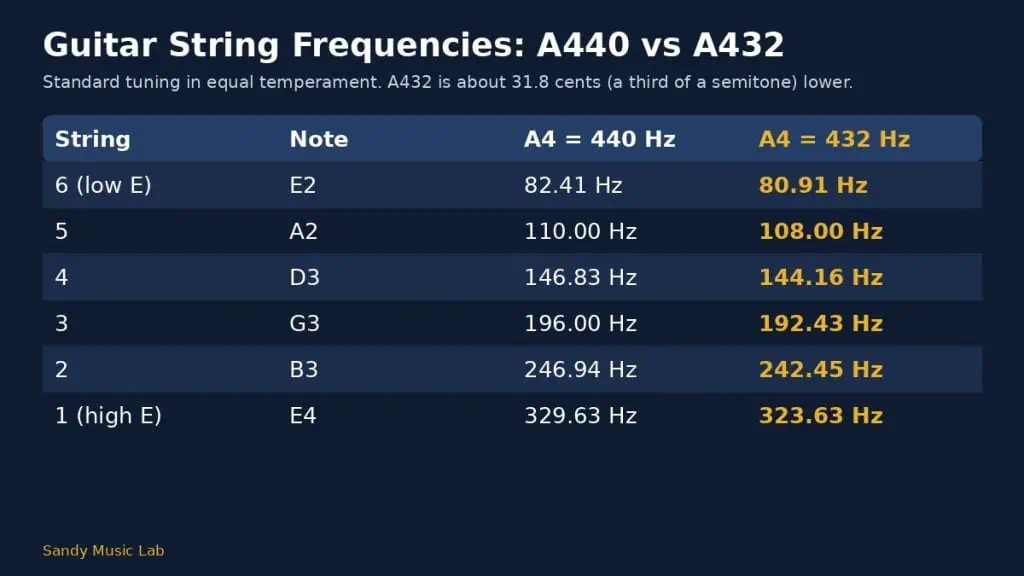
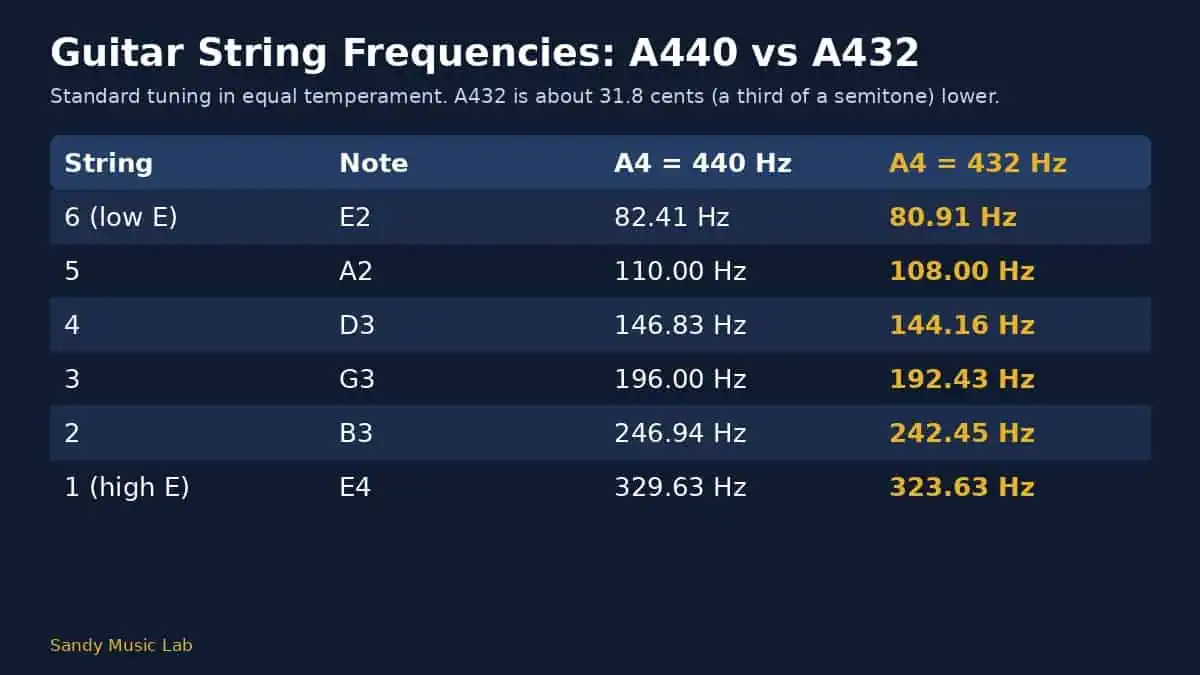
The math is simple: multiply any A440 frequency by 432 / 440 (0.98182) to get its A432 value. The chart above does this for all six guitar strings.
The 432 Hz claims, and what the evidence says
You will see a few common claims about 432 Hz tuning online:
- “432 Hz is mathematically in tune with the universe.” These ideas usually rely on number patterns, but the hertz is a man-made unit based on the second, so there is nothing natural about any particular number of vibrations per second.
- “432 Hz has healing effects.” There is no strong scientific evidence for this. A few small studies have reported mild differences in listener ratings or heart rate, but they are not large or well controlled enough to support health claims.
- “440 Hz was imposed to make music sound tense.” A440 was the result of decades of efforts to agree on one standard so instruments built in different countries could play together. The choice made practical sense for instrument makers and orchestras.
What is true: lower tunings can feel darker and a little more relaxed, simply because everything is lower and string tension drops slightly. If you enjoy that sound, it is a perfectly good artistic choice. It just isn’t magic.
How to tune a guitar to 432 Hz
You don’t need special gear. Any tuner with a calibration (reference pitch) setting can do it.
- Open the guitar tuner and find Reference pitch A4.
- Move the slider down to 432 Hz.
- Pick Standard tuning (or any other tuning) and tune each string as usual. The target frequencies update to the A432 values in the chart.
- To check by ear, play A 432 Hz on the tone generator and match your open A string (110 Hz at A440 becomes 108 Hz at A432), or the 5th fret of the low E.
- To go back, tap Reset to 440 Hz.
If your clip-on or pedal tuner has a “CAL” or “440” button, it can usually be set to 432 Hz the same way. Our guide to the best clip-on tuners covers models with calibration.
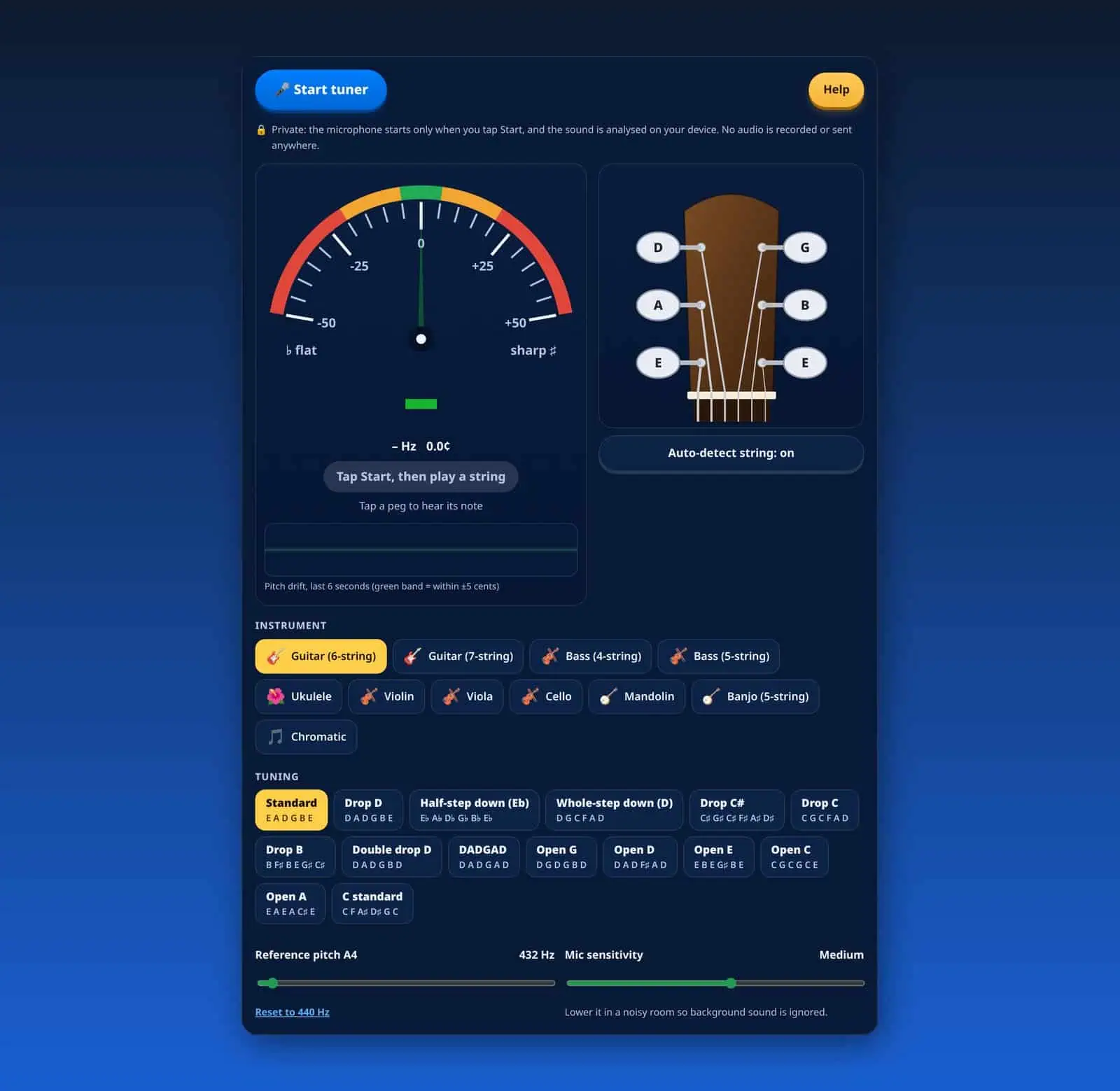
Free tool
Tune your guitar to A440 or A432
Set the reference pitch from 432 to 446 Hz, pick a tuning and tune with your mic.
Open the guitar tuner →432 Hz vs 440 Hz: when to use each
| Situation | Best reference |
|---|---|
| Playing with a band, at church services or at a jam | 440 Hz |
| Playing along with almost any commercial recording | 440 Hz |
| Matching a backing track recorded at 432 Hz | 432 Hz |
| Solo playing or recording where you like the lower, softer feel | 432 Hz, if you prefer it |
| Playing with an orchestra or piano tuned higher | Ask them, often 442 Hz |
A useful rule: tune to whatever the other instruments and recordings use. Being in tune with each other matters far more than the exact number.
How to hear 432 Hz vs 440 Hz yourself
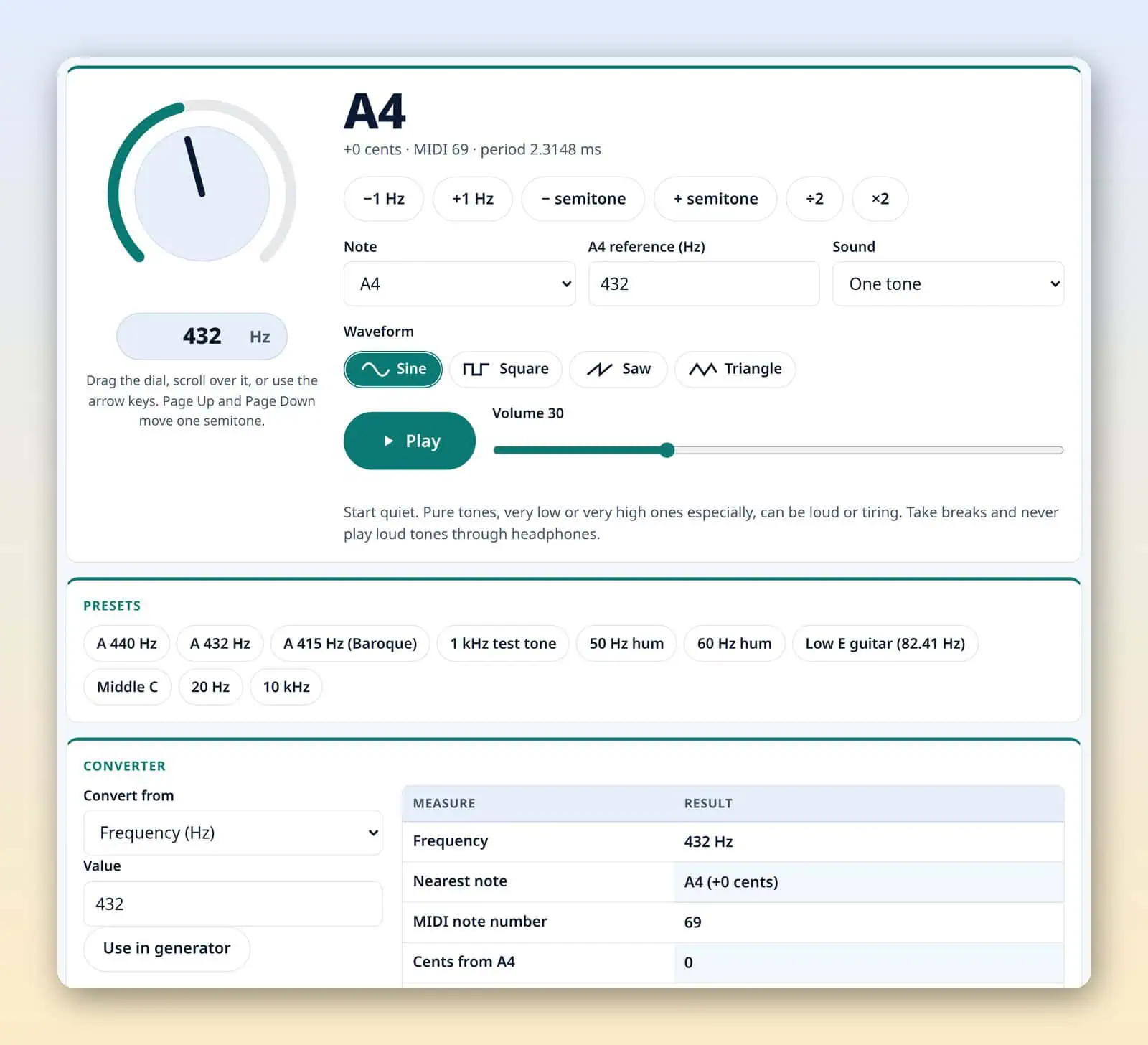
- Open the tone generator and play the A 440 Hz preset for a few seconds.
- Switch to the A 432 Hz preset and listen.
- Switch back and forth a few times, then try a sawtooth or triangle wave, which makes small pitch changes easier to hear.
- Close your eyes and ask a friend to switch at random. See whether you can name each one.
Most people hear that the second tone is lower but find it hard to say which is which without a reference, which is a good reminder of how small the difference really is. If you want to train this kind of listening, try the ear trainer.
Free tool
Hear 440 Hz and 432 Hz back to back
Play either reference, change the A4 setting and compare waveforms. Runs in your browser, no signup.
Open the tone generator →
Related guides
- How to tune a guitar by ear
- Guitar string names and notes
- How to tune half a step down
- 5 ways to know if your guitar is in tune
- Music terms glossary
How this guide was made
The frequencies in the chart were calculated with the standard equal temperament formula and checked against the Sandy Music Lab tuner and tone generator. Historical details come from the sources linked above. Written by David Sandy, a guitarist and songwriter.
432 Hz vs 440 Hz FAQs
Is 432 Hz better than 440 Hz?
Neither is objectively better. 440 Hz is the international standard, so it is best for playing with others. 432 Hz is about a third of a semitone lower, and some players simply prefer its feel.
What is standard concert pitch?
A4 = 440 Hz. It was recommended internationally in 1939 and adopted as the ISO 16 standard in 1955.
How many cents is 432 Hz from 440 Hz?
About 31.8 cents flat, which is roughly one third of a semitone.
Does 432 Hz have healing properties?
There is no strong scientific evidence that it does. Small studies exist, but none are robust enough to support health claims.
How do you tune a guitar to 432 Hz?
Set the tuner’s reference pitch (calibration) to A4 = 432 Hz, then tune each string normally. The low E becomes about 80.91 Hz instead of 82.41 Hz.
Why do some orchestras tune to 442 Hz?
A slightly higher reference gives a brighter sound, and many orchestras have used 442 or 443 Hz by tradition.