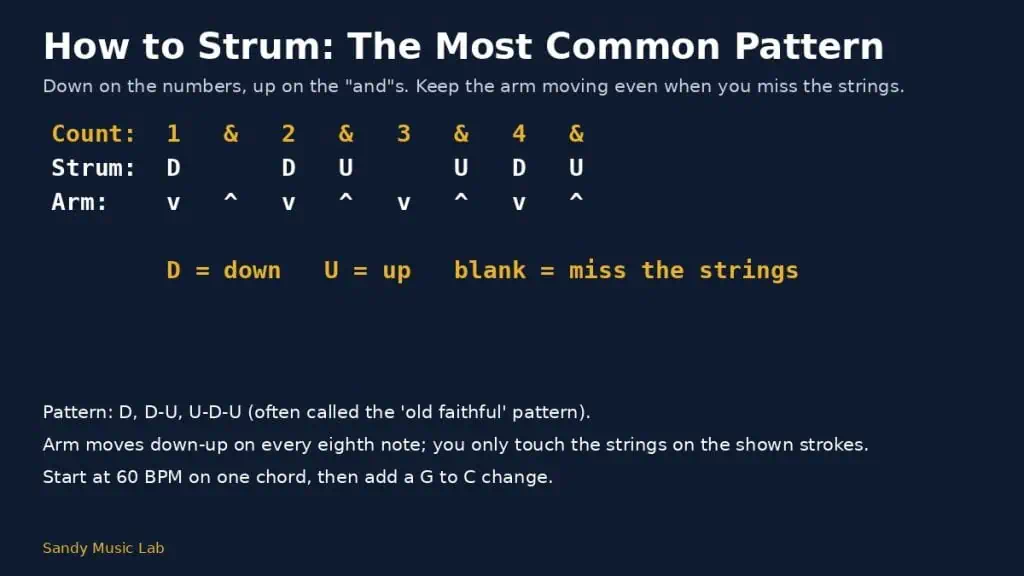
To learn how to strum a guitar, keep your strumming arm moving down and up in a steady rhythm, like a pendulum: down on every beat (1, 2, 3, 4) and up on every “and” in between. A strumming pattern is just that constant motion with some strokes skipped, where the pick misses the strings. Get the motion steady first, then patterns become easy.
Quick answer: hold the pick loosely with about 3 mm showing, and strum from the wrist and elbow across the strings over the soundhole or the end of the neck. Count “1 and 2 and 3 and 4 and”: strum down on the numbers and up on the “and”s. Keep the arm moving all the time, even when skipping strokes. The most common pattern is D, D-U, U-D-U. Start at 60 BPM on one chord.
How do you hold the pick for strumming?
Hold the pick between the pad of your thumb and the side of your index finger, with about 3 mm of the tip showing, and grip it loosely. A loose grip lets the pick flex and glide over the strings; a tight grip makes strumming sound harsh and the pick catch.
- Pick thickness: a thin to medium pick (about 0.5 to 0.7 mm) is easiest for strumming. See the best guitar picks.
- Angle: tilt the pick slightly so its edge brushes the strings.
- Where to strum: over the soundhole on an acoustic, or where the neck meets the body on an electric.
- No pick? Strum down with the nail of your index finger and up with the pad. Fingers give a softer sound.
How to strum a guitar: down and up strokes
To strum, swing the forearm from the elbow with a relaxed wrist, so the pick brushes all the strings on the way down and mainly the top three or four on the way up. Downstrokes are fuller and usually land on the beat; upstrokes are lighter and land between beats.
| Stroke | Strings | Sound | When |
|---|---|---|---|
| Down (D) | All the strings in the chord | Full, strong | On the beat: 1, 2, 3, 4 |
| Up (U) | Mostly the top 3 or 4 strings | Light, bright | Between beats: the “and”s |
| Miss | None (arm still moves) | Silence | Creates the pattern |
Only strum the strings that belong to the chord: for C, start from string 5; for D, start from string 4. Beginner guitar chords shows which strings each chord uses. Wikipedia’s strum article covers the technique across instruments.
How to strum a guitar in time: counting the rhythm
Count strumming rhythm out loud as “1 and 2 and 3 and 4 and”. The numbers are the beats, where your foot taps and downstrokes go; the “and”s are halfway between, where upstrokes go. This is called counting eighth notes, and most pop, rock and folk songs in 4/4 time use it.
Count:  1   &   2   &   3   &   4   &
Arm:    D   U   D   U   D   U   D   U
Practise that full pattern (every stroke hits) on one chord until it is even, using the free online metronome at 60 BPM. Then start skipping strokes to make the patterns below.
6 strumming patterns for beginners
These six strumming patterns cover most beginner songs. A blank means the arm still moves but misses the strings. Play each on one chord first, then on a two-chord change such as G to C. To hear them and slow them down, use the strumming patterns tool.
Count:          1   &   2   &   3   &   4   &

1. Downs        D       D       D       D
2. Down-ups     D   U   D   U   D   U   D   U
3. Old faithful D       D   U       U   D   U
4. Ballad       D       D   U   D       D   U
5. Rock 8ths    D   D   D   D   D   D   D   D   (all downs, fast)
6. Waltz (3/4)  D       D   U   D   U           (3 beats per bar)
| Pattern | Feel | Use it for |
|---|---|---|
| 1. Downs | Simple, steady | First songs, slow hymns, learning chord changes |
| 2. Down-ups | Driving, even | Folk, pop, campfire songs |
| 3. Old faithful (D, D-U, U-D-U) | Bouncy, very common | Countless pop and acoustic songs |
| 4. Ballad | Gentle push | Slower pop and worship songs |
| 5. Rock eighths | Punchy | Rock and punk rhythm, often with palm muting |
| 6. Waltz | Three beats per bar | Songs in 3/4 time |
For church songs, the worship strumming patterns guide adds patterns that suit slower and faster worship tempos. For rock eighths with a muted chug, see palm muting.
What are the most common strumming mistakes?
The most common strumming mistakes are stopping the arm between strokes, gripping the pick too hard, strumming from the shoulder, and hitting every string on every chord. Each one makes rhythm uneven or sound messy, and each has a quick fix.
| Mistake | What it sounds like | Fix |
|---|---|---|
| Stopping the arm for skipped strokes | Rhythm rushes or drags | Keep the down-up motion constant, just miss the strings |
| Tight pick grip | Harsh, pick catches or flies out | Loosen until the pick just stays put |
| Strumming from the shoulder | Tired arm, heavy sound | Move from the elbow with a loose wrist |
| Hitting the wrong bass strings | Muddy chords | Start the downstroke from the chord’s root string |
| Looking at the strumming hand | Missed chord changes | Watch the fretting hand, trust the rhythm |
| Pausing at chord changes | Gaps in the song | Change early on the last “and”, even if it rings open |
How long does it take to learn how to strum a guitar?
Most beginners can strum steady downstrokes in a few days and the old faithful pattern in one to three weeks, practising 10 minutes a day. Smooth strumming through chord changes usually takes one to two months, as covered in how long does it take to learn guitar.