A split sheet is a short written agreement that records who wrote a song and what percentage each writer owns. Every payment the song earns, from radio and streams to sync deals, is divided according to those percentages, so it is the most important page in any co-write. This guide gives you a split sheet template with every field you need, explains how to agree percentages, walks through a filled-in example, and shows how to print one in a minute with a free split sheet builder.
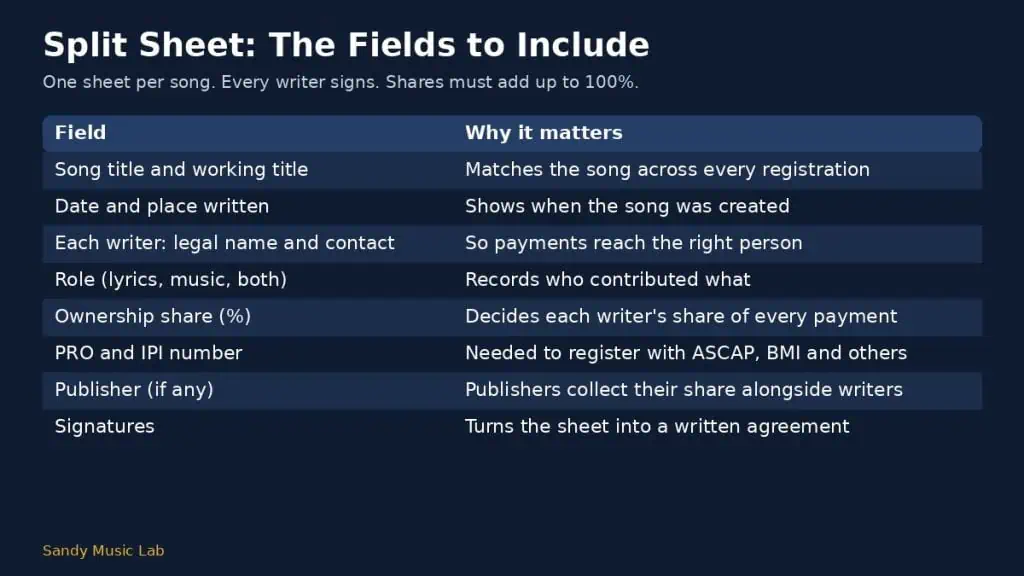
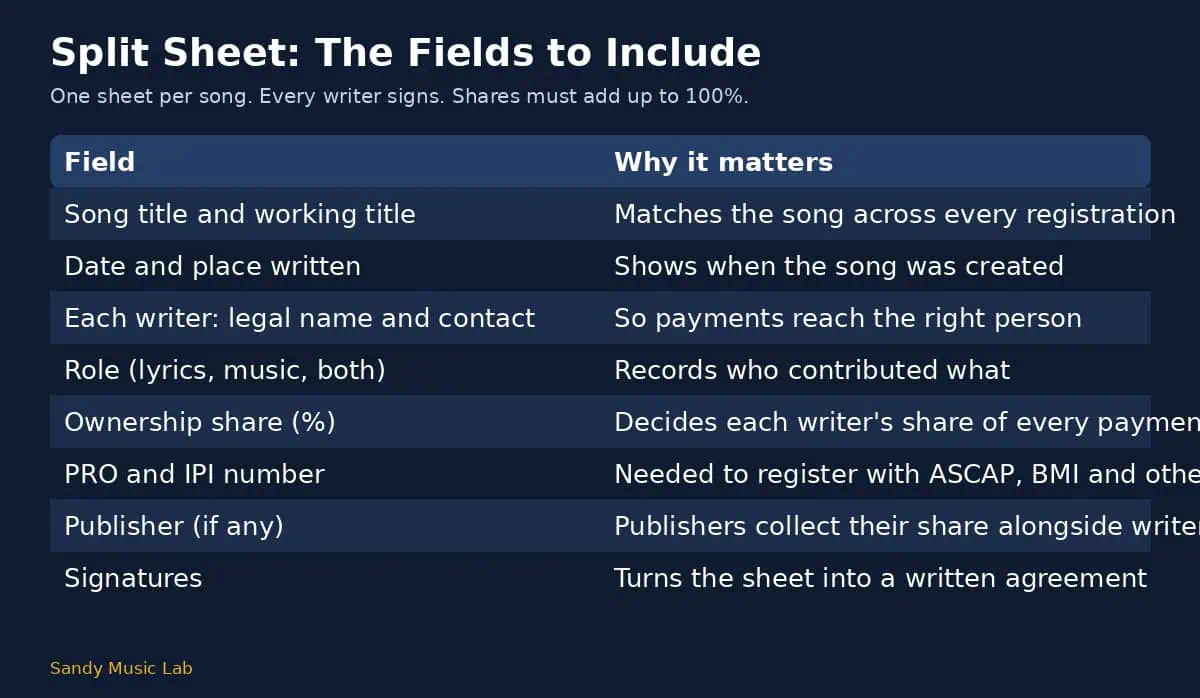
Quick answer: a split sheet template needs the song title, the date, each writer’s legal name and contact details, their role, their ownership percentage, their PRO and IPI number, any publisher, and every writer’s signature. The shares must add up to 100%. Fill it in and sign it at the end of the writing session, before the song is released or registered.
What is a split sheet?
A split sheet documents the ownership of the composition: the melody and lyrics, not the recording. In most countries a co-written song is jointly owned by its writers, and without a written agreement the default rules may not match what the writers intended. A signed split sheet avoids that by putting the agreed percentages on paper.
Performing rights organizations such as ASCAP and BMI, and the MLC for US mechanical royalties, all ask for writer shares when you register a song. The split sheet is where those numbers come from.
Split sheet template
Copy this template into a document or notebook, or use the printable builder further down.
| Field | Writer 1 | Writer 2 | Writer 3 |
|---|---|---|---|
| Legal name | |||
| Stage or pen name | |||
| Email and phone | |||
| Role (lyrics, music, both) | |||
| Ownership share (%) | |||
| PRO (ASCAP, BMI, SESAC, PRS, SOCAN…) | |||
| IPI / CAE number | |||
| Publisher and share (if any) | |||
| Signature |
At the top of the sheet, add the song title (and any working title), the date written, where it was written, and any samples or interpolations used. At the bottom, add a line confirming that the shares total 100%.
How to fill in a split sheet, step by step
- Do it at the end of the session. Memories fade fast, and it is far easier to agree splits while everyone is in the room.
- List every writer who contributed to the melody, lyrics or chords that define the song.
- Agree the percentages (see the next section) and write them down. Check they add up to 100%.
- Add PRO and IPI details for each writer, and publisher details if a writer has a publishing deal.
- Everyone signs. A photo or a scanned PDF shared with all writers is a sensible record.
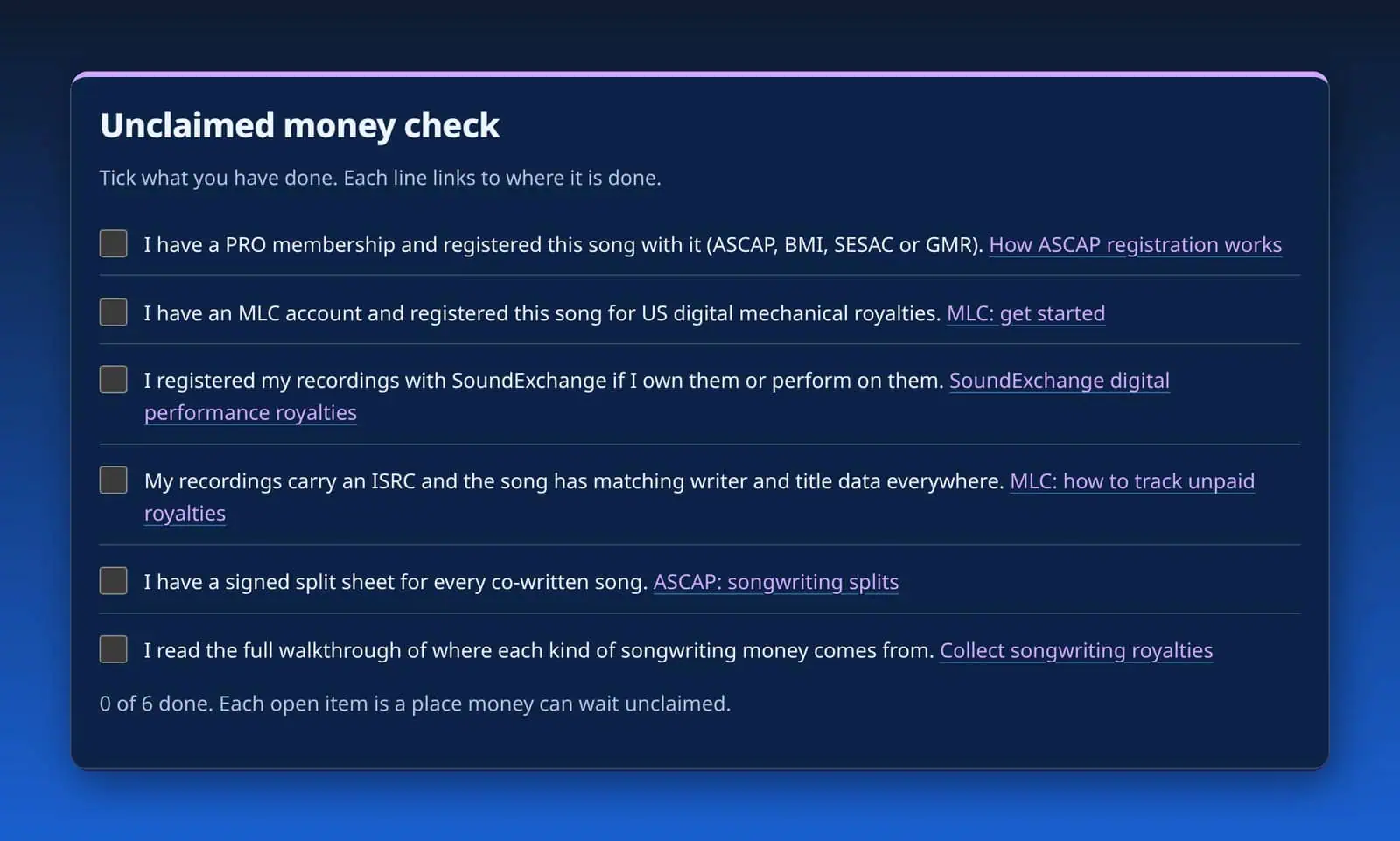
- Register the song with your PRO and other collection societies using the same titles and shares. The collect songwriting royalties guide covers where to register.
Free tool
Build and print a split sheet
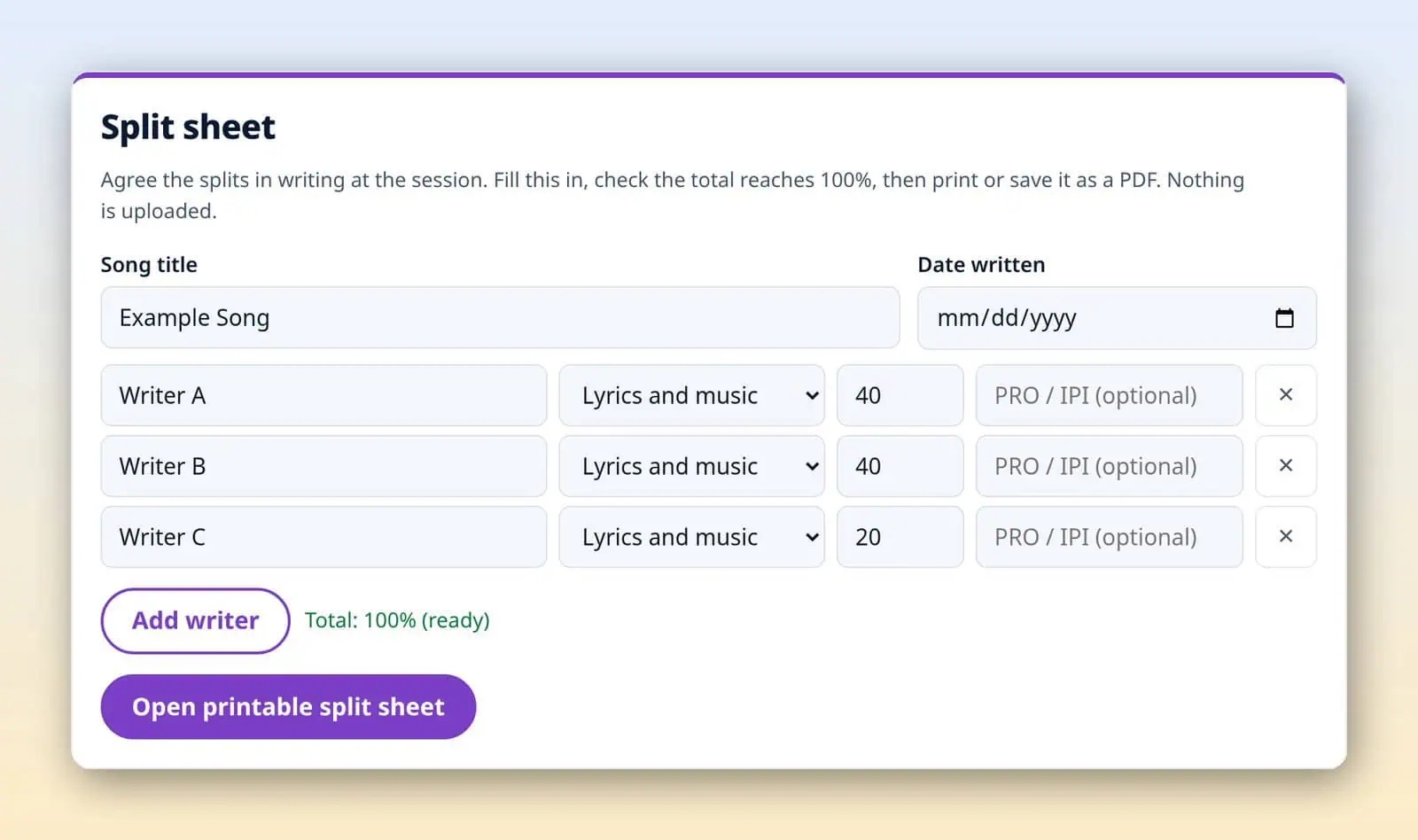
Add every writer, set the shares, check they reach 100% and print or save as PDF. Also estimates what streams pay each writer.
Open the split sheet builder →How to decide the percentages
There is no legal formula. The two most common approaches:
| Approach | How it works | Good for |
|---|---|---|
| Equal split | Everyone in the room gets the same share | Fast, friendly sessions; avoids arguments |
| Contribution-based | Shares reflect who wrote what | When contributions are clearly uneven |
Many songwriters default to an equal split among everyone who contributed to the writing, and only discuss changes when one person clearly wrote much more. Whatever you choose, agree it before anyone leaves. The how to co-write a song guide covers the etiquette of these conversations.
A filled-in split sheet example
| Field | Writer A | Writer B | Writer C |
|---|---|---|---|
| Role | Lyrics and melody | Music and melody | Lyrics |
| Ownership share | 40% | 40% | 20% |
| PRO | ASCAP | BMI | ASCAP |
| Publisher | Self-published | Self-published | Example Publishing |
| Signature | Signed | Signed | Signed |
Total: 100%. In this example, Writer C’s publisher collects the publisher share of Writer C’s 20%, while Writers A and B collect both the writer and publisher share of their 40% themselves if they are self-published and registered as their own publisher.
Common split sheet mistakes
- Waiting until release. Splits agreed months later are much harder.
- Shares that don’t add up to 100%. Collection societies will reject or hold the registration.
- Missing IPI numbers. Without them, payments can go unmatched.
- Confusing the song with the recording. A split sheet covers the composition. Producer and artist deals for the master recording are separate agreements.
- Forgetting samples. If the song uses a sample or interpolation, the original writers may be owed a share, which reduces the total available.
- Different titles on different registrations. Use exactly the same title everywhere.
Print a split sheet in a minute
The songwriter royalty calculator includes a split sheet builder. Type the song title and date, add each writer with their role, share and PRO details, and it shows the running total. When it reaches 100%, open the printable split sheet and print it or save it as a PDF for everyone to sign. Nothing you type is uploaded.
The same page estimates what streams and downloads pay each writer, so you can see what a 40% or 20% share means in practice.
Free tool
See what a split means in money
Enter expected streams and your share to estimate what each co-writer earns.
Open the royalty calculator →Related guides
- How to copyright a song
- How to collect songwriting royalties
- Songwriting template
- Music terms glossary

How this guide was made
The fields and steps follow guidance published by performing rights organizations and collection societies, linked above, and match the split sheet builder in the Sandy Music Lab royalty calculator. This is general information, not legal advice; for a large deal, talk to a music lawyer. Written by David Sandy, a guitarist and songwriter; see the editorial policy.
Split sheet FAQs
What is a split sheet?
A short written agreement listing every writer of a song and the percentage of the composition each one owns, signed by all of them.
Is a split sheet legally binding?
A signed split sheet is generally treated as a written agreement between the writers. For big deals, have a music lawyer review your paperwork.
When should you fill out a split sheet?
At the end of the writing session, before the song is released or registered.
Do producers go on the split sheet?
Only if they contributed to the composition, such as the melody, lyrics or chords. Producer fees and points on the recording are separate.
What if the percentages do not add up to 100%?
Fix it before anyone signs. Collection societies need shares that total 100% to register and pay the song.
Do you need a split sheet if you write alone?
It is not required, but a simple record with the title, date and your details is still useful for registration.