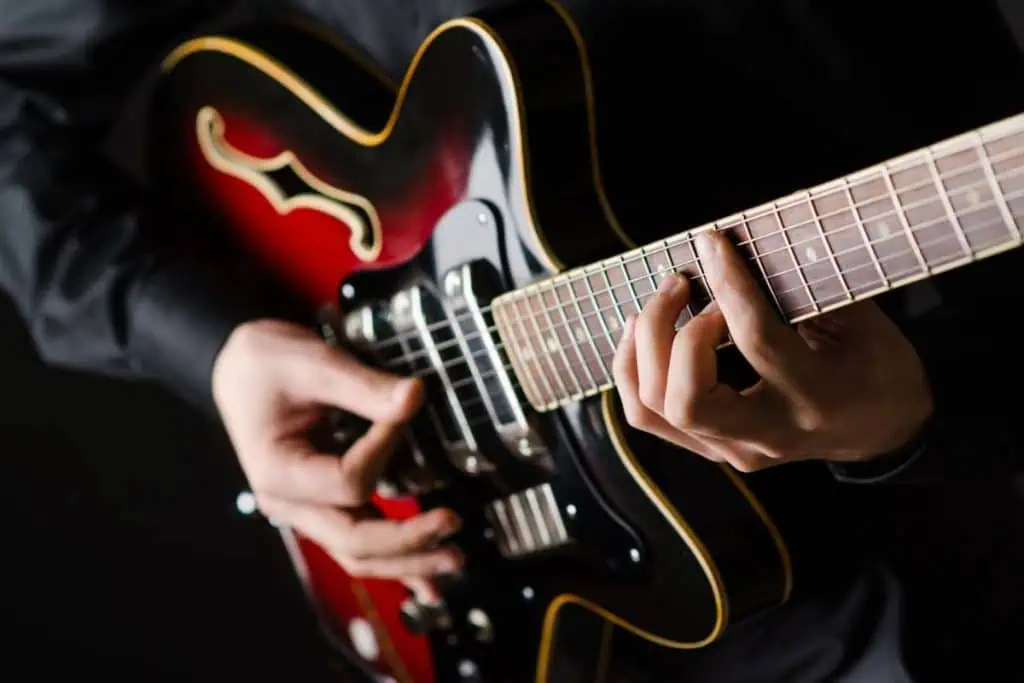
To slap bass, bounce the side of your thumb’s knuckle off the string where the neck meets the body, then pop a higher string by hooking it with your index or middle finger and letting it snap back against the frets. Start with thumb-only exercises at 60 BPM. Then add octave pops and left-hand ghost notes.
Slap is the percussive, funky sound of Larry Graham, Marcus Miller, Flea and Mark King. It looks flashy, but it’s built on a few simple motions you can learn in a couple of weeks. If you’re still on the basics in our bass guitar for beginners guide, get comfortable with fingerstyle and muting first, then come back here.
This guide to slap bass for beginners covers setup, thumb and pop technique, muting, ghost notes and six progressive exercises. Every tab is in standard EADG tuning. Brush up on note names with our bass guitar notes chart if you need to.
🎸 Free download
Not sure which guitar is right for you?
Get the free Guitar Gear Cheat Sheet: match your style, budget and hands to the right guitar in 2 minutes. You’ll also get my 30-Day Practice Plan as a bonus.
Send My Cheat Sheet →Table of Contents
Slap Bass for Beginners: Set Up Your Bass First
Slap is easier on a bass with fairly low action, bright strings and a little scooped EQ:
- Action: slightly lower than your fingerstyle setup helps the popped string snap against the frets. See how to set up a bass guitar.
- Strings: fresh roundwounds, ideally stainless steel, give the classic bright slap tone. Flatwounds don’t slap well. See best bass strings.
- Amp EQ: boost the bass and treble slightly and cut the low mids a little. Start subtle.
- Pickups: on a Jazz-style bass, both pickups on full is the classic slap sound. On a P/J or a humbucker bass, experiment.
How to Slap Bass: The Thumb
Learning how to slap bass starts with the thumb, which provides most of the low notes.
- Hand position. Hover your plucking hand over the end of the fingerboard, where the neck meets the body. Your forearm should be roughly parallel to the strings, with a relaxed, loose wrist.
- Thumb angle. Hold your thumb roughly parallel to the strings, pointing toward the neck.
- The motion. Rotate your forearm, like turning a doorknob, so the bony side of your thumb’s knuckle strikes the string and bounces straight off. Don’t push through the string. The bounce is everything.
- Where to hit. Strike the string over the last few frets (around the 20th–24th fret area, or the end of the fingerboard on 20-fret basses).
- Volume and tone. A good slap is bright and percussive. A dull thud usually means you’re leaving your thumb on the string too long.
How to Slap Bass: The Pop
The pop gives the high, snappy note, usually an octave above the slapped note.
- Curl your index (or middle) finger slightly under the D or G string.
- Pull the string up and away from the body, about a quarter to half an inch, as part of the same forearm rotation that drives the thumb.
- Release it so it snaps back against the frets with a crack.
- Don’t yank too hard. A small, controlled pull sounds better and keeps you in time.
Thumb and pop work like a pendulum. The thumb strikes on the way down, and the finger pops on the way back as your forearm rotates.
Muting and Ghost Notes
In slap bass for beginners, clean playing is mostly about the notes you don’t let ring:
- Left-hand muting: lightly lay your fretting fingers across the strings so they’re muted but not fretted. Slapping these strings gives a percussive “ghost note” (shown as x in tab).
- Right-hand muting: when you pop a high string, your thumb’s resting position helps mute the lower strings.
- Hammer-ons and pull-offs add notes without extra right-hand motion, which is the secret to many fast slap lines.
Slap Bass Exercises (Beginner to Intermediate)
Work through these slap bass exercises in order, because each step in this slap bass for beginners routine builds on the last. Use a metronome, start at 60 BPM and only speed up when each exercise is clean. T = thumb, P = pop, x = muted ghost note, h = hammer-on.
Exercise 1: Open-String Thumb
Slap each open string four times in quarter notes, then eighth notes. Focus on an even volume and a clean bounce.
G|-----------------|
D|-----------------|
A|---------0-0-0-0-|
E|-0-0-0-0---------|
   T T T T T T T T
Exercise 2: Thumb and Pop Octaves
The classic slap move. Slap the root on the E string, then pop the octave two strings up and two frets higher.
G|-----------------|
D|---2---2---2---2-|
A|-----------------|
E|-0---0---0---0---|
   T P T P T P T P
Exercise 3: Moving Octaves
Move the octave shape through E, G, A and C, keeping your fretting hand’s index on the root and ring or pinky on the octave.
G|---------------------5-|
D|---2-----5-----7-------|
A|-------------------3---|
E|-0-----3-----5---------|
   T P   T P   T P  T P
Exercise 4: Adding Ghost Notes
Insert a left-hand-muted ghost note (x) with the thumb between the root and the pop. This “T x P” rhythm is the engine of most funk slap.
G|-----------------------|
D|-----2-------2-------2-|
A|-----------------------|
E|-0-x---0-x-----0-x-----|
   T T P T T   P T T   P
Exercise 5: Hammer-On Groove
Slap the open E, then hammer on to the 2nd fret without slapping again. Pop the octave and repeat.
G|-------------|
D|-------2-----|
A|-------------|
E|-0h2---------|
   T h  P
Exercise 6: E Minor Pentatonic Slap Riff
Combine everything over the E minor pentatonic scale (E G A B D):
G|---------------------------|
D|-----2-------------5-------|
A|-------------0h2-----------|
E|-0-x---0-3-------------0---|
   T T P T T T h   P     T
Learn the scale shapes behind this riff in bass scales for beginners.