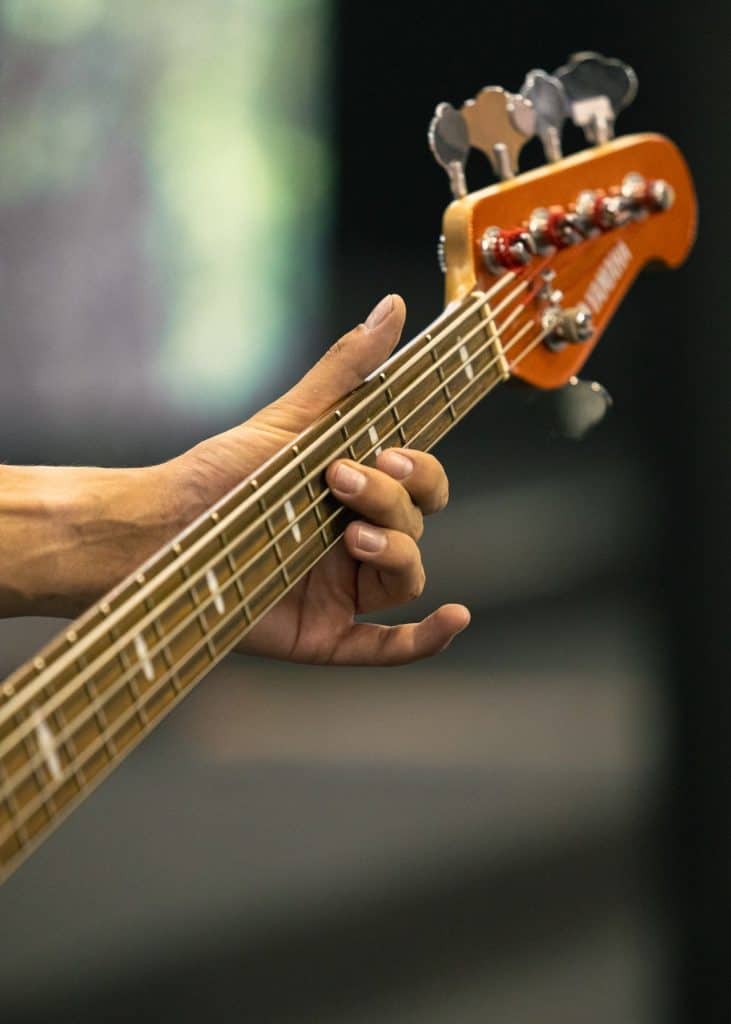
Here is how to set up a bass guitar, in order: tune to pitch, set neck relief with the truss rod (about 0.012 in. at the 8th fret), set action at the 17th fret (about 6/64 in. bass side, 5/64 in. treble side), then intonation and pickup height. You’ll need about 30–45 minutes and basic tools.
Knowing how to set up a bass guitar gives you the cheapest upgrade a bass will ever get. If you’re working through our bass guitar for beginners guide, this is the step that makes a $200 bass feel like a $600 one. Low, even action means less finger fatigue, cleaner notes and better tuning everywhere on the neck.
This guide walks through how to set up a bass guitar at home using Fender’s published factory specs as the starting point. Once it’s set up, try it on our easy bass songs for beginners and learn the neck with the bass guitar notes chart.
🎸 Free download
Not sure which guitar is right for you?
Get the free Guitar Gear Cheat Sheet: match your style, budget and hands to the right guitar in 2 minutes. You’ll also get my 30-Day Practice Plan as a bonus.
Send My Cheat Sheet →Table of Contents
How to Set Up a Bass Guitar: Tools You Need
- A clip-on or pedal tuner (accurate to ±1 cent if possible)
- A capo (optional, but it makes relief checks easier)
- A set of feeler gauges (0.008–0.020 in.)
- A 6-inch steel ruler marked in 64ths of an inch or in millimetres
- The right truss rod wrench for your bass (usually a 4 mm, 5 mm or 1/8 in. Allen key, or a Phillips screwdriver for heel-adjust Fenders)
- Small Allen keys or a screwdriver for the bridge saddles
- Fresh strings, if your current set is old. Intonation on dead strings is never accurate.
How to Set Up a Bass Guitar to Fender Specs
Fender publishes these factory targets for its basses, and they’re the numbers most guides on how to set up a bass guitar start from. Other brands are similar, and they’re good starting points for nearly any 4-string:
| Fingerboard radius | Neck relief (8th fret) | Action, bass side (17th fret) | Action, treble side (17th fret) |
|---|---|---|---|
| 7.25 in. (vintage) | 0.014 in. (0.35 mm) | 7/64 in. (2.8 mm) | 6/64 in. (2.4 mm) |
| 9.5–12 in. (most modern) | 0.012 in. (0.30 mm) | 6/64 in. (2.4 mm) | 5/64 in. (2.0 mm) |
| 15–17 in. | 0.010 in. (0.25 mm) | 6/64 in. (2.4 mm) | 5/64 in. (2.0 mm) |
Source: Fender’s bass setup guide. Fender also notes that players with a light touch can go lower, while players who dig in hard may need a little more height to avoid rattles.
Step-by-Step: How to Set Up a Bass Guitar
When you learn how to set up a bass guitar, follow these steps in order. Each adjustment affects the ones after it, so doing them out of order means repeating work.
- Tune to pitch. Tune all four strings to E–A–D–G with the bass in playing position. String tension changes neck relief, so always measure at pitch.
- Check neck relief. Capo the 1st fret, then hold the E string down at the last fret. Slide a feeler gauge between the bottom of the string and the top of the 8th fret. For most modern basses, aim for about 0.012 in.
- Adjust the truss rod if needed (see the next section). Use small turns of 1/8 to 1/4 turn, then retune and recheck.
- Set the action. Measure from the top of the 17th fret to the bottom of each string with your ruler. Raise or lower each bridge saddle with its height screws to reach about 6/64 in. on the E string and 5/64 in. on the G string, with the A and D strings following the curve of the fingerboard.
- Check the nut. Fret each string at the 3rd fret and tap it over the 1st fret. There should be a tiny gap. If there is no gap, the nut slot is too low and may buzz. If the gap is large, the first-position notes will feel stiff and play sharp. Nut work is best left to a tech.
- Set the intonation. Play the 12th-fret harmonic, then fret the 12th-fret note. If the fretted note is sharp, move the saddle back (away from the neck). If it’s flat, move the saddle forward. Retune after every adjustment.
- Set the pickup height. Fret the outer strings at the last fret and measure from pole piece to string. Fender’s starting points for standard P and J pickups are 7/64 in. on the bass side and 5/64 in. on the treble side.
- Play-test. The final step in how to set up a bass guitar is to play every fret on every string at your normal attack. A little fret noise when you dig in hard is normal on bass. Notes that die out or buzz through the amp are not.
Bass Truss Rod Adjustment
The truss rod is the part of how to set up a bass guitar that worries beginners most, but it’s simply a steel rod inside the neck that counteracts string tension. A bass truss rod adjustment changes the neck’s relief, which is the slight forward bow that gives the strings room to vibrate. It doesn’t directly set action height. That’s the saddles’ job.
- Too much relief (neck bowed forward, high action in the middle of the neck): turn the truss rod nut clockwise (righty-tighty) to straighten the neck.
- Too little relief or back-bow (buzzing in the lower frets): turn the nut counter-clockwise to let string tension pull in more relief.
These directions apply when you’re looking at the nut. On headstock-adjust necks, that means looking down the neck from the headstock. On heel-adjust vintage Fenders, you’re looking at the nut from the body end.
The golden rule of how to set up a bass guitar safely: make truss rod changes in 1/8 to 1/4 turns. Wood takes time to settle, so check again after an hour or the next day. Fender advises loosening the strings before adjusting heel-access rods, and stopping if you meet heavy resistance. A stuck or maxed-out rod is a job for a tech, not more force.
Seasonal humidity changes are the most common reason a neck drifts. Our article Do truss rods loosen over time? explains why your bass may need a small tweak in spring and autumn.
Bass Action Height
Bass action height is the gap between the top of the 17th fret and the bottom of the string. Low action is easier to play but can buzz. High action is cleaner and punchier but harder on your hands. This chart shows how different playing styles usually set it:
| Style | Typical action at 17th fret (E / G) | Why |
|---|---|---|
| Light-touch fingerstyle, slap | 2.0 mm / 1.6 mm | Fast and easy, with a little fret growl |
| All-round (Fender spec) | 2.4 mm / 2.0 mm | Balanced feel and clean tone |
| Heavy attack, pick playing, rock | 2.8 mm / 2.4 mm | Room for big string excursion without rattles |
| Flatwounds, vintage tone | 2.8–3.2 mm / 2.4–2.8 mm | Thump and sustain, and higher tension strings |
The general skills of how to set up a bass guitar are the same as on a six-string, so our guitar action guide is a helpful companion. Just remember that bass strings swing much wider than guitar strings and need more clearance.
If you change string gauge, for example moving from 45–105 to 50–110, expect to recheck relief and action, because heavier strings pull the neck forward more. See our best bass strings guide for gauge and tension comparisons.
How to Set Up a Bass Guitar for Perfect Intonation
Intonation makes the notes in tune all the way up the neck. Because the string bends slightly when you fret it, and because thicker strings are stiffer, each saddle has to sit at a slightly different distance from the nut. That’s why bass saddles usually step back from G to E.
- Tune the open string perfectly.
- Play the 12th-fret harmonic and confirm it reads in tune.
- Fret the note at the 12th fret with normal pressure.
- Sharp? Lengthen the string by moving the saddle back toward the tail of the bass.
- Flat? Shorten the string by moving the saddle toward the neck.
- Retune and repeat until the harmonic and the fretted note match within ±2 cents.
Do this with your bass in playing position and with the same strings you’ll use. If the saddle runs out of travel, it usually means the strings are worn out or the wrong gauge.
When Not to Set Up a Bass Guitar Yourself
Knowing how to set up a bass guitar yourself saves money, but some jobs need a professional.
DIY setup covers 90% of what a bass needs. Book a professional if you notice any of the following:
- The truss rod won’t turn, or you’ve run out of adjustment.
- Specific frets buzz no matter how you set relief. That usually means a high fret that needs levelling.
- The nut slots are too low or too high.
- Electronics crackle or cut out.
- The neck has a twist.
A professional setup usually costs $50–$80 in the US and is well worth it on a new or used bass.
How Often Should You Set Up a Bass?
Once you know how to set up a bass guitar, check relief and action every time you change strings, and do a full setup at least twice a year, usually at the start of