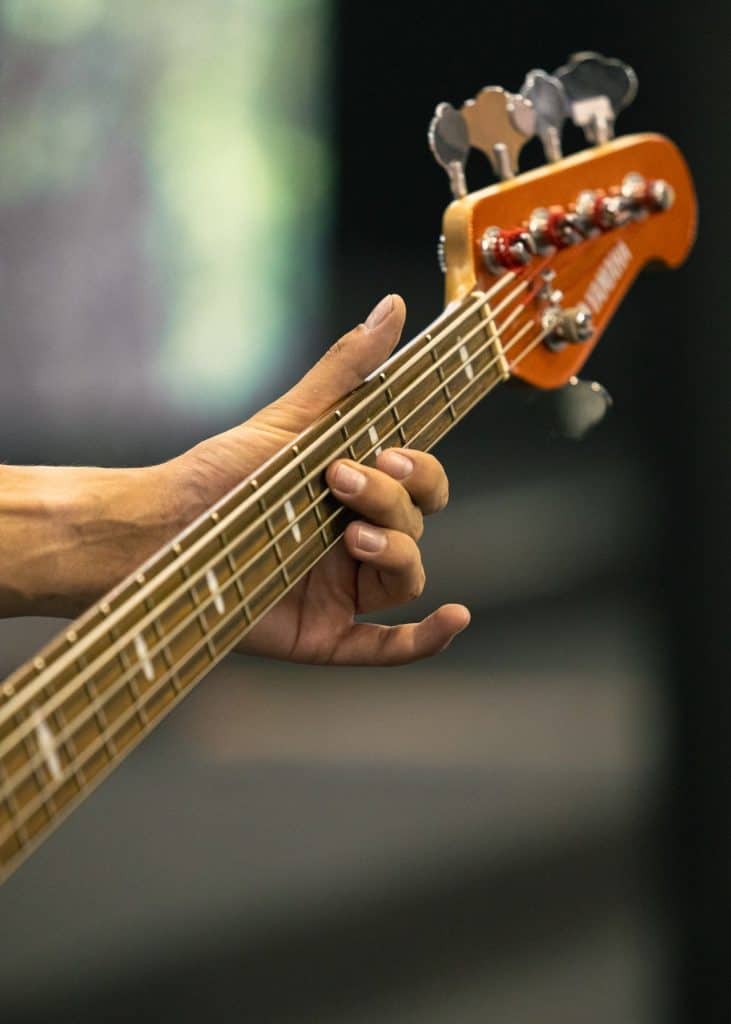
The five essential bass scales for beginners are major, natural minor, major pentatonic, minor pentatonic and blues. Each fits in one movable pattern across three strings that starts on the E or A string. Learn one shape a week at 60–80 BPM, then move it to any root note to play in any key.
Bass scales for beginners are the vocabulary behind every bass line you’ll learn. They’re Week 4 of our bass guitar for beginners lessons plan, and they make much more sense once you know the bass guitar notes on the fretboard.
This guide covers the essential bass scales for beginners as movable one-octave shapes. Every tab below is in standard EADG tuning and uses the one-finger-per-fret method. Apply them right away to the riffs in easy bass songs for beginners.
🎸 Free download
Not sure which guitar is right for you?
Get the free Guitar Gear Cheat Sheet: match your style, budget and hands to the right guitar in 2 minutes. You’ll also get my 30-Day Practice Plan as a bonus.
Send My Cheat Sheet →Table of Contents
Why Bass Scales for Beginners Matter
Bass parts aren’t just root notes. Fills, walking lines and melodic riffs all come from scales. Knowing a few shapes lets you:
- Connect chord roots smoothly instead of jumping around.
- Write your own lines over any progression.
- Understand why a riff works, which makes it easier to memorise.
- Play in any key by moving one shape.
Scales also train your ears. After a few weeks you’ll start to hear whether a line moves up a step or jumps a fifth, which makes learning songs by ear much faster. And they build the finger strength and independence you need for longer practice sessions, which is especially useful if your hands tire quickly on the heavier bass strings.
Because bass is tuned in fourths, every scale shape is movable. Start the same shape on a different fret and you’re in a different key.
1. The Major Scale
The major scale (do-re-mi) is the first of the bass scales for beginners that most teachers assign. It follows the pattern whole–whole–half–whole–whole–whole–half. Here’s G major starting on the 3rd fret of the E string. Use your middle finger on the first note.
G major (one octave)
G|--------------|
D|---------2-4-5|
A|---2-3-5------|
E|-3-5----------|
   G A B C D E F# G
Move the whole shape up two frets (start on fret 5) and you have A major. Start on the A string’s 3rd fret and you have C major.
2. The Natural Minor Scale
The natural minor scale follows whole–half–whole–whole–half–whole–whole and sounds darker. Here’s A minor from the 5th fret of the E string. Use your index finger on the first note.
A natural minor (one octave)
G|---------------|
D|-----------5-7-|
A|-----5-7-8-----|
E|-5-7-8---------|
   A B C D E F G A
Pentatonic Scale Bass Patterns
The pentatonic scale drops two notes from the major or minor scale, leaving five notes that almost never clash with the chords. That’s why the pentatonic scale on bass is the backbone of rock, blues, funk, country and gospel lines.
3. Minor Pentatonic (A)
A minor pentatonic
G|-----------|
D|---------5-7|
A|-----5-7---|
E|-5-8-------|
   A C D E G A
4. Major Pentatonic (G)
G major pentatonic
G|-------------|
D|---------2---5|
A|---2---5-----|
E|-3-5---------|
   G A B D E G
Notice that A minor pentatonic and C major pentatonic contain the same five notes (A C D E G), just starting in different places. The same relationship links every major key with its relative minor.
5. The Blues Scale (A)
Add one “blue note” (the flat fifth) to minor pentatonic and you get the blues scale:
A blues scale
G|-------------|
D|-----------5-7|
A|-----5-6-7---|
E|-5-8---------|
   A C D Eb E G A
Bass Scale Patterns Reference Table
| Scale | Formula (intervals) | Notes in example key | Sound | Common styles |
|---|---|---|---|---|
| Major | 1 2 3 4 5 6 7 | G A B C D E F# | Bright, happy | Pop, country, worship |
| Natural minor | 1 2 b3 4 5 b6 b7 | A B C D E F G | Dark, sad | Rock, metal, ballads |
| Major pentatonic | 1 2 3 5 6 | G A B D E | Open, sweet | Country, gospel, soul |
| Minor pentatonic | 1 b3 4 5 b7 | A C D E G | Bluesy, strong | Rock, blues, funk |
| Blues | 1 b3 4 b5 5 b7 | A C D Eb E G | Gritty, tense | Blues, rock, jazz |
Interval formulas follow standard music theory, as explained in resources like musictheory.net’s major scale lesson and Berklee College of Music‘s online courses.
How to Practice Bass Scale Patterns
Practice bass scale patterns with a metronome. Speed comes from accuracy, not effort. Try this 15-minute routine:
- 2 minutes: Play the shape slowly at 60 BPM, one note per click, alternating index and middle plucking fingers.
- 3 minutes: Play it in eighth notes (two notes per click), up and down.
- 3 minutes: Move the shape to three new keys, for example G, A and C.
- 3 minutes: Play in thirds (1–3, 2–4, 3–5 and so on) to train your ear.
- 4 minutes: Improvise a simple line over a backing track using only that scale.
Record yourself once a week. Listening back is the quickest way to hear uneven notes, rushed timing or strings that ring when they should be muted, and it shows you how much progress you’ve made since you started.
With any of these bass scales for beginners, raise the metronome by 5 BPM when you can play the shape cleanly four times in a row. Keep your fretting hand relaxed, press just behind the fret, and mute the strings you’re not playing.
Using Scales in Real Bass Lines
Here’s a simple way to turn one of these bass scales for beginners into a groove over an A minor chord. Play root, octave and the minor pentatonic notes in between:
G|-----------------|
D|-------7-----5---|
A|-------------7-5-|
E|-5-5-8---5-8-----|
From there, try connecting chords with scale steps. If the song moves from G to C, walk up G–A–B–C from the G major scale on the last beats of the bar. That’s the first step toward the walking bass lines used in jazz and blues.
Bass Scales for Beginners in Any Key: Where to Start
Because the shapes are movable, you only need to know where the root is. Use this table to start bass scales for beginners in the most common keys. The E-string shape covers lower keys, and the A-string shape covers keys whose root is easier to reach there.
| Key (root) | Root on E string | Root on A string | Common in |
|---|---|---|---|
| E | Fret 0 or 12 | Fret 7 | Rock, blues, metal |
| F | Fret 1 | Fret 8 | Pop, R&B |
| G | Fret 3 | Fret 10 | Country, worship, folk |
| A | Fret 5 | Fret 0 or 12 | Rock, blues, country |
| Bb | Fret 6 | Fret 1 | Jazz, horn-driven funk |
| C | Fret 8 | Fret 3 | Pop, worship |
| D | Fret 10 | Fret 5 | Rock, folk, worship |
Open-string versions of these shapes (keys of E and A) sound great but need a different fingering, because the open string replaces your first finger. Learn the fretted shapes first, then experiment with open strings.
A Two-Octave Major Scale Shape
Once the one-octave shape is solid, extend it. This two-octave G major scale starts on the E string and shifts position on the D string. Use your index finger to slide from fret 4 to fret 5 on the D string, then continue up the G string.
G major (two octaves)
G|------------------------4-5-7-|
D|-----------2-4-5-7-------------|
A|---2-3-5-----------------------|
E|-3-5---------------------------|
   G A B C D E F# G A  B C D
Go slowly and stop at the highest note you can reach cleanly. You don’t need to play the full second octave on day one. The notes are G A B C D E F# G on the lower strings, then A, B, C and D continuing up. To complete the second octave, add E, F# and G at the G string’s 9th, 11th and 12th frets once you’re comfortable shifting.
Bass Scales for Beginners by Style
- Rock and punk: roots, fifths and octaves first, then minor pentatonic for fills.