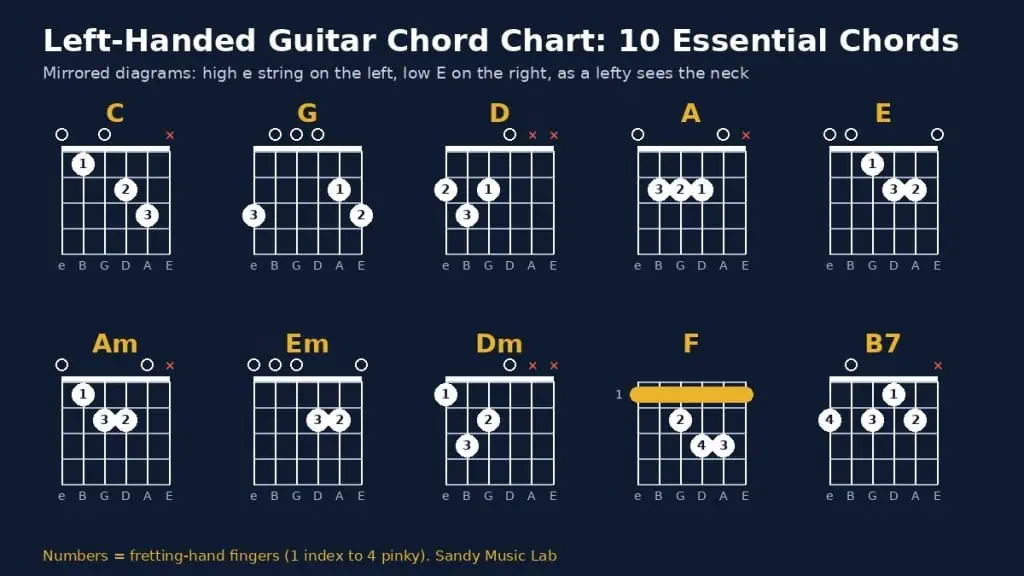
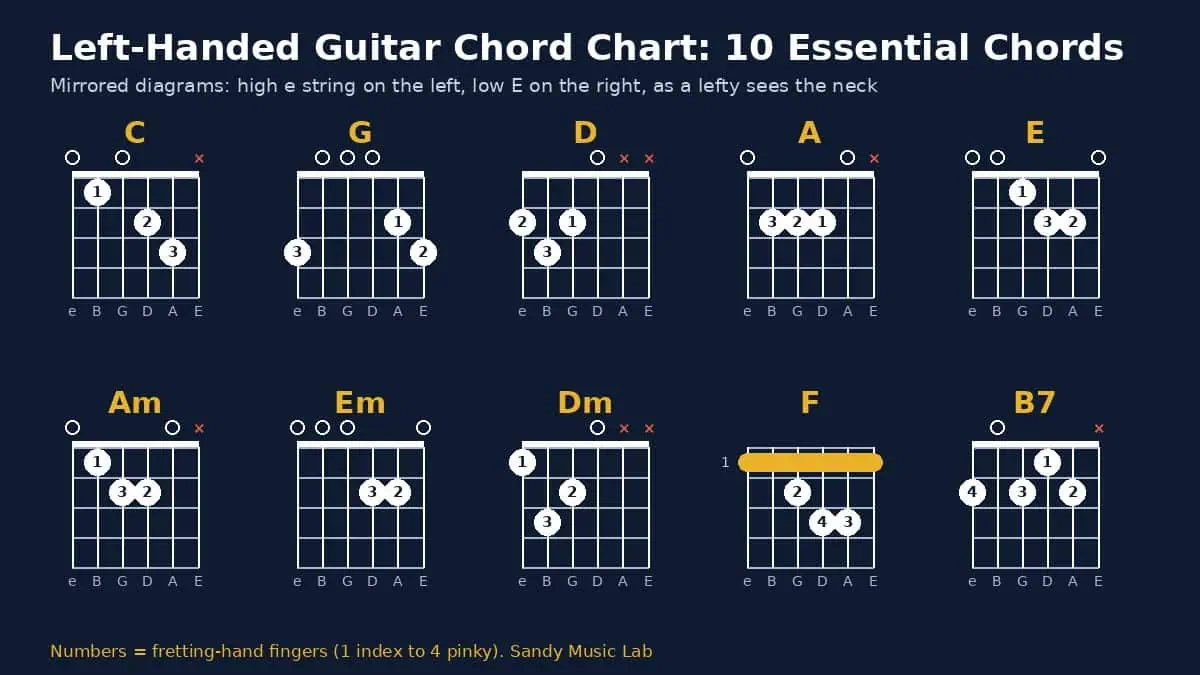
A left handed guitar chord chart is a normal chord chart flipped left to right, so the thin high e string is on the left and the thick low E string is on the right, exactly as a lefty sees the neck when looking down at the guitar. The chart below draws the 10 chords most beginners learn first that way, with finger numbers for your fretting hand.
Quick answer: on a left-handed chord diagram, the high e string is the leftmost line and the low E string is the rightmost, the reverse of a right-handed chart. Fret positions and finger numbers do not change: a C chord is still 3rd fret on the A string, 2nd fret on the D string and 1st fret on the B string. To flip any right-handed chart, read its fret numbers from right to left.
How do you read a left handed guitar chord chart?
Read a left handed guitar chord chart like a picture of your own neck: vertical lines are strings, with high e on the left and low E on the right, horizontal lines are frets, and dots show where your right-hand fingers press. An O above a string means play it open, and an X means do not play it.
- Strings: from left to right, e B G D A E. A right-handed chart runs E A D G B e.
- Frets: the thick top line is the nut. The first gap below it is the 1st fret.
- Numbers in the dots: 1 is your index finger, 2 middle, 3 ring and 4 pinky, on your fretting hand (your right hand as a lefty).
- Curved bar: a barre, where one finger presses several strings at once, as in the F chord.
The same mirroring applies to the guitar itself: Wikipedia’s guitar article notes that simply restringing a right-handed guitar reverses its saddle angle and hurts intonation. The general how to read a chord chart guide covers lead sheets, slash chords and rhythm notation, which work the same for lefties.
What are the 10 essential left-handed guitar chords?
The 10 essential left-handed guitar chords are C, G, D, A, E, Am, Em, Dm, F and B7, the same first chords right-handed players learn, and the chord shapes themselves never change. The table lists each one as text, string by string from high e to low E, matching the chart above. A 0 is an open string and x is a muted string.
| Chord | High e | B | G | D | A | Low E | Fingers (e to E) |
|---|---|---|---|---|---|---|---|
| C | 0 | 1 | 0 | 2 | 3 | x | -, 1, -, 2, 3, – |
| G | 3 | 0 | 0 | 0 | 2 | 3 | 3, -, -, -, 1, 2 |
| D | 2 | 3 | 2 | 0 | x | x | 2, 3, 1, -, -, – |
| A | 0 | 2 | 2 | 2 | 0 | x | -, 3, 2, 1, -, – |
| E | 0 | 0 | 1 | 2 | 2 | 0 | -, -, 1, 3, 2, – |
| Am | 0 | 1 | 2 | 2 | 0 | x | -, 1, 3, 2, -, – |
| Em | 0 | 0 | 0 | 2 | 2 | 0 | -, -, -, 3, 2, – |
| Dm | 1 | 3 | 2 | 0 | x | x | 1, 3, 2, -, -, – |
| F | 1 | 1 | 2 | 3 | 3 | 1 | 1, 1, 2, 4, 3, 1 (barre) |
| B7 | 2 | 0 | 2 | 1 | 2 | x | 4, -, 3, 1, 2, – |
These are standard fingerings. Some teachers play G with fingers 4, 3 and 2 instead, which makes the change to C easier later. Either is fine.
How do you flip a right-handed chord chart for left-handed guitar?
To flip a right-handed chord chart for left-handed guitar, reverse the string order and keep everything else. Right-handed diagrams and tabs list strings from low E to high e; a lefty view lists them from high e to low E. The frets, finger numbers and chord names stay exactly the same.
- For a chord written as numbers, such as C = x32010, read it backwards: 01023x. That is the lefty left-to-right view.
- For a drawn diagram, imagine it in a mirror, or hold your phone screen up to a mirror. The dots that were on the left move to the right.
Tabs need no flipping at all. Guitar tablature lines are labeled by string name, with the high e on the top line, so a lefty reads tab exactly like a right-handed player. If you use the free chord finder, keep the string names in mind and read each diagram from the high e side.
Which left-handed chords should you learn first?
Learn Em and Am first, then C, G and D, because those five chords cover thousands of songs and need only two or three fingers. E and A come next, and save F and B7 for after the open chords feel steady. Practise changes between pairs rather than single chords.
| Week | Chords | Practice change |
|---|---|---|
| 1 | Em, Am | Em to Am, four strums each |
| 2 | C, G | G to C, then C to Am |
| 3 | D, E, A | D to G, A to D, E to A |
| 4 | Dm, B7 | Am to Dm, Em to B7 |
| 5 and later | F | C to F, then the full C – G – Am – F progression |
Keep each change slow and steady with the free online metronome, starting at 60 BPM. The guitar keys for beginners guide shows which of these chords belong together in the keys of G, C, D, A and E.
What songs can you play with these left-handed chords?
With these left-handed chords you can play most beginner songs, because the common progressions use only four of them. G, C, D and Em cover a huge share of pop, folk, country and hymn arrangements, and C, G, Am and F is the famous I-V-vi-IV progression.
- G, C, D: the classic three-chord set for folk, country and many hymns. See easy gospel songs on guitar and hymns on guitar.
- G, D, Em, C: the most-used four-chord loop in modern pop.
- C, G, Am, F: the same idea in the key of C, once F is comfortable.
- Am, Dm, E: a minor-key set for darker songs.
For strumming patterns that match these progressions, open the free strumming patterns tool, which plays each pattern back at any tempo.
Do left-handed players need a special chord chart?
Left-handed players do not strictly need a left handed guitar chord chart, since frets and fingers are identical, but a mirrored chart removes a mental flip at the start. Many lefties learn from right-handed charts and stop noticing within a few weeks. A mirrored chart is most useful in the first month and for drawn diagrams, not tabs.
If you are still deciding whether to play left-handed at all, read can a left-handed person play a right-handed guitar. Need a lefty instrument? The best left handed guitars guide lists current factory left-handed models.
Why do left-handed chords feel harder at first?
Left-handed chords feel harder at first for the same reasons right-handed chords do: finger strength, stretch and pressing hard enough without muting the next string. Handedness is rarely the cause. If chords keep buzzing, check the guitar before blaming your hands, because high action makes every chord harder.
- Buzzing: press just behind the fret, not on top of it.
- Muted strings: arch your fingers so the tips come down straight.
- Sore fingertips: practise in short sessions; the soreness fades within a few weeks.
- Guitar setup: a converted right-handed guitar with the wrong nut can make every chord harder. See turning a right-handed acoustic guitar left-handed.
How we made this left handed guitar chord chart
Each chord was drawn from the standard open-position voicing and checked string by string against the standard tuning note layout using the Sandy Music Lab fretboard tool, then mirrored for left-handed players. The fingerings are the most common teaching fingerings. Sandy Music Lab is written by David Sandy, and the editorial policy explains how lessons are checked. Spot a mistake in a diagram? Tell us. For more on chord shapes across the neck, the music theory for guitar guide is the next step.
Left-handed chord chart FAQs
Are left-handed guitar chords different?
No. The chord shapes, frets and finger numbers are the same. Only the picture is mirrored, because the low E string sits on the other side of the neck.
How do I read a right-handed chord chart as a lefty?
Read the strings in reverse. A right-handed chart runs E A D G B e from left to right; for a lefty view, read it e B G D A E.
Do left-handed players read tabs differently?
No. Tab lines are labeled by string, with the high e on top, so lefties read tab exactly the same way.
What is the easiest left-handed guitar chord?
Em is the easiest: two fingers on the 2nd fret of the A and D strings, with all six strings strummed.
Is there a left-handed version of the C chord?
The C chord is the same: 3rd fret on the A string, 2nd fret on the D string, 1st fret on the B string, with the low E string muted. On a lefty diagram, the A string dot appears near the right side.
Can I print this left-handed chord chart?
Yes, save the chart image above and print it at full width. It is drawn at 1200 by 675 pixels, which prints clearly on a standard page.
Should left-handed beginners learn barre chords early?
Learn the open chords first. Add F and other barre chords once open chord changes are steady, usually after a month or two.