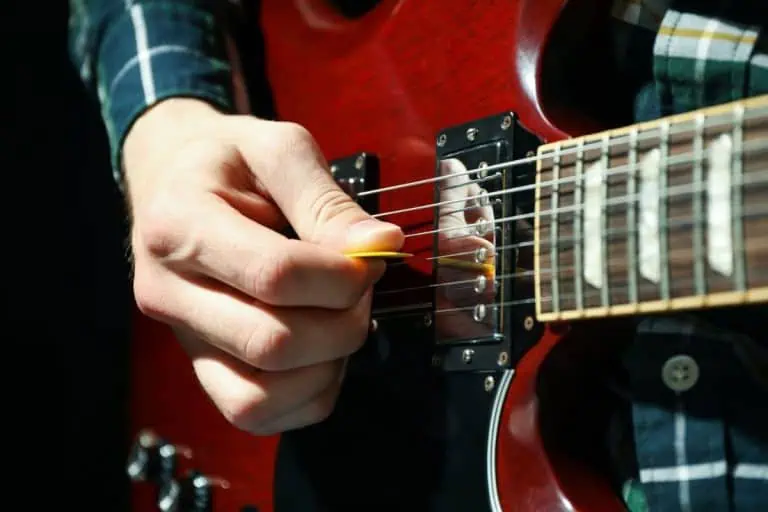
It’s hard to be a left-handed person, especially when it comes to an instrument like the guitar. Like so many other instruments, a standard guitar is set up for right-handed people. With left-handed guitars hard to find and often more expensive, southpaws may wonder if it’s possible to learn to play on a right-hander. Our guide on how to play guitar left handed walks through the true-lefty, flipped and right-handed options.
Quick answer: Yes. A left-handed person can play a right-handed guitar by playing it as it comes, flipping it upside down, or restringing it left-handed. Many lefties, including Mark Knopfler and Joe Perry, play standard right-handed guitars. If you are a beginner, try a right-handed and a left-handed guitar for a few minutes each and keep whichever feels more natural.
Disclosure: some links in this guide are affiliate links. As an Amazon Associate, Sandy Music Lab earns from qualifying purchases at no extra cost to you, and commissions never decide which products make a list. How we research and choose gear.
A left-handed person can play a right-handed guitar with some practice. Left-handed guitars can be hard to come by and are limited in their availability, so many lefties choose this route. Players can flip the guitar upside down, restring it to be left-handed, or simply learn how to play right-handed.
This article will explore different ways that left-handed people can approach playing a right-handed guitar (here’s how to make a right handed guitar left handed).
Related: what is shredding on guitar? and how to shred on guitar, 11 ways you can practice guitar when traveling, and how to tune your guitar a half step down. New to this topic? Start with our self-taught guitar roadmap. Looking for a left-handed bass? See the best left-handed bass guitars.
Why Play a Right-Handed Guitar?
If there are left-handed guitars out there, why bother learning how to play a right-handed guitar at all? The truth is that while there are left-handed guitars out there, they may not be as easy to find as you think. Some reasons lefty guitarists prefer righty guitars are outlined below.
Availability
There are fewer left-handed people in the world, so, unfortunately, there are fewer left-handed guitars. If you’ve had your heart set on a particular kind of guitar, you might have a disappointing realization when you look it up and find that it is only available in right-handed models.
Some manufacturers don’t make lefty guitars in batches but instead require customers to buy custom orders for lefty guitars. Gibson is one such manufacturer. However, custom lefties will be significantly more expensive.
Expense
Lefty guitars, for the most part, will cost more than their right-handed counterparts. Left-handed guitars are produced in much smaller quantities, requiring additional time and specialized tools.
As a hobby, playing guitar can get expensive between strings, cables, amplifiers, and repairs. Insisting on getting a lefty guitar will only add to the cost. You may simply decide that it’s more economical to get a right-handed guitar and teach yourself to play!
Easier To Play Other’s Guitars
Most of all, learning how to play right-handed guitars will make your life much easier if you ever want to play somebody else’s instrument. The overwhelming majority of players will own right-handed guitars. Playing a left-handed guitar means you will effectively be tied to your own instrument with little opportunity to explore other models.
As a beginner, you may not anticipate being in a situation where you want to play somebody else’s guitar. If you ever advance to a point where you are playing in front of other people, however, you may be handed a guitar and asked to play something. It would be disappointing to have to explain that you don’t play this kind of guitar!
What Are Your Four Options as a Lefty?
| Option | How it works | Pros | Cons |
|---|---|---|---|
| Standard right-handed guitar, played normally | Fret with your left hand, pick with your right | Cheapest and easiest to find; every lesson, chord chart and tab matches | Your non-dominant hand does the picking |
| Left-handed guitar | Mirror-image body and strings, fret with your right hand | Dominant hand does the fretwork; feels natural to many lefties | Fewer models, often higher prices or special orders, hard to play other people’s guitars |
| Right-handed guitar flipped upside down | Same strings, neck points the other way | Pick with your dominant hand without buying a new guitar | Low E ends up on the bottom, chord shapes and tabs are mirrored, controls sit in the way on an electric |
| Right-handed guitar restrung left-handed | Strings reversed so low E is nearest the ceiling | Looks and plays like a true lefty guitar | Nut slots and bridge are cut for the original string order, so it can pinch, buzz or play out of tune without work |
Fender notes that only about 10 percent of guitarists play left-handed (Fender), which is why left-handed models are harder to find and why most lessons assume a right-handed player.
How Can You Test Which Setup Feels Right?
Spend about 10 minutes on each setup before you spend money:
- Pick up a standard guitar and play open strings and a simple chord, such as Em, with your left hand fretting.
- Flip it, or find a left-handed guitar in a shop, and play the same thing with your right hand fretting.
- Play a slow strum on both, then try a four-note picked pattern. Notice which hand feels clumsy: the strumming hand, or the fretting hand.
- Do the “air guitar” test: stand up and mime a solo. The hand that goes to the neck without thinking is a good hint.
- Learn one setup for a few weeks. Switching later means relearning chord shapes, so it is better to commit to one orientation early.
There is no wrong answer. Plenty of left-handed players have good reasons to choose a standard guitar, because the fretting hand does most of the complicated finger movement.
What Does It Take to Convert a Right-Handed Guitar to Left-Handed?
Flipping the strings is not as simple as reversing them. On most guitars the nut slots are cut to fit each string’s thickness in a particular order, so reversed strings can sit too loose or too tight in the slots. A proper conversion usually means a new nut, and on many electrics also repositioning the strap button, the output jack and the controls. On an electric with angled pickups or a bridge that is compensated for string length, the intonation can end up off, and the pickup pole pieces do not line up as the maker intended. If you want a left-handed electric or acoustic without these compromises, buy a left-handed model or have a luthier do the conversion. For the acoustic version, see our guide to turning a right-handed acoustic guitar left-handed.
How Do You Read Chord Charts and Tabs as a Left-Handed Player?
Most chord charts and tabs are drawn for right-handed players, with the low E string on the left. If you play a true left-handed guitar, a mirror image of the chart is what you need. If you play a standard guitar normally, you can use any chart as is. Our guitar chord finder and chord chart library show standard right-handed diagrams, so hold the page up to a mirror, or flip the image, if you are playing left-handed. For a learning plan that works with either setup, see how to learn guitar by yourself, and if you are shopping, start with how to buy a guitar.
How Left-Handed People Can Play a Right-Handed Guitar
So if left-handed guitars have too many disadvantages for you, you may decide to take the plunge and learn how to play a right-handed guitar. Great—now you need to decide how you’re going to choose to play it.
There are actually three different ways lefty guitarists can approach playing a righty guitar. Each way has its advantages and drawbacks, so you may want to give each of them a try and see what feels the most comfortable for you.
Upside-Down
The first way to play a righty guitar is upside-down. Some guitarists simply take a right-handed guitar and point the neck to the right side of their body instead of the left. This puts the pick in their dominant hand, just like righty guitarists. The advantage of this is that right-handed guitars will no longer pose an obstacle when you want to jam on somebody else’s instrument!
This playing method is somewhat tricky since the strings will now be facing the opposite direction, putting the high E string on the top of the fretboard instead of the bottom. This means that you will have to learn the shapes of chords and all tablature backward, which can be very tricky indeed. Once you master this technique, no right-handed guitar will pose an obstacle to you.
If you’re already a seasoned guitarist, however, you will likely have trouble with this method. Playing a right-handed guitar upside-down will probably come easier to beginners, who have less guitar knowledge to relearn.
Restrung As Left-Handed
Another method some guitarists use is restringing their right-handed guitar entirely so that the strings are in the right order. This will put the low E where the high E used to be, the G where the B is, and so on.
The first and most famous guitarist to play this way was Jimi Hendrix, who restrung his Stratocaster to be left-handed. The effect this has on the electric guitar is particularly profound because of their pickups. Pickups are small magnetic transducers underneath each string on an electric guitar.
Pickups on electrics are usually angled in some way. This emphasizes certain strings and tones above others and gives each kind of electric guitar a distinct sound. Restringing the guitar to become a lefty will place different strings over the different pickups, emphasizing different notes than what the manufacturer intended. Your guitar will sound even more unique.
Restringing your guitar this way will also make the guitar impossible to play for right-handed players and can also be counterintuitive if you’re used to restringing the guitar already.
Right-Handed
Finally, many players simply decide to play right-handed. Even if you’re not ambidextrous, playing right-handed guitar may not be as difficult as you think.
Your right hand is closer to the bridge on a standard right-handed setup, holding the pick and strumming the strings. The left hand is actually doing the more complicated work of forming chord shapes and fingering along the fretboard. Right-handed guitarists tend to struggle with this but eventually get used to using their non-dominant hand. If you decide to switch, see our left-handed guitar chord chart and the best left-handed acoustic-electric guitars.
Picking up a new instrument is going to feel awkward no matter what. Some players use this to their advantage and force themselves to learn to play right-handed.
Sticking to Lefty Guitars
Maybe you’ve tried to play on a righty guitar and struggled in the past. In that case, you may want to go ahead and purchase a lefty guitar instead. Your playing will be best when you are playing an instrument that you love and are comfortable playing.
If you lack a lefty guitar, there are several relatively cheap options available on Amazon. Lefty acoustic guitars are fairly easy to find online. (Though keep in mind that these will have a lower sound quality than high-end acoustics!)
The Sawtooth Left-Handed Acoustic Dreadnought has nearly 500 five-star reviews on Amazon and costs under $150. Reviews agree that the sound quality is fairly good for a cheap acoustic.
A lefty electric will cost a little more than a lefty electric. This is because electric guitars are usually stylized and have cutaways, while acoustics are mostly symmetrical. The Fender Squier Left-Handed Affinity Telecaster is one of the cheaper models available from a major guitar manufacturer.
How To Turn a Right-Handed Acoustic Guitar Left-Handed
Are you a southpaw strummer who needs a left-handed guitar but you don’t have the budget for it? And you’re not allowed to part with your right-handed one because it was a gift from your late rock-and-roller grandma? A practical recourse: convert it to match your natural inclination.
1. Decide Which Conversion Method To Use
Professional musicians have opposing views on whether it’s easy to flip a right-handed guitar to accommodate left-handedness. Everything Burns author Anndy Negative claims it’s effortless and involves only a few steps.
Conversely, award-winning, critically-acclaimed musician Jessica Delfino says it’s possible, though tricky.
Guitar seller Marty, who runs The Acoustic Guitarist blog, agrees with Delfino, confirming that changing the orientation of a right-handed acoustic guitar to left-handed is not as simple as changing over the strings. (If you want your guitar to sound terrific, that is.) For what strings to use on a lefty, see left-handed guitar strings.
If you’re not put off by the tug-of-war, these are two ways to do the conversion:
- If you’re a newbie guitarist: Marty suggests sticking to the restringing method and flipping the nut.
- If your skill level is mid-range: He recommends letting a professional luthier (a stringed instrument expert) do the conversion for you, especially if your instrument is rare, expensive, vintage, or has sentimental value.
According to Musical Mind, converting a standard guitar to a lefty does not pose any tonal or structural difficulties or damage. However, it is best to buy the correct guitar suited precisely for you, whatever your hand orientation may be. Understandably, it is not always possible to find the guitar you desire in a left-handed version.
So, you should do the conversion only as a last resort—if you have absolutely no other options.
How Can You Tell a Left-Handed Guitar From a Right-Handed One?
Lefty Fretz, an online resource for left-handed guitarists, states that you can determine if a guitar is left-handed or right-handed simply by holding the guitar upright.
You can easily distinguish a left-handed guitar from a right-handed guitar by placing the instrument vertically in front of you and inspecting the strings. If the thickest string is on the left, the guitar is for righties. If it’s on the right, it’s for lefties.
Why Convert When You Can Buy?
Marty, a lefty musician, explains that left-handed guitars were rare in the old days. Not anymore. You can find them online or in specialty music stores.
Holding on to a standard guitar may be a matter of being a stickler to quality. Jimi Hendrix said he preferred right-handed guitars because they had a better build. This isn’t 100% accurate anymore, thanks to the advent of CNC instrument manufacturing.
3ERP’s rapid prototyping expert Ronan Ye defines CNC (computer numerical control) machining as a subtractive manufacturing process that uses machine tools and computerized controls to remove layers from solid material to produce premium musical instruments.
Nowadays, left-handed guitars are as magnificent-sounding as right-handed ones and only slightly more expensive.
The last (and typical) answer to the above question is economics.
Left-handed guitars can be more expensive than right-handed guitars. It can also be impractical to spend loads on a brand-new instrument if you’re just starting out, so many find it more convenient to adapt a right-handed guitar, rather than spending extra on a left-handed one.
Besides, some of the best lefty guitar players in the world have converted standard guitars to left-handed versions. Three of them were:
- Jimi Hendrix
- Kurt Cobain
- Tim Armstrong from Rancid
The last one already owns a custom shop model from Gretsch, and yet he still uses an old upside-down strung ax from the same brand.
Anndy Negative sums it up succinctly: “If (a guitar) ain’t broke, just make it left-handed.”
2. Prepare Your Workspace Before Converting the Guitar
Protect and secure your instrument by preparing a suitable venue to work on it. Place some cushioning (like a folded towel) under the body and headstock to keep the guitar in place and protect its back portion from being scratched or dented.
You’ll also want to dust your workspace to prevent any buildup from getting on your guitar. Make sure you have adequate lighting available, so you’re able to see everything clearly when converting it.
Lastly, keep the instrument out of reach of children and pets to avoid any damages or potential scratches.
3. Swap the Strings
Tools needed for restringing:
- A new set of strings
- String winder
- Wire cutters
- Small pliers
- Cleaner
In place of the tools above, you can get multipurpose tools like these from Amazon.com:
- D’Addario Pro-Winder—This ergonomically designed gadget is a peg winder, bridge pin puller, and built-in steel clipper in one. You can use it on acoustic and electric guitars, basses, mandolins, and banjos. The Pro-Winder also comes in a bass guitar version.
- Ernie Ball Musician’s Tool Kit—It is an all-in-one instrument care system with set-ups, string changes, and a carrier bag.
Steps
- Prepare your right-handed guitar as per the suggestion above.
- Buy a new batch of strings, like Ernie Ball 2146 Regular Slinky acoustic guitar strings. You can buy a two or three-pack, and you’ll have spares in case you make a mistake.
- Loosen the strings. You can do it slowly, string by string, by turning the knobs individually. Or use a peg winder to do a faster job.
Note: If you have a pickup (specifically a piezo) under your guitar’s saddle, it’s better to loosen the strings one at a time because piezo pickups are quite sensitive to intense pressure. (A piezo pickup is a device that absorbs string or guitar body vibrations to generate sound, normally from the saddle.)
Loosening all the strings at once can mess up the balance. Your treble or bass sides could be louder or softer than the other. Once the balance is set, it can be hard to get it back in the desired spot. To play safe, just change one string at a time.
- Take the bridge pins out with pliers or a wire cutter. Note that doing so may scratch or crack the pins’ surface, especially if they’re made of bone. An alternative is to place a coin under the tail end of the pin with one hand and push it out from inside the guitar’s body while your other hand pulls its head out.
- Remove the old strings from the guitar.
- Clean the entire instrument, especially the grungy parts previously covered by the strings.
- Change the bridge and saddle. (See the procedure below.)
- Reverse or increase the depth of the nut. Use a knife or file. Or take the nut out, spin it around, and put it back in. Use a strong adhesive to prevent it from bouncing. (See the procedure and flipping alternative below.)
- Restring the guitar in reverse order.
- Move the strap peg on the side closest to the fretboard to the opposite side.
- Attach your shoulder strap to the repositioned peg.
The above procedure is a simplified version from Anndy Negative.
If you want more comprehensive instructions on restringing a standard acoustic guitar, watch this demonstration from a professional guitar stringer:
4. Modify or Replace the Saddle
The bridge and saddle are vital components of your guitar. The bridge is a raised wooden bar that supports the strings and secures them to the guitar’s body.
The saddle is a thin strip of bone, plastic, tusk, or ivory that sits on the bridge. It is similar to the nut because it holds the strings in place, determines their length, and spaces them out. Its role is to transmit the vibrations from the strings to the bridge and the soundboard. Otherwise, string vibration by itself is insufficient to deliver an acceptable volume.
The saddle’s position in many acoustic guitars with steel strings is typically at a slight angle instead of being parallel to the nut. The purpose of these angled (aka “compensated”) saddles is to make up for the greater thickness of the strings and improve intonation—the ability to play in tune throughout the neck.
Experts say that righty-to-lefty instrument converters should take note of the considerable compensation on playability and intonation on your guitar’s bridge. If you simply reverse the order of the strings, you may lose out on these features.
How to Change the Saddle
Switch the saddle by:
- Filling in its existing groove.
- Then reroute it on an inverted angle.
It’s better to have a pro luthier do this for you unless you’re skilled in tasks like this. Otherwise, you may ruin your guitar.
As classical guitars have lighter nylon strings and need less drastic compensation, most have non-angled bridge saddles. In some guitars, however, the bridge saddle has a slight compensation angle. If your instrument has a compensated bridge saddle, reverse it.
Novice guitarists owning classical or steel-stringed guitars need not be overly concerned with the compensation angle because often, they will be playing in the open chord position anyway, where intonation is not a big deal.
5. Modify or Replace the Nut
For the uninitiated, this is the thin cream or white bone, ivory, or plastic strip nearest the first fret. It is also the last component between the strings and the tuning keys.
The nut has grooves increasing in depth from the highest to the lowest string to make up for the extra thickness of the lower wound strings.
Because of the shape of most nuts, experts do not recommend just flipping them over. If you reverse-string your guitar without changing the nut, the instrument may produce an unintentional droning sound.
Why? The notches will be too big to encase the treble strings and too small to hold the bass strings. Even if you just carve the small grooves wider for the bass strings, you will still end up with the treble strings vibrating haphazardly in the bigger slots, generating “fret buzz.” It’s a not-so-funny noise from strings vibrating against one or more of the frets.
Also, the string with the smaller diameter (the high E) will sit lower in the notch, while the thicker low E string will be positioned higher, affecting the action (aka playability) and becoming more onerous to play.
So, instead of grappling with filling in old notches and carving out new ones like what Mr. Negative suggested above, it’s better to buy a left-handed nut. Left-handed nuts are not as plentiful as right-handed ones, but they are available online. They will also be cheaper than purchasing an entire left-hand guitar.
How to Change the Nut
- Take out the right-handed nut by removing the seal of the fixative holding it in place. Use a file or a razor blade. When you hear a snap, the glue’s seal has yielded. In most acoustic guitars, manufacturers use only a tiny amount of adhesive. So, you won’t need much exertion to remove it. This way, you will be able to safeguard the finish.
- An alternative to step one (if the nut is not ensconced in a channel) is to use a light hammer with a bit of wood placed between the hammer and the nut. This is meant to distribute the impact with minimal force. Lightly tap until the nut is dislodged.
- Clean the remaining nut channel, if necessary. Wipe off any adhesive residue. Clean and sand the surface until it is flat.
- Put in the replacement left-handed nut.
Make sure you order the correct width for your guitar’s neck by measuring the original nut before throwing it away. Do not order a blank, because if you make a mistake on it or order the wrong one, you may have to wait a long time for a replacement.
Some music stores offer a bridge saddle and nut combo. Choose bone or tusk instead of plastic. Either will give a premium look to your converted instrument and will last longer.
Marty suggests marking the slots with a graphite pencil because its residue will help the strings stretch over the grooves in the nut and protect them, particularly the wound strings, from damage.
6. Reposition the Fret Markers
On steel-stringed players, fret markers are made of plastic, wood, clay, or mother of pearl and are located on the fingerboard. Classical guitars don’t have inlay fret markers and have position indicators on the side of the neck instead.
Most classical guitars’ position markers are on the 3rd, 5th, 7th, and 9th frets. Steel-stringed players also have their 12th, 15th, and 17th frets marked.
On a newly converted classical guitar, the fret markers will be on the wrong side. If this is an issue for you, transfer them to the correct one.
Converted classical guitar owners may want to buy stickers or decals in place of the standard fret markers.
For example, I like the Rosette Black/Ivory Fret Dots from Amazon.com. These dual-color, non-adhesive classical guitar markers are semi-permanent but easy to remove.
How to Change the Fret Markers
Some guitarists sniff at lowly fret dots. If you are one of them and prefer a professional setup, create your markers the hard way.
Marty suggests to:
- Drill a hole in the middle of each fret.
- Insert fret marker strips.
- Cut parallel to the crown of the fret.
- Sand and polish the surface until you achieve a smooth finish.
Before puncturing anything, though, check that your drill bit is the same diameter as your marker strips.
7. Change the Pickguard
A pickguard (aka scratchplate) is a thin shield next to the soundhole that protects the guitar body from scratches and dents from the pick (aka plectrum).
Be prepared to leave marks when changing the pickguard, particularly on older guitars. On a new guitar, not so much. Still, tan lines are inevitable.
Start the removal process by working a corner of the pickguard until a small section yields. Continue to ply the edges until you can remove the entire pickguard without scratching the body’s surface.
Older acoustics require sanding and refinishing the surface before the substitution can take place. If you are not bothered by the position of the pickguard, don’t replace it, recommends Marty.
What Do You Really Have To Change To Convert a Right-Handed Acoustic to Left-Handed?
| Part | Must change? | What happens if you skip it |
|---|---|---|
| Strings (restring in reverse) | Yes | Nothing else works without this |
| Nut | Yes, for a proper result | The slots are cut for thick strings on the wrong side, so the high strings sit loose and buzz and the low strings bind or sit high |
| Saddle | Yes, for a steel-string guitar | The saddle angle (compensation) is cut for a right-handed guitar, so the intonation is off, especially up the neck |
| Strap button | Yes | The guitar will not hang correctly from a strap |
| Pickguard | Optional | It will be on the wrong side, but it still protects the finish |
| Fret markers | Optional | The side dots will be on the audience side, which only matters if you use them |
| Cutaway or electronics | Cannot fix | A cutaway will be on the wrong side and the upper frets harder to reach. An electric guitar’s controls and pickups are also on the wrong side |
Is It Better To Flip the Strings or Buy a Left-Handed Guitar?
| Option | Cost | Result |
|---|---|---|
| Just restring the guitar and play upside down | Almost free | Works, but intonation and the nut may be poor, and the controls and cutaway are on the wrong side |
| Restring, flip or replace the nut, and fix the saddle | Moderate, and needs a luthier for the saddle | A properly working left-handed guitar, though it can still look unusual |
| Buy a used left-handed guitar | Often similar to a new right-handed guitar | The best sound and feel, with no work or risk to your guitar |
If the guitar is valuable, rare or sentimental, do not modify it. Selling it and buying a left-handed guitar, or having a luthier do the conversion, avoids permanent damage.
Related reading: can a left-handed person play a right-handed guitar and our best left-handed guitars.
What else changes for a left-handed player?
Beyond the strings, nut and saddle, a few smaller parts of a guitar are built for one hand. Knowing them helps you decide whether to convert a right-handed guitar or buy a left-handed one.
- Strap buttons: on a flipped guitar the bottom strap button sits in a different place relative to your body. Some players add a button on the other horn so the guitar balances properly.
- Cutaway: a right-handed cutaway ends up on the wrong side when flipped, so reaching the upper frets is harder. This is the main reason many lefties prefer a true left-handed model.
- Controls: on electrics, the volume knob ends up above the strings when you flip the guitar, which makes volume swells awkward.
- Pickguard: an acoustic pickguard sits below the soundhole on the picking side. Flip the guitar and it is on the wrong side, so the top can get scratched.
- Saddle compensation: acoustic saddles are angled and shaped for right-handed stringing. A reversed saddle or a new left-handed saddle keeps the guitar in tune up the neck.
If you are still choosing, our guides to the best left-handed guitars, left-handed guitar strings and how to play guitar left-handed cover the next steps, and the left-handed guitar chord chart shows chord shapes drawn for lefties.
Final Thoughts On Can A Left-Handed Person Play A Right-Handed Guitar?
Left-handed guitarists can easily play a right-handed guitar if they are willing to think about the instrument a little differently. If you’re struggling to find a lefty guitar, it might be worth thinking about playing a right-handed guitar instead.
There are numerous different ways to adjust a righty guitar to suit a lefty’s needs, but left-handed people can also simply decide to play a right-handed guitar with their right hand. Ultimately, there is no wrong way to set up your guitar, as long as it helps you play to the best of your ability.
Frequently Asked Questions
Can a left-handed person play a right-handed guitar?
Yes. Many left-handed guitarists play standard right-handed guitars, with the left hand on the fretboard. The fretting hand does most of the complicated work, so it is not a disadvantage, and it makes it easy to find guitars, lessons and chord charts.
Should a left-handed beginner learn on a right-handed or left-handed guitar?
Try both for a few minutes. If neither feels clearly better, a standard right-handed guitar is the easiest choice because instruction, tabs and used guitars are all set up for it. If one orientation feels natural right away, go with that.
Can you play a right-handed guitar upside down?
Yes, but the strings stay in the same order, so the low E ends up closest to the floor and chord shapes appear mirrored. It is workable for some players, but it can make controls awkward on an electric and makes standard chord charts harder to use.
Is it hard to restring a right-handed guitar left-handed?
It is easy to do, but it does not always play well. The nut and bridge are cut for the original string order, so the reversed strings can buzz, pinch or intonate poorly unless you also replace the nut and adjust the setup.
Which famous guitarists are left-handed but play right-handed guitars?
Mark Knopfler and Joe Perry are two well-known examples. Jimi Hendrix is the famous example of a left-handed player who played a right-handed guitar flipped upside down and restrung.
Can you turn a right-handed guitar into a left-handed guitar?
Yes. Restring it in reverse, replace the nut, fix the saddle angle and move the strap button. A cutaway or electronics cannot be corrected.
Can you just flip a right-handed guitar upside down and restring it?
You can play it that way, but the nut slots and saddle compensation are cut for a right-handed guitar, so the tone, action and intonation suffer.
Do you need a new nut to convert a guitar to left-handed?
For a proper result, yes. A left-handed nut or a recut nut puts the thick string slots on the correct side.
Is it better to buy a left-handed guitar?
Usually. It avoids damage and sounds better. Converting makes sense only for an inexpensive guitar or a sentimental one a luthier can handle.
Can you convert an electric guitar to left-handed?
You can restring it, but the controls, pickups, bridge compensation and cutaway are on the wrong side, so a proper conversion is more involved than on an acoustic.