The fastest way to learn how to improvise on guitar is to limit yourself: one key (A minor), one scale shape (pentatonic box 1), and at first only three notes. Play short phrases over a backing track, leave space between them, and end on the root note A. Improvising is mostly about phrasing and listening, not knowing every scale. The seven steps below build from three notes to full solos, with tab for each step.
Quick answer: put on a slow blues or rock backing track in A, use the A minor pentatonic box 1 at the 5th fret, and start with just three notes on the G and B strings. Play two- to four-note phrases, rest, then answer yourself (call and response). End phrases on A, the root. Add one new note or technique at a time, such as a bend or slide, and record yourself to hear what works.
How to improvise on guitar: what do you need to start?
To start improvising on guitar you need one scale shape, a backing track or chord loop in the right key, and a few minutes of focused practice. You do not need to know music theory first. Most beginners start with the minor pentatonic scale, because its five notes fit over blues, rock and pop in a minor key without many wrong notes.
| You need | Use this | Why |
|---|---|---|
| One scale shape | A minor pentatonic, box 1 (5th fret) | Five safe notes, easy pattern |
| Something to play over | A blues or rock backing track in A | Gives your phrases a context |
| Steady time | The free online metronome or a drum loop | Keeps phrases in rhythm |
| A way to listen back | A phone recorder | You hear what works |
Wikipedia’s improvisation article describes improvising as creating music in the moment, usually within a style’s rules. On guitar, those rules start with key and scale.
Step 1: Learn one scale shape to improvise with
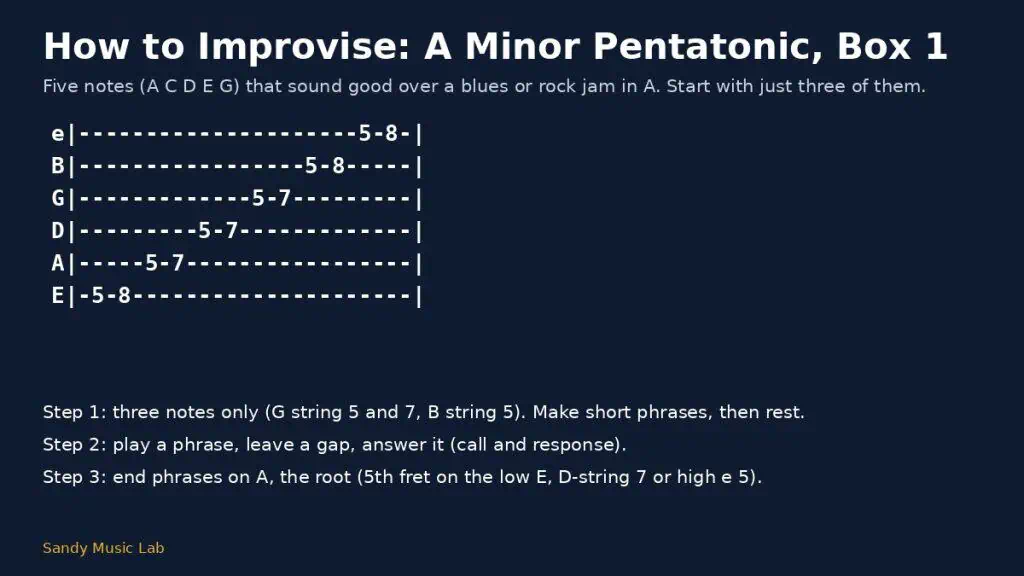
Learn the A minor pentatonic box 1, with your index finger at the 5th fret. It contains the notes A, C, D, E and G, and the root A sits on the low E string 5th fret, the D string 7th fret and the high e string 5th fret. Every note below was checked in standard tuning.
e|---------------------5-8-|
B|-----------------5-8-----|
G|-------------5-7---------|
D|---------5-7-------------|
A|-----5-7-----------------|
E|-5-8---------------------|
Play it up and down with alternate picking until it is automatic. The pentatonic scale guide covers all five shapes when you are ready.
Step 2: Make phrases with three notes
Use only three notes, the G string 5th and 7th frets (C and D) and the B string 5th fret (E). Make short phrases of two to four notes, then stop. Limiting the notes forces you to focus on rhythm and feel, which is what makes improvising sound musical.
- Play the same three notes in different rhythms.
- Repeat a phrase twice, then change its last note.
- Leave at least as much silence as playing.
Step 3: Use call and response
Call and response means playing a short phrase (the call), leaving a gap, then playing a phrase that answers it. It is how blues singers and guitarists have built solos for a century, and it makes even simple ideas sound like a conversation. Try a two-bar call, then a two-bar answer that starts the same way and ends differently.
Step 4: End on target notes
Target notes are the notes you land on at the end of a phrase. The safest target is the root, A. Next, aim for the chord tones of whichever chord is playing: over A7 aim for A or E, over D7 aim for D or A, over E7 aim for E or B.
| Chord in the backing | Safe target notes | Where in box 1 |
|---|---|---|
| A (I) | A, E | Low E 5, D 7, high e 5; A 7, B 5 |
| D (IV) | D, A | A 5, G 7; low E 5, D 7 |
| E (V) | E, B (B is outside the pentatonic, so use E) | A 7, B 5 |
This is the start of soloing over chord changes, covered fully in chord tones on guitar.
Step 5: Add one technique at a time
Once phrases flow, add expression one technique at a time: a bend, a slide, a hammer-on, or vibrato on the last note. Spend a few days on each, so it becomes part of your vocabulary instead of a trick you forget.
| Technique | Try it on | Guide |
|---|---|---|
| Bend | G string 7th fret, bend up to sound like the 9th | Best guitar strings for bending |
| Slide | G string 5 to 7 | How to read guitar tab |
| Hammer-on and pull-off | G string 5h7, 7p5 | Hammer ons and pull offs |
| Vibrato | Any target note | Wobble the pitch slightly at the end of a phrase |
Step 6: Improvise on guitar over real progressions
Next, improvise over a real chord progression. The best first one is the 12-bar blues in A, because the A minor pentatonic works over all three chords and the form repeats every 12 bars, so you always know where you are.
- Blues in A: the 12 bar blues guitar form, with box 1 over everything.
- Add the blue note: the blues scale adds one note (Eb) for extra grit.
- Minor rock and pop: loop Am, G, F (or Am, F, C, G) and use box 1 again.
- Jazz and more complex chords: see the tips for improvising over jazz chords.
Step 7: Record, listen and borrow ideas
Record a few minutes of improvising each week and listen back. Keep the phrases