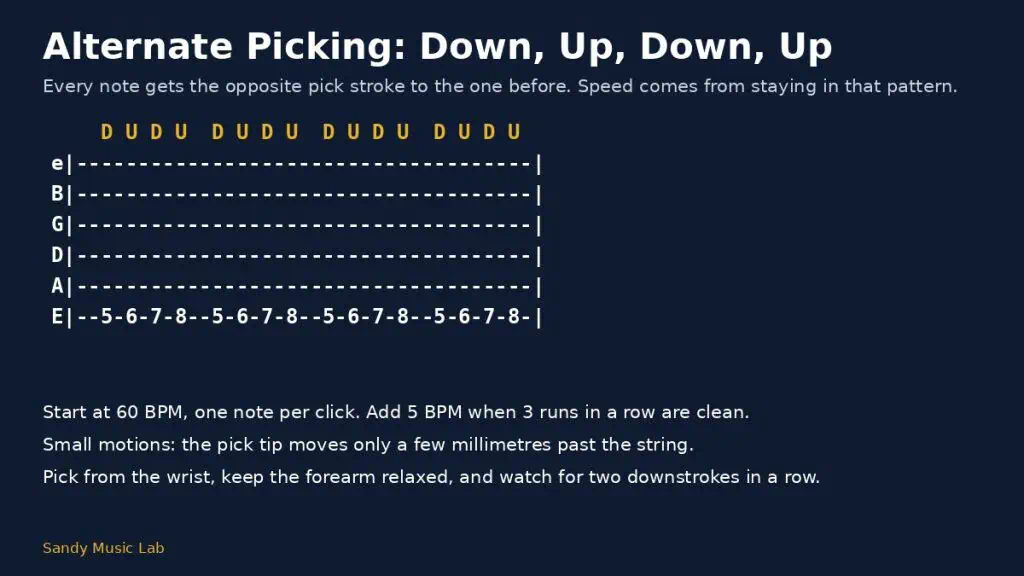
These alternate picking exercises train the most useful picking habit on guitar: a strict down, up, down, up pattern, where every note gets the opposite stroke to the one before. Start each drill at 60 BPM with one note per click, and only add speed when three runs in a row are clean. The seven drills below go from a single string to string crossing, scales and bursts, with a 4-week metronome plan to tie them together.
Quick answer: alternate picking means picking down, up, down, up without breaking the pattern, even when you change strings. Hold the pick between the thumb and the side of the index finger with only 2 to 3 mm showing, move from the wrist, and keep motions small. Practise with a metronome: start at 60 BPM, one note per click, and add 5 BPM after three clean runs. Eighth notes at 120 BPM is a solid first goal.
What is alternate picking?
Alternate picking is a technique where you strictly alternate downstrokes and upstrokes, so the pick never makes two strokes in the same direction in a row. It is the most efficient way to pick fast single-note lines, because every motion of the hand produces a note.
| Picking method | Pattern | Best for |
|---|---|---|
| Alternate picking | Down, up, down, up, always | Most lead lines, scales, fast riffs |
| Downpicking | All downstrokes | Heavy, even rhythm (see downpicking) |
| Economy picking | Alternate, but sweeps when crossing strings | Smooth runs across strings |
| Legato | Few pick strokes, mostly hammer-ons and pull-offs | Flowing lines |
For legato, see hammer ons and pull offs. Most players mix methods, but strict alternate picking is the best foundation.
How should you hold the pick for alternate picking?
Hold the plectrum between the pad of the thumb and the side of the index finger, with only about 2 to 3 mm of the tip showing. Grip just firmly enough that the pick does not twist. Move mainly from the wrist, keep the forearm relaxed, and keep each stroke small so the pick barely clears the string.
- Pick angle: tilt the pick slightly so the edge glides through the string instead of slapping it flat.
- Anchor (optional): some players lightly rest the palm edge near the bridge for stability.
- Pick thickness: a medium or heavy pick (about 0.8 mm and up) stays steadier for fast single notes. See the best guitar picks.
- Tension check: if your forearm burns, stop, shake out, and slow down 10 BPM.
7 alternate picking exercises with tab and BPM targets
Play every exercise with a strict down-up pattern, starting on a downstroke. Use the free online metronome and start at the tempo shown. Speed targets are for eighth notes (two notes per click) unless the drill says otherwise.
Exercise 1: one-string 1-2-3-4. Start: 60 BPM, one note per click.
   D U D U  D U D U
e|--------------------|
B|--------------------|
G|--------------------|
D|--------------------|
A|--------------------|
E|--5-6-7-8--8-7-6-5--|
Exercise 2: tremolo on one note. Fast, even repeats of one note. Start: 60 BPM, four notes per click, for 30 seconds.
e|--5-5-5-5-5-5-5-5--|
B|-------------------|
G|-------------------|
D|-------------------|
A|-------------------|
E|-------------------|
Exercise 3: two-string crossing. Inside and outside picking across a pair of strings. Start: 60 BPM.
e|-----------------------|
B|--5---7---5---7--------|
G|----5---7---5---7------|
D|-----------------------|
A|-----------------------|
E|-----------------------|
Exercise 4: 1-2-3-4 across all strings. The classic chromatic drill with alternate picking on every note. Start: 60 BPM.
e|----------------------------------------------5-6-7-8-|
B|------------------------------------5-6-7-8-----------|
G|--------------------------5-6-7-8---------------------|
D|----------------5-6-7-8-------------------------------|
A|------5-6-7-8-----------------------------------------|
E|5-6-7-8-----------------------------------------------|
Exercise 5: A minor pentatonic, two notes per string. Up and down the first box shape from the pentatonic scale guide. Start: 60 BPM.
e|-----------------------------5-8-8-5-----------------------------|
B|-------------------------5-8---------8-5-------------------------|
G|---------------------5-7-----------------7-5---------------------|
D|-----------------5-7-------------------------7-5-----------------|
A|-------------5-7---------------------------------7-5-------------|
E|---------5-8-----------------------------------------8-5---------|
Exercise 6: three-note-per-string scale. A major scale shape on the low strings. Three notes per string changes which stroke starts each string, a key alternate picking skill. Start: 60 BPM.
e|-----------------------|
B|-----------------------|
G|-----------------------|
D|-----------------6-7-9-|
A|---------5-7-9---------|
E|--5-7-9----------------|
Exercise 7: speed bursts. Play four notes at your target speed, then rest for a beat. Short bursts teach the hands the fast motion without tension. Start: 80 BPM, then 100, then 120.
   (fast)    (rest)  (fast)    (rest)
e|--5-6-7-8-----------5-6-7-8----------|
B|-------------------------------------|
G|-------------------------------------|
D|-------------------------------------|
A|-------------------------------------|
E|-------------------------------------|
What is a good alternate picking speed?
A good first goal is clean eighth notes at 120 BPM, which is four notes per second. Sixteenth notes at 120 BPM (eight notes per second) is a common intermediate goal. Clean and even matters more than fast, so log your best clean tempo each day.