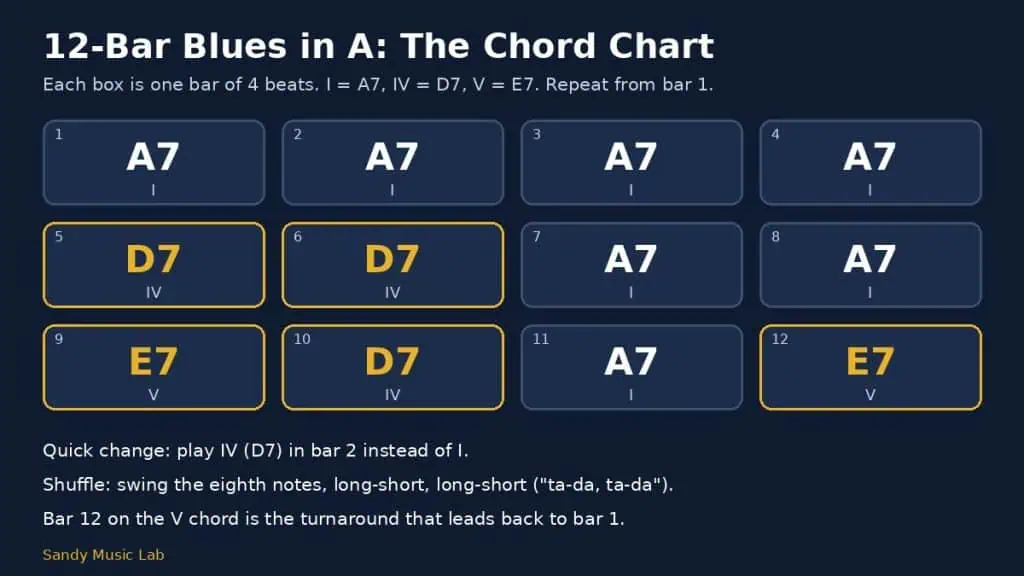
12 bar blues guitar uses just three chords, the I, IV and V of a key, in a fixed 12-bar pattern that repeats for the whole song. In A, that means A7, D7 and E7: four bars of A, two of D, two of A, then E, D, A and E to turn around. Add a swung shuffle rhythm and you have the backbone of blues, early rock and roll and countless jams. This guide covers the progression, the quick change, the classic shuffle riff in tab and how to move it to any key.
Quick answer: the 12-bar blues in A is | A7 | A7 | A7 | A7 | D7 | D7 | A7 | A7 | E7 | D7 | A7 | E7 |, then repeat. The numbers are I, IV and V of the key. Play it with a shuffle: swing the eighth notes long-short, and use the A5 to A6 riff (A string open with the D string at frets 2 and 4). For the quick change, play D7 in bar 2.
What is the 12-bar blues progression?
The 12-bar blues is a chord progression that lasts 12 bars of four beats and uses the I, IV and V chords of a key. Wikipedia’s twelve-bar blues article gives the standard form below, with the last bar often switching to V to lead back to the start.
| Bars 1 to 4 | Bars 5 to 8 | Bars 9 to 12 |
|---|---|---|
| I, I, I, I | IV, IV, I, I | V, IV, I, V |
| A7, A7, A7, A7 | D7, D7, A7, A7 | E7, D7, A7, E7 |
| E7, E7, E7, E7 | A7, A7, E7, E7 | B7, A7, E7, B7 |
The second and third rows are the same progression in A and in E, the two most common guitar keys for blues because their chords use open strings. Roman numerals make it easy to move: I is the key, IV is four notes up the scale, V is five. The diatonic chords guide shows how to find them in any key.
Which chords do you need for 12 bar blues guitar in A?
For 12 bar blues guitar in A you need A7, D7 and E7. Dominant 7th chords give the blues its bluesy, unresolved sound, though plain A, D and E major chords also work. All three are open chords, checked note by note.
| Chord | Frets (strings 6 to 1) | Notes |
|---|---|---|
| A7 | x 0 2 0 2 0 | A E G C# E |
| D7 | x x 0 2 1 2 | D A C F# |
| E7 | 0 2 0 1 0 0 | E B D G# B E |
For more 7th chord shapes, including movable ones, see 7th chords on guitar.
How do you play a blues shuffle on guitar?
To play a blues shuffle, play the root and fifth of each chord (a power chord), then stretch your ring finger two frets up to make the sixth, and rock between the two in a swung rhythm. In A, that is the open A string with the D string at the 2nd fret, then the 4th fret.
Shuffle riff on A (I chord), one bar:
e|-------------------------|
B|-------------------------|
G|-------------------------|
D|-2--2--4--4--2--2--4--4--|
A|-0--0--0--0--0--0--0--0--|
E|-------------------------|
On D (IV chord): the same shape moved to the D and G strings.
e|-------------------------|
B|-------------------------|
G|-2--2--4--4--2--2--4--4--|
D|-0--0--0--0--0--0--0--0--|
A|-------------------------|
E|-------------------------|
On E (V chord): the same shape on the low E and A strings.
e|-------------------------|
B|-------------------------|
G|-------------------------|
D|-------------------------|
A|-2--2--4--4--2--2--4--4--|
E|-0--0--0--0--0--0--0--0--|
Play each pair of eighth notes with a swing: the first note long, the second short, like “ta-da, ta-da”. That long-short feel is the shuffle rhythm. Palm mute lightly for a tighter sound; see palm muting. Use all downstrokes at first, then try alternating down-up strokes.
What is the quick change in 12 bar blues?
The quick change is a common variation where you play the IV chord in bar 2 and go back to I in bar 3. It breaks up the first four bars and is used in a huge number of blues songs. Bandleaders often call it out before a song starts.
| Version | Bars 1 to 4 | Bars 5 to 8 | Bars 9 to 12 |
|---|---|---|---|
| Standard | A7, A7, A7, A7 | D7, D7, A7, A7 | E7, D7, A7, E7 |
| Quick change | A7, D7, A7, A7 | D7, D7, A7, A7 | E7, D7, A7, E7 |
| Slow ending | A7, A7, A7, A7 | D7, D7, A7, A7 | E7, E7, A7, A7 |
The “slow ending” with two bars of V and two of I is common at the end of a song. If in doubt at a jam, listen to the first chorus, or ask “quick change or not?” before you start.
What is a turnaround in 12 bar blues?
A turnaround is the end of the 12-bar form, usually bars 11 and 12, that leads back to the start. The simplest turnaround is just the V chord in bar 12 (E7 in A). Players often add a short lick or a chromatic walk down over the I chord in bar 11 before landing on V.
- Simplest: bar 11 on A7, bar 12 on E7.
- Walk-down: in bar 11, walk the bass down chromatically, then land on E7 in bar 12.
- Ending: on the last chorus, finish on A7 (or A9) instead of E7.
Turnaround licks use the blues scale, covered in blues scale on guitar. For soloing over the form, see how to get better at lead guitar.
How do you play 12 bar blues guitar in other keys?
To play 12 bar blues guitar in another key, find the I, IV and V chords of that key and slot them into the same 12 bars. Movable shapes make this easy: the shuffle riff and power chords slide anywhere on the neck. Use the chord transposer to convert the chart.
| Key | I | IV | V | Notes |
|---|---|---|---|---|
| E | E7 | A7 | B7 | The classic guitar blues key |
| A | A7 | D7 | E7 | All open chords |
| G | G7 | C7 | D7 | Common with horns and piano |