Hammer ons and pull offs let you play two or more notes with a single pick stroke. For a hammer-on, you pick a note and then bring another finger down hard on a higher fret of the same string. For a pull-off, you pick a fretted note and flick that finger off sideways, so a lower fret or open string sounds. Together they are called legato playing, and they make lines smoother and faster than picking every note. The six exercises below take you from your first hammer-on to clean legato runs.
Quick answer: for a hammer-on, pick a note, then press a higher fret on the same string firmly and quickly with another finger, without picking again. For a pull-off, fret both notes, pick the higher one, then pull that finger slightly down and off the string so it plucks the lower note. In tab, hammer-ons are h (5h7) and pull-offs are p (7p5). Aim for the second note to be as loud as the first.
What are hammer ons and pull offs?
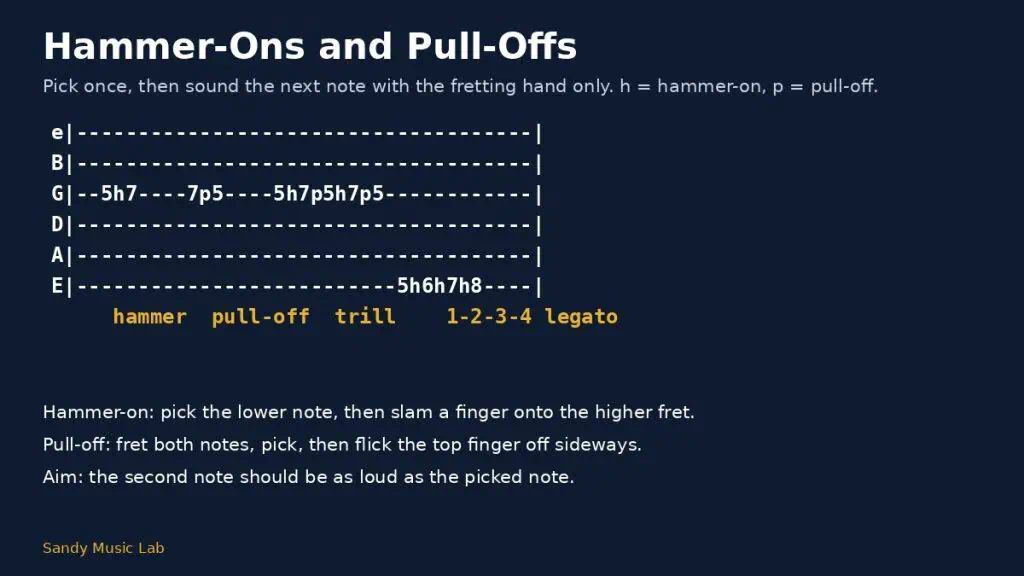
Hammer ons and pull offs are fretting-hand techniques that sound notes without the pick. A hammer-on moves up in pitch by tapping a finger onto a higher fret, and a pull-off moves down by plucking the string with the finger as it leaves a fret. Both keep the string vibrating from the original pick stroke, which is the basis of legato guitar playing.
| Technique | Direction | Tab symbol | How the note is sounded |
|---|---|---|---|
| Hammer-on | Up (higher fret) | h, as in 5h7 | Finger strikes the fret hard |
| Pull-off | Down (lower fret or open) | p, as in 7p5 | Finger plucks the string as it leaves |
| Trill | Up and down, fast | 5h7p5h7 | Rapid hammer-ons and pull-offs |
| Legato run | Several notes | 5h7h8 | Many notes from one pick stroke |
Tab symbols are explained in full in how to read guitar tab.
How do you do a hammer-on?
To do a hammer-on, pick a fretted or open note, then bring a fretting finger down onto a higher fret of the same string quickly and firmly, just behind the fret wire. Use the fingertip, and think of hitting the fret, not pressing the string.
- Fret the first note: for example, index finger on the 5th fret of the G string.
- Pick it once: a normal downstroke.
- Hammer: while the note rings, bring your ring finger down onto the 7th fret, fast and from about 1 cm above.
- Keep the first finger down: the index stays on the 5th fret so you are ready to pull off.
- Listen: the hammered note should be nearly as loud as the picked one.
How do you do a pull-off?
To do a pull-off, fret both notes on the same string, pick the higher one, then pull the top finger slightly downward toward the floor as you lift it, so it plucks the string and the lower note sounds. Simply lifting straight up gives a weak, quiet note.
- Fret both notes: index on the 5th fret and ring finger on the 7th fret of the G string.
- Pick the 7th fret note.
- Pull off: flick the ring finger down and away, catching the string slightly as it leaves.
- Keep the index firm: the 5th fret must stay pressed, or the note goes dead.
- Mute the next string: the pull-off motion can catch the string below, so let the finger come to rest against it.
Why do hammer ons and pull offs sound weak or buzz?
Hammer-ons usually sound weak because the finger lands too slowly or too far from the fret, and pull-offs sound weak because the finger lifts straight up instead of plucking. Buzzing comes from landing in the middle of the fret space or from low action.
| Problem | Cause | Fix |
|---|---|---|
| Hammered note is quiet | Finger lands slowly or too softly | Hammer faster, from a little higher |
| Hammered note buzzes | Landing far from the fret wire | Land just behind the fret |
| Pull-off is quiet | Lifting straight up | Pull down and off, plucking the string |
| Wrong note after pull-off | Lower finger not pressed | Keep the lower finger firmly down |
| Other strings ring | No muting | Rest spare fingers or the picking hand on unused strings |
| Weak notes on acoustic | Heavy strings and high action | Practise on electric first, or check the setup |
High action makes legato much harder. If notes still buzz or die, see guitar setup cost for what a setup fixes.
6 hammer-on and pull-off exercises (with tab)
Play each exercise slowly with the free online metronome. Start at 60 BPM with one note per click, and move up 5 BPM only when every note is even in volume.
Exercise 1: single hammer-on. Pick the 5th fret, hammer the 7th. Repeat on every string.
e|--5h7----5h7--|
B|--5h7----5h7--|
G|--5h7----5h7--|
D|--5h7----5h7--|
A|--5h7----5h7--|
E|--5h7----5h7--|
Exercise 2: single pull-off. Fret the 5th and 7th, pick the 7th, pull off to the 5th.
e|--7p5----7p5--|
B|--7p5----7p5--|
G|--7p5----7p5--|
D|--7p5----7p5--|
A|--7p5----7p5--|
E|--7p5----7p5--|
Exercise 3: open-string pull-offs. A common sound in folk and rock licks. Keep the pull-off strong enough to ring the open string.
e|--3p0--2p0--3p0--2p0--|
B|--3p0--1p0--3p0--1p0--|
G|----------------------|
D|----------------------|
A|----------------------|
E|----------------------|
Exercise 4: the trill. One pick stroke, then alternate hammer-ons and pull-offs for as long as the note lasts.
e|---------------------|
B|---------------------|
G|--5h7p5h7p5h7p5h7p5--|
D|---------------------|
A|---------------------|
E|---------------------|
Exercise 5: 1-2-3-4 legato. Pick the first note, hammer three more with fingers 2, 3 and 4. Then reverse with pull-offs. It is the legato version of the classic finger exercise in the guitar warm-ups and exercises guide.
e|-----------------------------|
B|-----------------------------|
G|-----------------------------|
D|-----------------------------|
A|-----------------------------|
E|--5h6h7h8----8p7p6p5---------|
Exercise 6: A minor pentatonic legato. Pick once per string going up with hammer-ons, then come back down with pull-offs. This shape is covered in the pentatonic scale guide.
   up (hammer-ons)                 down (pull-offs)
e|-------------------------5h8--|--8p5-------------------------|
B|--------------------5h8-------|-------8p5--------------------|
G|---------------5h7------------|------------7p5---------------|
D|----------5h7-----------------|-----------------7p5----------|
A|-----5h7----------------------|----------------------7p5-----|
E|5h8---------------------------|---------------------------8p5|
How fast should you practise hammer ons and pull offs?
Practise them slowly enough that every note is equally loud, usually 60 to 80 BPM at first. Speed comes from accuracy and relaxed hands, not force. Add 5 BPM at a time and stop if your hand tenses or notes start to drop out.
| Week | Target (one note per click) | Focus |
|---|---|---|
| 1 | 60 BPM | Even volume on exercises 1 and 2 |
| 2 | 70 BPM | Open-string pull-offs and trills |
| 3 | 80 BPM, then two notes per click | 1-2-3-4 legato |
| 4 | 60 BPM, two notes per click | Pentatonic legato run |
Five minutes a day is enough; the guitar practice routine shows where a technique block fits. For more drills, see the best guitar exercises.
How this guide was made
Technique steps were checked against Wikipedia’s hammer-on and pull-off articles and standard teaching methods, and all exercises were written for this guide. Sandy Music Lab is written by David Sandy, and the editorial policy explains how guides are researched. Spotted an error? Tell us.
Hammer-on and pull-off FAQs
What is the difference between a hammer-on and a pull-off?
A hammer-on goes up in pitch by striking a higher fret. A pull-off goes down by plucking the string with the finger as it leaves a fret.
Why are pull-offs harder than hammer-ons?
Because the finger has to pluck the string as it leaves, not just lift. Pull slightly downward toward the floor and keep the lower finger pressed firmly.
Do you pick the second note in a hammer-on?
No. Only the first note is picked. The second note comes from the force of the finger hitting the fret.
Are hammer-ons easier on electric or acoustic guitar?
Electric, because the strings are lighter and the action is usually lower. They work on acoustic too, with a firmer hammer.
What is legato on guitar?
Legato means smooth, connected notes. On guitar it usually means playing lines mostly with hammer-ons and pull-offs instead of picking every note.
How long does it take to learn hammer-ons and pull-offs?
Most beginners get a usable hammer-on in a day or two. Even, fast legato takes a few weeks of short daily practice.
Can you hammer on from an open string?
Yes. Pick the open string and hammer any fret on it. It is common in folk, blues and rock licks.