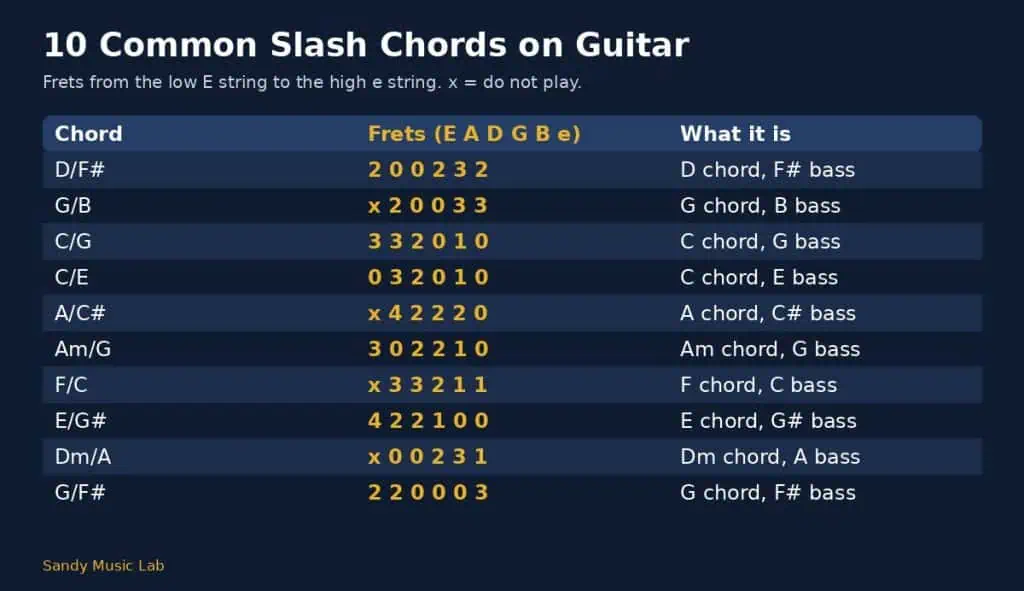
Slash chords on guitar are chords with a different note in the bass, written as chord/bass note. D/F# means play a D chord with F# as the lowest note; G/B means a G chord with B in the bass. They sound like a normal chord, but the moving bass note links chords together smoothly. This guide explains how to read slash chords, gives you the 10 most common shapes, and shows how to use them in progressions.
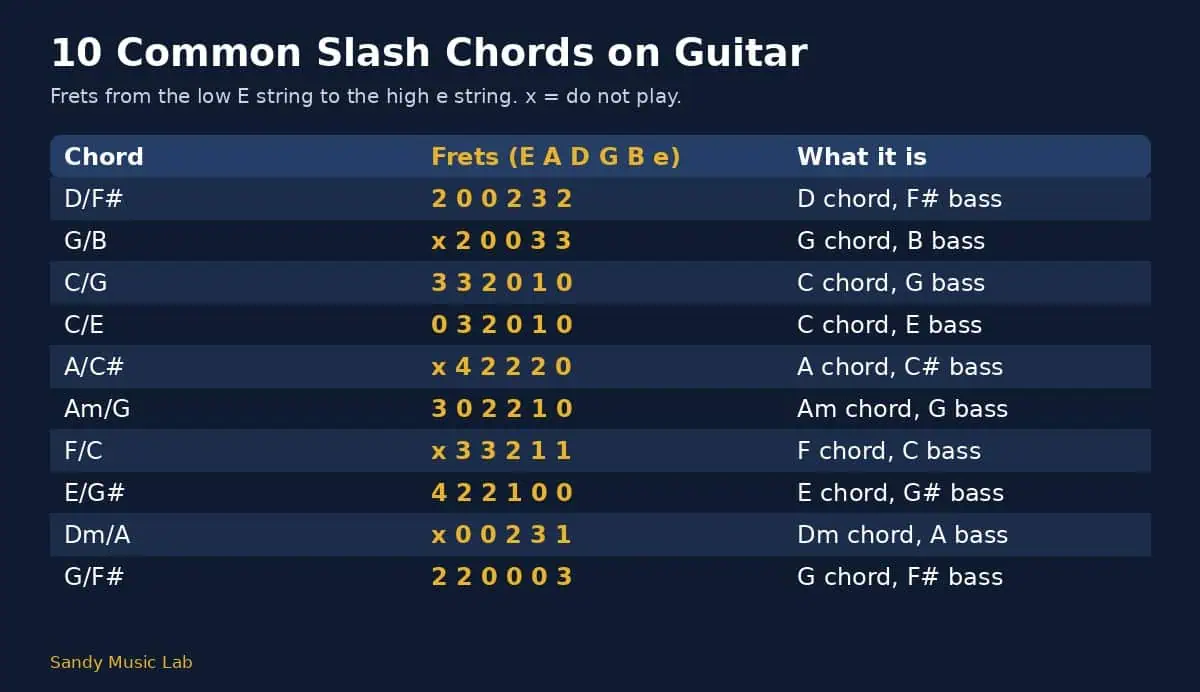
Quick answer: a slash chord such as D/F# is read as “D over F sharp”: the letter before the slash is the chord, and the letter after is the lowest note. Play the chord shape and make sure that bass note is the lowest one you strum. The most common slash chords on guitar are D/F# (2 0 0 2 3 2), G/B (x 2 0 0 3 3) and C/G (3 3 2 0 1 0).
What is a slash chord on guitar?
A slash chord is any chord written with a slash and a second note name. The part before the slash is the chord. The part after the slash is the bass note, the lowest note you play.
There are two kinds:
- Inversions: the bass note is already part of the chord. D/F# is a D major chord (D, F#, A) with its 3rd, F#, in the bass. C/G is a C chord with its 5th in the bass.
- Added bass notes: the bass note is not in the chord. G/F# adds an F# under a G chord, and Am/G adds G under A minor. These create a richer, more colorful sound.
How do you read slash chords?
| Written | Say it | Play |
|---|---|---|
| D/F# | D over F sharp | A D chord with F# as the lowest note |
| G/B | G over B | A G chord with B as the lowest note |
| C/E | C over E | A C chord with E as the lowest note |
| Am/G | A minor over G | An A minor chord with G as the lowest note |