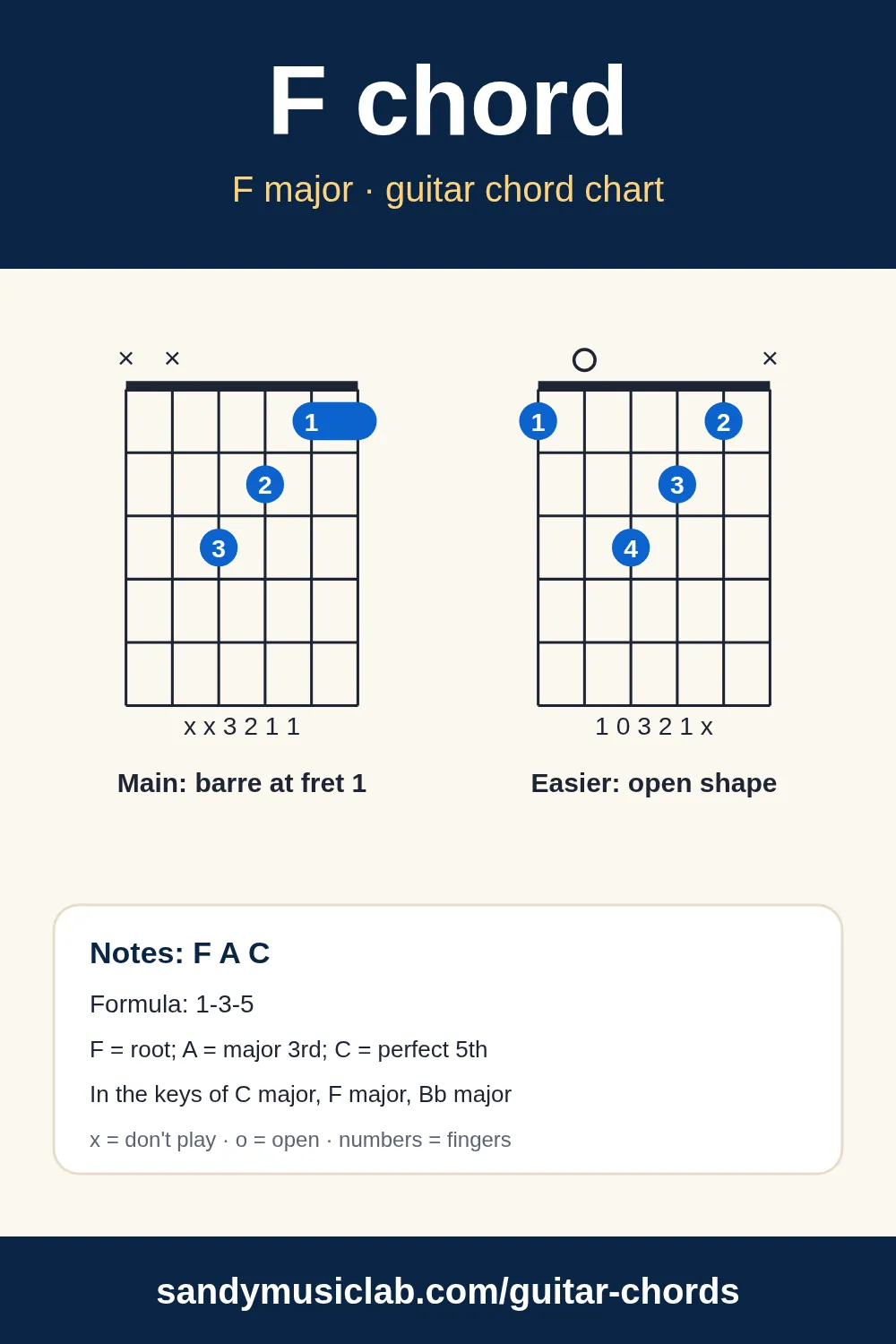
F chord facts
| Chord | F (F major) |
|---|---|
| Other names | Fmaj, FM |
| Notes | F, A, C |
| Intervals | F (root), A (major 3rd), C (perfect 5th) |
| Formula | 1-3-5 |
| Difficulty | Intermediate (barre or stretch) |
| Shapes on this page | 3 |
How do you play F on guitar?
The main shape is x x 3 2 1 1 (Easy F (4 strings)). Finger by finger:
- Lay your index finger flat across the B to high e strings at fret 1. This is the barre.
- Put your middle finger (2) on the G string at fret 2 (A, the major 3rd).
- Put your ring finger (3) on the D string at fret 3 (F, the root).
- Don't play the low E and A strings: start your strum on the D string, or touch them lightly to mute.
- Strum, then pick each string one at a time and fix any string that buzzes or is silent.
This is a barre chord, so it takes a few weeks to sound clean. Keep the index finger straight and close to the fret wire, pull back gently with the arm rather than squeezing with the thumb, and check each string one at a time. The finger stretching exercises help with the reach.
What is the easiest way to play F?
The easier version is 1 0 3 2 1 x (Open position). It keeps the sound of F with less effort and no barre.
- Put your index finger (1) on the low E string at fret 1 (F, the root).
- Put your middle finger (2) on the B string at fret 1 (C, the perfect 5th).
- Put your ring finger (3) on the G string at fret 2 (A, the major 3rd).
- Put your pinky (4) on the D string at fret 3 (F, the root).
- Let the A (A) string ring open.
- Don't play the high e string: start your strum on the low E string, or touch it lightly to mute.
- Strum, then pick each string one at a time and fix any string that buzzes or is silent.
Another route is a capo: put it on a fret and play an open shape that sounds as F. The chord transposer and capo finder works out the shape for you.
What other ways can you play F?
- Full F barre (1st fret): 1 3 3 2 1 1. Barre at fret 1; movable, so the same shape works for other roots.
What notes are in the F chord?
F is a major triad: the root F, a major 3rd above it (A) and a perfect 5th above the root (C). The major 3rd (4 semitones) is what makes it sound major; lower it by one fret and you get Fm.
A major chord sounds bright, stable and finished. It is the chord most songs start and end on, so it is the first shape most players learn in each key.
| Note | Interval from F | Semitones |
|---|---|---|
| F | root | 0 |
| A | major 3rd | 4 |
| C | perfect 5th | 7 |
For more on how chords are built from intervals, see chord tones on guitar and music theory for guitar.
Which keys use the F chord?
In a major key, major chords sit on the I, IV and V degrees. F is home base (I) in F major, the IV chord in C major and the V chord in Bb major, which is why it turns up in so many songs.
| Key | Role | Written as | Chords in that key |
|---|---|---|---|
| C major | IV | F | C – Dm – Em – F – G – Am – Bdim |
| F major | I | F | F – Gm – Am – Bb – C – Dm – Edim |
| Bb major | V | F | Bb – Cm – Dm – Eb – F – Gm – Adim |
See diatonic chords on guitar for how these tables are built.
What chord progressions use F?
These are generic progressions built from the keys above (they are not taken from a specific song). Strum each chord for one bar and loop.
| Key | Pattern | Chords |
|---|---|---|
| C major | I – V – vi – IV | C – G – Am – F |
| F major | I – V – vi – IV | F – C – Dm – Bb |
More ideas: chord progressions for different moods and the Nashville number system.
What are common mistakes when playing F?
- Letting the 3rd (A) go quiet. That note defines the chord as major; if a finger touches the string under it, the chord sounds hollow.
- Strumming the strings marked x. A wrong bass note turns F into an inversion or a different chord altogether.
- Pressing too hard. Squeezing pulls strings sharp and tires your hand; press just hard enough to stop the buzz.
- Squeezing with the thumb on the barre. Pull back slightly with the arm instead, and move the barre finger right next to the fret.
- Hitting the bass strings marked ×. Aim the strum at the D string.
Which chords are related to F?
Try Fsus2, Fsus4 or Fadd9 in place of F for a more open sound. Fmaj7 softens it, and F7 makes it want to move to the chord a 5th below.
- Fm (F minor)
- F7 (F seventh)
- Fmaj7 (F major seventh)
- Fm7 (F minor seventh)
- Fsus4 (F suspended fourth)
- Fsus2 (F suspended second)
- Fadd9 (F add nine)
- Dm (D minor)
- Bb (B flat major)
F chord FAQ
How do you play F on guitar?
The most common F shape is x x 3 2 1 1 from the low E string to the high e string (Easy F (4 strings)). x means don't play that string and 0 means play it open.
What notes are in the F chord?
F contains F, A, C. Its formula is 1-3-5.
What is the easiest way to play F?
Try 1 0 3 2 1 x (Open position). It uses 4 fretted notes and no barre.
What key is F in?
F belongs to C major (as the IV chord), F major (as the I chord), Bb major (as the V chord).
Why does my F chord buzz?
Press each string just behind the fret wire, keep your fingertips upright so they don't touch the next string, and keep your thumb behind the neck. On a barre, roll the index finger slightly onto its bony edge.
Can I use a capo for F?
Yes. A capo lets you play F with an easier open shape: use the chord transposer to find which shape to play for a given capo fret.
What is the difference between F and Fm?
F major has a major 3rd (A); Fm has a minor 3rd (Ab). The other two notes are the same.
Free tools and guides
- Guitar chord finder: tap any shape on a fretboard and get its name.
- Chord transposer and capo finder: move a song with F to an easier key.
- All guitar chord charts: every root and chord type.
- How to read a chord chart.