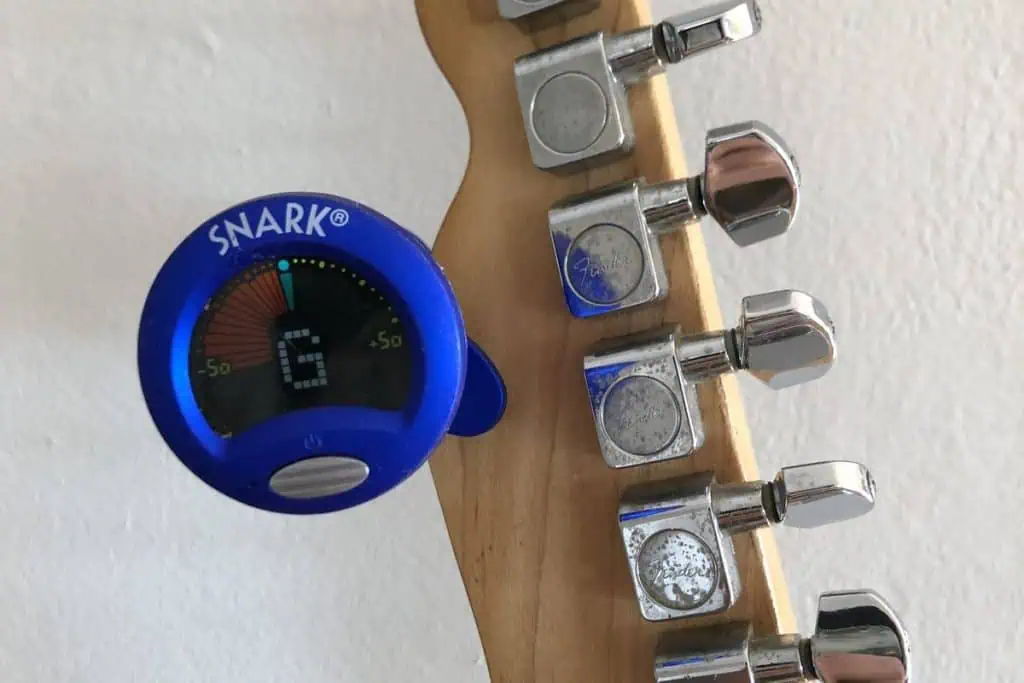
Quick answer: The best clip-on tuner for most players is the Snark SN-8. It’s the one I’ve used for years: quick, accurate, cheap, and its screen turns to face you. For tuning all six strings at once, get the TC Electronic PolyTune Clip. For maximum accuracy, the Peterson StroboClip HD. To hide the tuner on stage, the D’Addario Micro.
A clip-on tuner grips your headstock and reads the vibration of the guitar, not the sound in the room. That means it works in a noisy rehearsal, on stage, or while someone else is playing. It’s the first accessory I recommend to every new guitarist.
Here are five clip-on tuners that are currently sold, starting with the one I use. Want the bigger picture, including pedal tuners and strobe units? See our full guitar tuner guide.
Our top picks at a glance
| Product | Best for | Key features | Price |
|---|---|---|---|
| Snark SN-8 Super Tight All Instrument Tuner | Everyday tuning on a budget | Display rotates 360°, tap tempo metronome, pitch calibration and transpose | Check current price |
| TC Electronic PolyTune Clip | Tuning all six strings at once | Polyphonic, strobe (±0.02 cent) and chromatic (±0.5 cent) modes, 108-LED matrix display, A4 435–445 Hz | Check current price |
| Peterson StroboClip HD | Maximum accuracy | Strobe tuner rated ±0.1 cent, 50+ Sweetened Tuning presets, HD backlit display, CR2032 battery | Check current price |
| Fender FT-1 Pro Clip-On Tuner | A simple, no-fuss clip-on | Full-range chromatic, dual rotating hinges, backlit LCD needle that turns green in tune, CR2032 included, 1-year warranty | Check current price |
| D’Addario Micro Headstock Tuner (2-pack) | Hiding the tuner on stage | Tiny clip that hides behind the headstock, piezo pickup, 410–480 Hz calibration, tri-color backlit screen, 360° swivel | Check current price |
No clip-on tuner with you? Our free online guitar tuner uses your phone or laptop mic and shows a big needle meter.
The picks, reviewed
1. Snark SN-8 Super Tight All Instrument Tuner — best for everyday tuning on a budget
Key features: Display rotates 360°, tap tempo metronome, pitch calibration and transpose
This is the tuner in my own gig bag, and it’s the one I’ve used for years. It’s accurate, it’s fast, and I’ve only replaced the battery once. When I need to tune quickly between songs, this is what I reach for.
Snark lists a “super tight” tuning mode, a brighter display that rotates 360 degrees so you can read it from any angle, plus a tap-tempo metronome and pitch calibration and transpose features.
Pros:
- The one I actually use
- Display turns to face you on any headstock
- Extra features (metronome, transpose) for the price
Cons:
- Plastic clip feels less premium than metal-hinged tuners
- Single-string chromatic only (no polyphonic mode)
2. TC Electronic PolyTune Clip — best for tuning all six strings at once
Key features: Polyphonic, strobe (±0.02 cent) and chromatic (±0.5 cent) modes, 108-LED matrix display, A4 435–445 Hz
The PolyTune Clip lets you strum all the open strings at once and shows which ones are off. That’s the quickest way to check your tuning between songs. TC Electronic rates its strobe mode at ±0.02 cent and its chromatic mode at ±0.5 cent, with a tuning range of A0 to C8.
It runs on a CR2032 battery (included) and weighs 32 g, so it doesn’t pull on the headstock.
Pros:
- Polyphonic mode is a real time-saver
- Strobe mode for setup and intonation
- Bright display
Cons:
- Costs more than basic clip-ons
- Polyphonic mode works best with standard-style tunings
3. Peterson StroboClip HD — best for maximum accuracy
Key features: Strobe tuner rated ±0.1 cent, 50+ Sweetened Tuning presets, HD backlit display, CR2032 battery
Peterson has made strobe tuners since 1948. The StroboClip HD puts that approach in a clip-on rated at ±0.1 cent. Its 50+ “Sweetened Tuning” presets slightly offset some strings so open chords sound sweeter. It also handles capo and drop-tuning transposition.
Peterson lists a bright HD display with 192 strobe segments, auto-shutoff and up to 24 hours of continuous use from a replaceable CR2032 battery.
Pros:
- Strobe accuracy
- Sweetened Tunings for acoustic and 12-string
- Readable in bright light
Cons:
- Priciest pick here
- A strobe takes a minute to get used to
4. Fender FT-1 Pro Clip-On Tuner — best for a simple, no-fuss clip-on
Key features: Full-range chromatic, dual rotating hinges, backlit LCD needle that turns green in tune, CR2032 included, 1-year warranty
If you just want a clip-on that works, the FT-1 Pro keeps it simple. It has a needle display with a backlight that turns green when you’re in tune, and dual hinges so you can angle the screen.
It’s full-range chromatic, so it also works for bass, ukulele and alternate tunings. Fender includes the battery and a 1-year limited warranty.
Pros:
- Easy to read
- Flexible dual hinge
- Battery included
Cons:
- No strobe or polyphonic mode
- Fewer extras than the Snark
5. D’Addario Micro Headstock Tuner (2-pack) — best for hiding the tuner on stage
Key features: Tiny clip that hides behind the headstock, piezo pickup, 410–480 Hz calibration, tri-color backlit screen, 360° swivel
The Micro is small enough to sit behind the headstock, where the audience won’t see it, so you can leave it on all the time. It picks up vibration through a piezo, so a noisy room doesn’t throw it off. The screen shows red, yellow or green depending on how close you are.
This listing is a 2-pack, so you can keep one on each guitar.
Pros:
- Practically invisible
- Two tuners in the pack
- Good in loud rooms
Cons:
- Small screen
- Clip feels less sturdy than bigger tuners
How to choose a clip-on tuner
- Display: you have to read it at an angle, often under stage lights. Bright, rotating displays (Snark, Fender) help.
- Mode: chromatic is enough for most players. Polyphonic (PolyTune Clip) checks all strings at once. Strobe (Peterson, or the PolyTune’s strobe mode) is for setups and intonation.
- Size: tiny tuners like the D’Addario Micro hide behind the headstock, so you can leave them on.
- Calibration: if you play with a piano or backing tracks that aren’t at A440, make sure you can change the reference pitch.
- Battery: all five here use a CR2032 coin cell. Keep a spare in your case.
Changing key with a capo? Our free chord transposer and capo finder shows the chord shapes for any capo position. If your strings keep slipping out of tune after you change them, check that the gauge suits your tuning with the string gauge finder. And if the tuner itself acts up, see guitar tuner not working.
Frequently asked questions
Are clip-on tuners accurate?
Yes. A standard chromatic clip-on is accurate enough for playing. Strobe clip-ons, like the Peterson StroboClip HD (rated ±0.1 cent) and the PolyTune Clip in strobe mode (±0.02 cent), are accurate enough for setups.
Do clip-on tuners work on acoustic guitars?
Yes. They read vibration through the headstock, so they work on acoustic, electric, bass and ukulele, with or without a pickup.
Can I leave a clip-on tuner on my guitar?
You can, especially small ones that sit behind the headstock. Take it off before storing the guitar in a tight case, and check that the rubber pads don’t mark a nitro finish.
Clip-on tuner or tuner app?
An app is free but struggles in noisy rooms, because it listens through a microphone. A clip-on reads vibration, so it works on stage. More in tuner or tuner app.
What battery does a clip-on tuner use?
All five tuners here use a CR2032 coin cell.
Final thoughts
For most players, the Snark SN-8 is the easy pick. It’s the tuner I keep in my own gig bag. Step up to the PolyTune Clip if you want to tune all six strings at once, or the StroboClip HD if you set up your own guitars.
As an Amazon Associate, Sandy Music Lab earns from qualifying purchases. Specs come from the manufacturers and retailers listed; check the product page for the current price.
Featured photo: “LCD clip on guitar tuner” by medicalfools / David Chancey, CC BY-SA 4.0, via Wikimedia Commons (cropped).