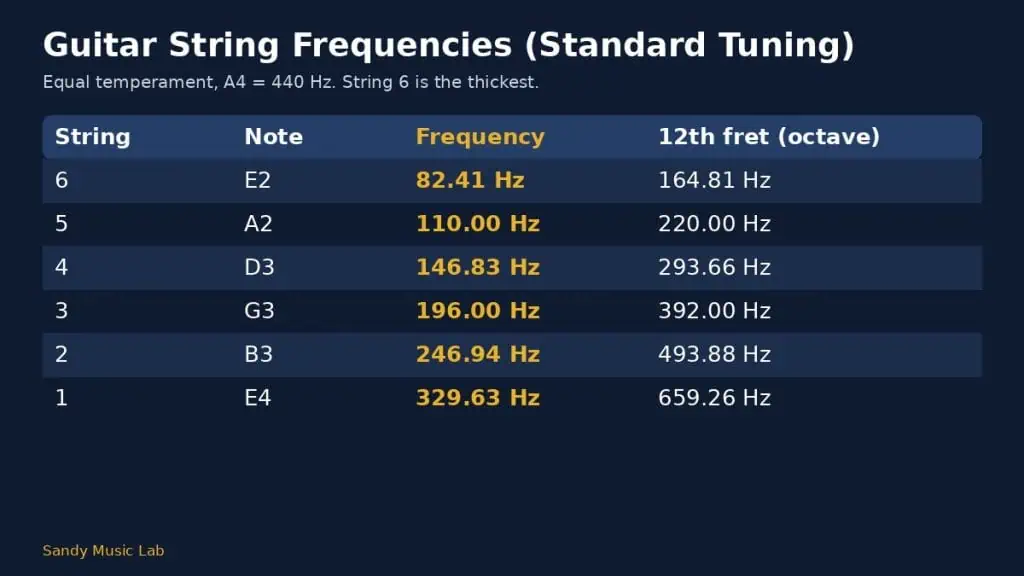
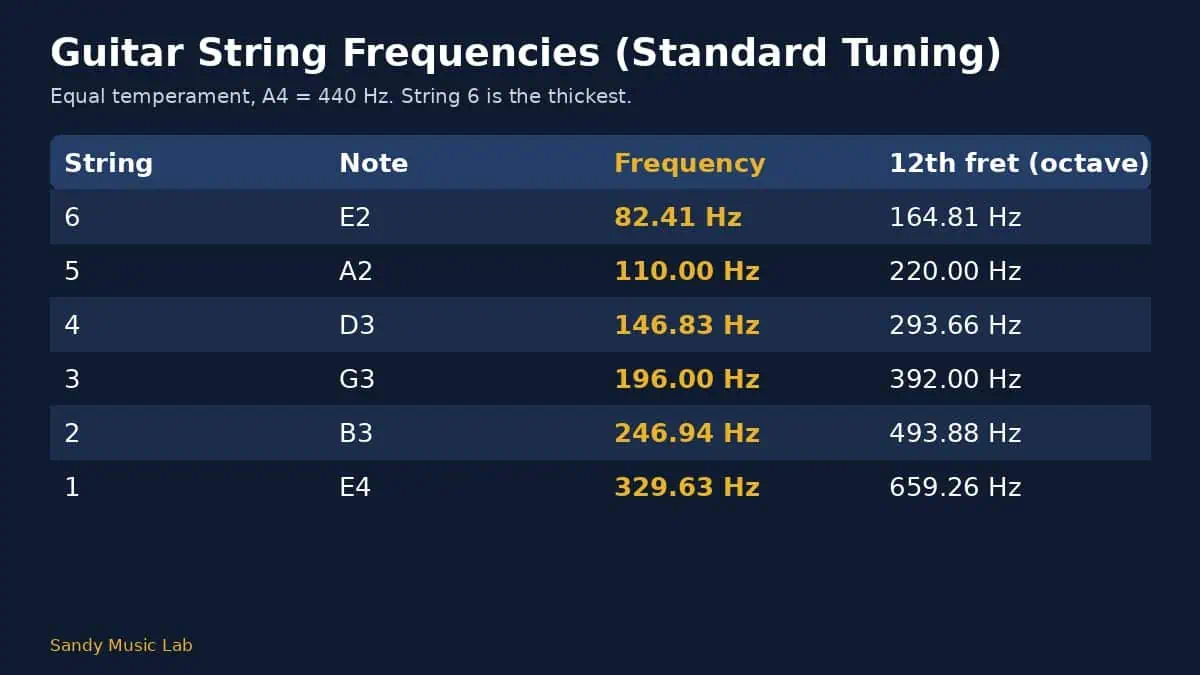
Guitar string frequencies in standard tuning are 82.41 Hz for the low E, 110 Hz for A, 146.83 Hz for D, 196 Hz for G, 246.94 Hz for B and 329.63 Hz for the high E. Below you will find a frequency chart for every string, the values for drop D, half-step-down, D standard and bass guitar, the simple formula behind them, and how to use frequencies to tune by ear with a free tone generator.
Quick answer: in standard tuning (A4 = 440 Hz) the six open strings are E2 82.41 Hz, A2 110 Hz, D3 146.83 Hz, G3 196 Hz, B3 246.94 Hz and E4 329.63 Hz. The high E is exactly two octaves above the low E, so its frequency is four times higher.
Guitar string frequency chart
Standard tuning (E A D G B E) uses these frequencies when the reference pitch is A440:
| String | Name | Scientific pitch | Frequency (Hz) |
|---|---|---|---|
| 6 (thickest) | Low E | E2 | 82.41 |
| 5 | A | A2 | 110.00 |
| 4 | D | D3 | 146.83 |
| 3 | G | G3 | 196.00 |
| 2 | B | B3 | 246.94 |
| 1 (thinnest) | High E | E4 | 329.63 |
Notice the pattern: the A string is exactly 110 Hz, a quarter of A440, because it is two octaves below concert A. If you need help remembering the string names themselves, see our guide to guitar string names and notes.
Guitar string frequencies for alternate tunings
Drop and down tunings lower some or all strings. These values are all at A4 = 440 Hz.
| Tuning | 6 | 5 | 4 | 3 | 2 | 1 |
|---|---|---|---|---|---|---|
| Standard (E A D G B E) | 82.41 | 110.00 | 146.83 | 196.00 | 246.94 | 329.63 |
| Drop D (D A D G B E) | 73.42 | 110.00 | 146.83 | 196.00 | 246.94 | 329.63 |
| Half step down (Eb Ab Db Gb Bb Eb) | 77.78 | 103.83 | 138.59 | 185.00 | 233.08 | 311.13 |
| D standard (D G C F A D) | 73.42 | 98.00 | 130.81 | 174.61 | 220.00 | 293.66 |
| Drop C (C G C F A D) | 65.41 | 98.00 | 130.81 | 174.61 | 220.00 | 293.66 |
| Open G (D G D G B D) | 73.42 | 98.00 | 146.83 | 196.00 | 246.94 | 293.66 |
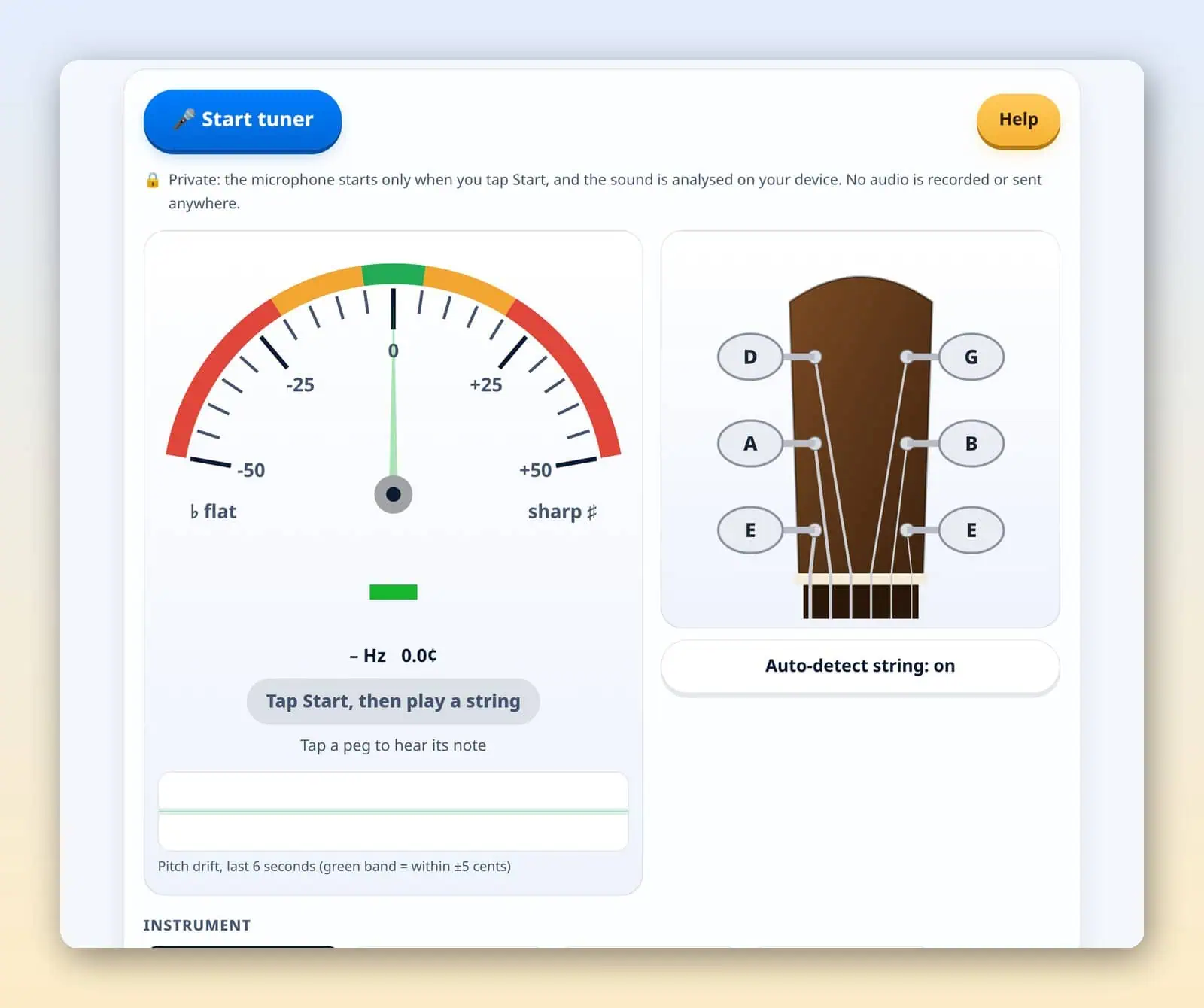
The guitar tuner has all of these tunings built in, and the tune half a step down guide explains when to use Eb tuning.
Free tool
Tune every string to the exact frequency
Pick a tuning, tap a peg to hear the target note, or tune with your mic. Works for guitar, bass and ukulele.
Open the guitar tuner →Bass guitar string frequencies
A 4-string bass is tuned one octave below the lowest four guitar strings.
| String | Note | Frequency (Hz) |
|---|---|---|
| Low B (5-string) | B0 | 30.87 |
| E | E1 | 41.20 |
| A | A1 | 55.00 |
| D | D2 | 73.42 |
| G | G2 | 98.00 |
The formula behind guitar string frequencies
In equal temperament, every half step multiplies the frequency by the twelfth root of 2, about 1.0595. So:
- One fret up = frequency × 1.0595
- 12 frets up (one octave) = frequency × 2
- Any note: f = 440 × 2^(n / 12), where n is the number of half steps above (positive) or below (negative) A4
Example: the low E is 29 half steps below A4, so 440 × 2^(-29 / 12) = 82.41 Hz. On a 24-fret guitar, the highest note on the high E string is E6, 1,318.51 Hz.
What sets a string’s frequency?
A vibrating string’s pitch depends on three things, described by Mersenne’s laws:
- Length: a shorter vibrating length gives a higher frequency. This is why fretting a note raises the pitch.
- Tension: more tension gives a higher frequency. Turning the tuning peg changes tension.
- Mass: heavier strings vibrate more slowly. That is why the low strings are thicker and wound.
These same factors decide how tight a set feels. The string tension calculator shows the tension for each string at any tuning and scale length, and the string gauge finder suggests a set for lower tunings.
Fundamental vs overtones
When you pluck a string, it vibrates at its fundamental frequency (the number in the chart) and at many overtones at the same time: 2×, 3×, 4× the fundamental and so on. The mix of overtones is what makes a guitar sound like a guitar and not a pure sine tone. It is also why a low E string produces useful sound far above 82 Hz, and why EQ for guitar often works in the 100 Hz to 5 kHz range. The EQ frequency chart covers that side.
How to tune using frequencies
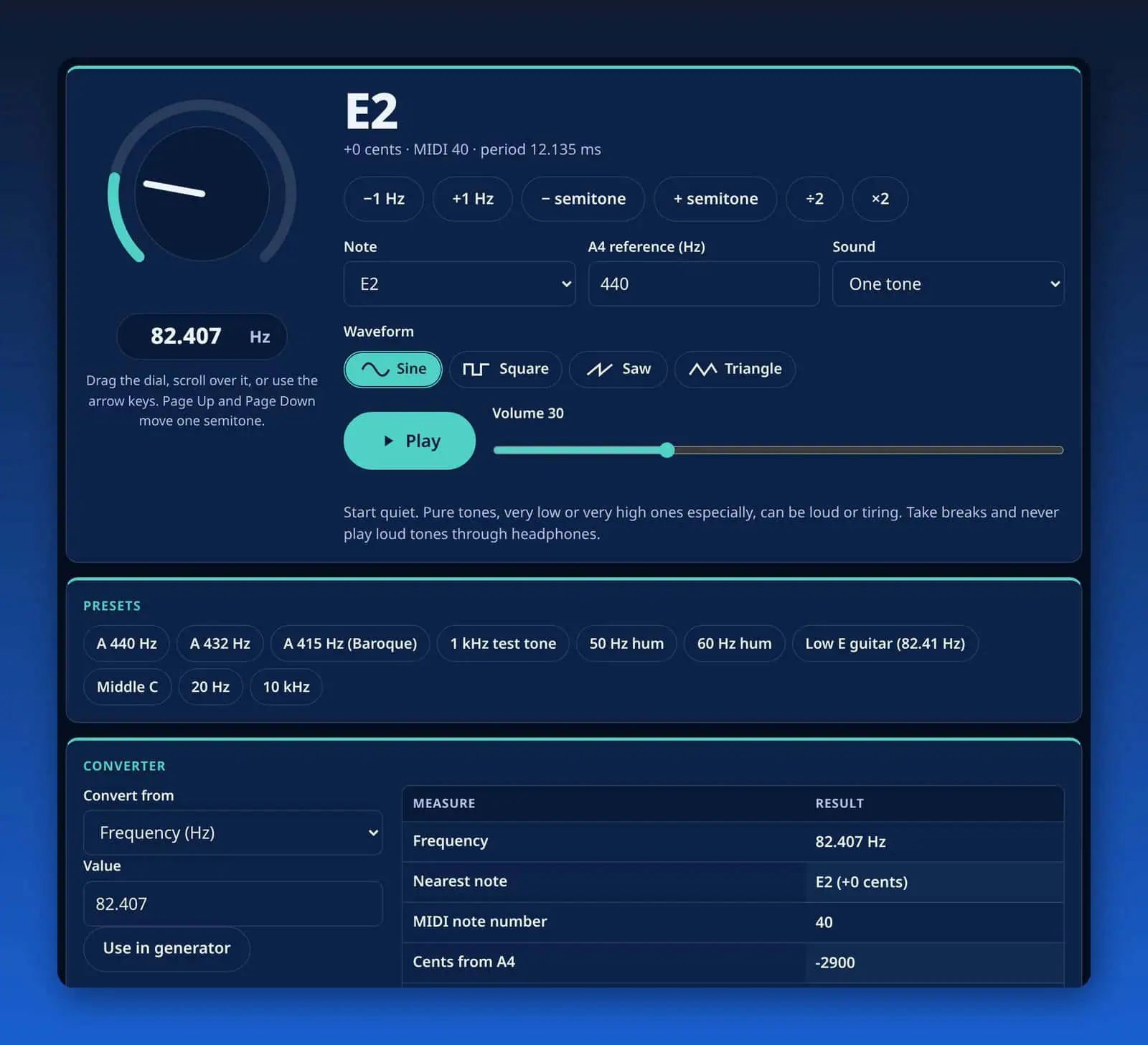
- Open the tone generator and play the frequency for the string, for example 82.41 Hz for the low E.
- Pluck the open string and listen for “beats”, a slow wobble in volume.
- Turn the peg until the beating slows down and disappears. Then the string matches the tone.
- Repeat for each string, or tune one string and use the 5th fret method from our tune a guitar by ear guide.
Low tones are hard to hear on small speakers, so for the low E you can play E3 (164.81 Hz) and match the 12th fret harmonic instead.
Free tool
Play any frequency
Type a frequency or pick a note, choose the waveform and use it as a tuning or test tone.
Open the tone generator →How this guide was checked
All frequencies were calculated with the equal temperament formula at A4 = 440 Hz, rounded to two decimals, and checked against the Sandy Music Lab tuner and tone generator. Written by David Sandy, a guitarist and songwriter; see the editorial policy for how guides are researched.
Guitar string frequency FAQs
What frequency is the low E string on a guitar?
82.41 Hz in standard tuning at A4 = 440 Hz. It is the note E2.
What frequency is the high E string?
329.63 Hz (E4), exactly four times the low E.
What frequency is the A string on a guitar?
110 Hz, the note A2, two octaves below A440.
What is the lowest frequency on a guitar?
In standard tuning, the open low E at 82.41 Hz. Drop D lowers it to 73.42 Hz, and drop C to 65.41 Hz.
What is the highest note on a guitar?
On a 24-fret guitar, E6 at the 24th fret of the high E string, about 1,318.51 Hz. A 22-fret guitar reaches D6, about 1,174.66 Hz.
How much does one fret change the frequency?
Each fret multiplies the frequency by about 1.0595 (the twelfth root of 2), and 12 frets double it.