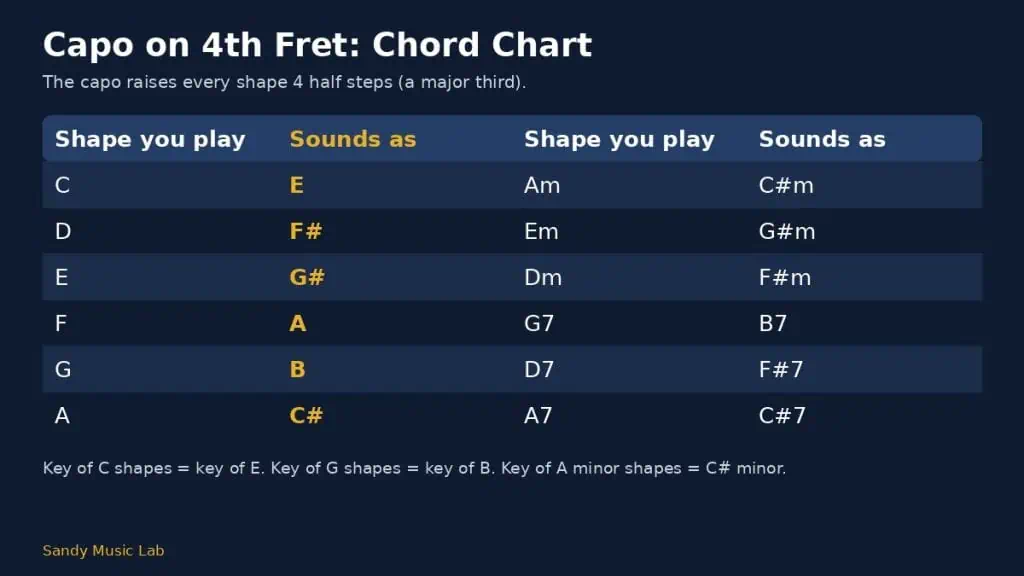
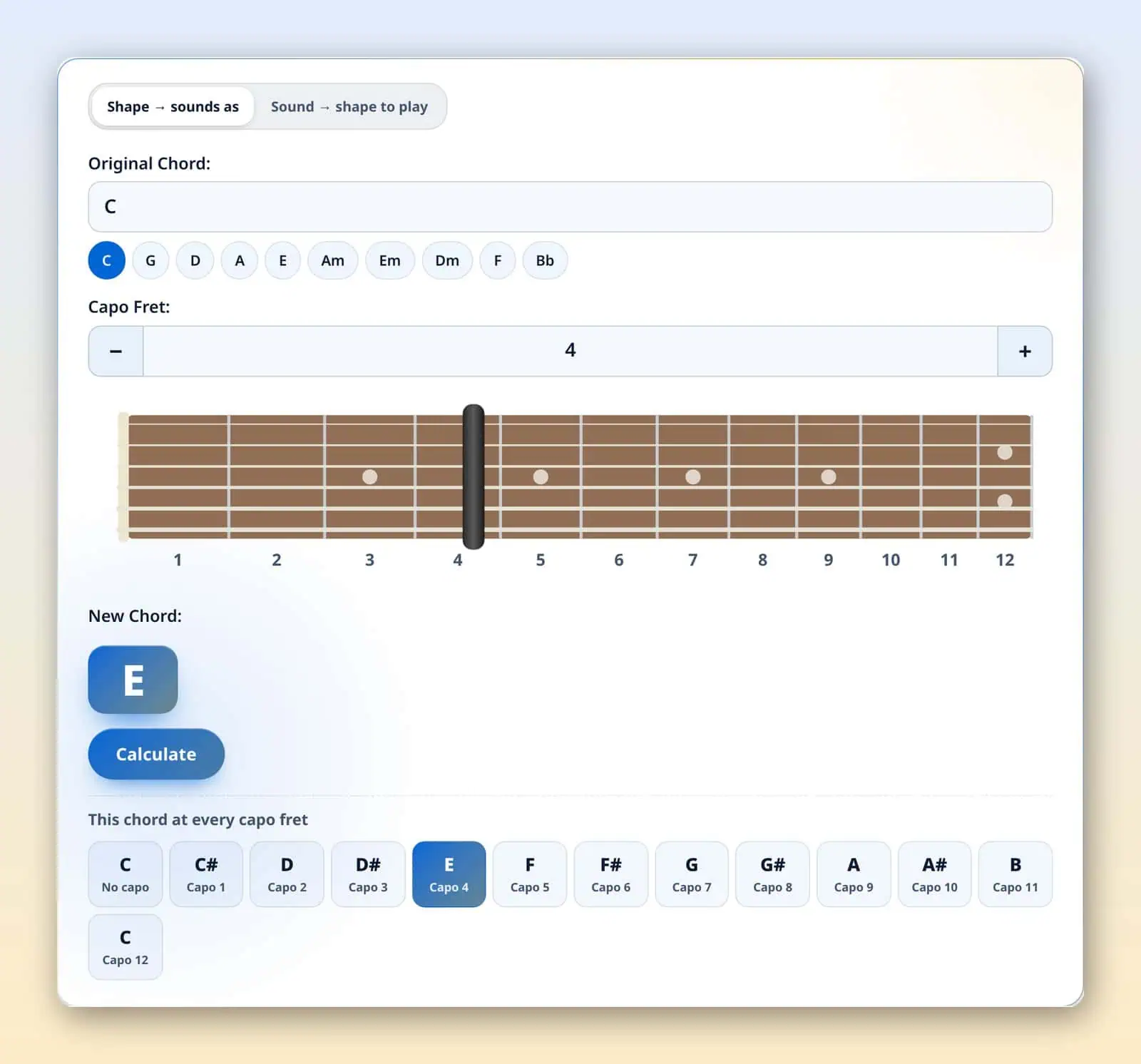
A capo on 4th fret raises every chord shape by four half steps. A C shape sounds as E, a G shape sounds as B, a D shape sounds as F# and an Am shape sounds as C#m. Capo 4 is the go-to for sharp keys like E, B and C#m, and for a brighter, chiming sound from simple open shapes. Here is the full capo on 4th fret chord chart, the keys you play in, a reverse chart and how capo 4 compares with capo 2 for the same key.
Quick answer: with a capo on the 4th fret, every chord sounds four half steps higher than its shape. C becomes E, D becomes F#, E becomes G#, G becomes B, A becomes C#, Am becomes C#m and Em becomes G#m. Key-of-C shapes put you in E, key-of-G shapes put you in B and A minor shapes put you in C# minor.
Capo on 4th fret chord chart
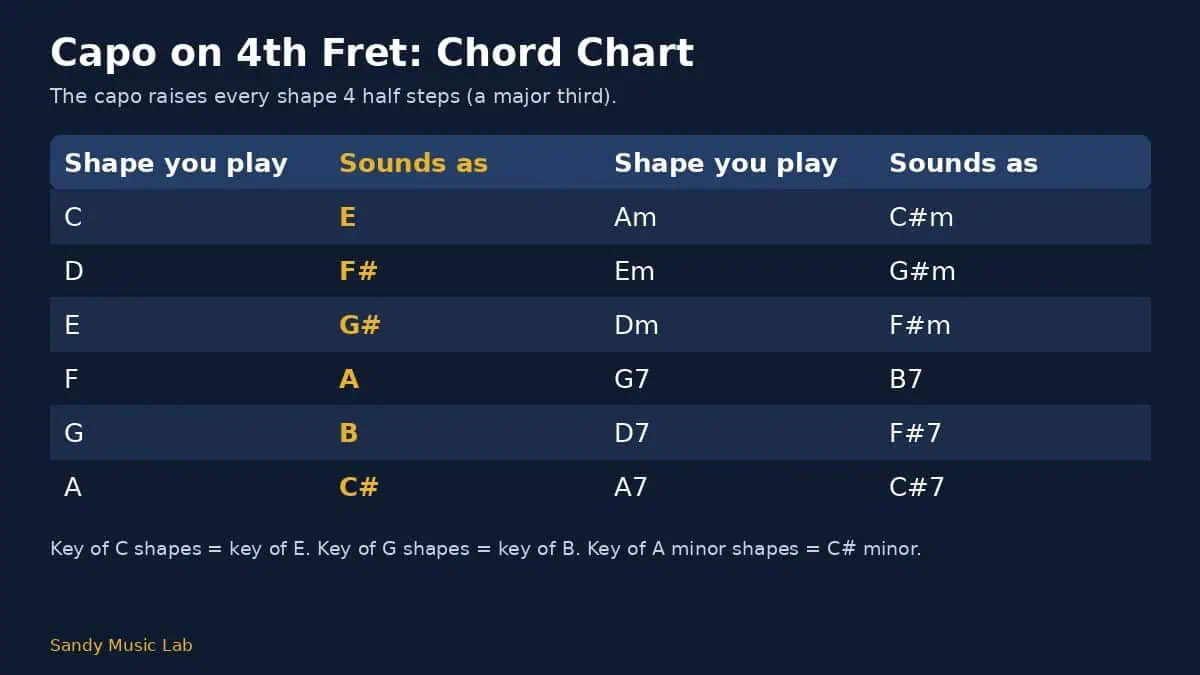
Each fret adds one semitone, so the 4th fret adds four semitones, a major third. Keep the same fingering and the chord name moves up. Use this table whenever a chord sheet says “capo 4”.
| Chord shape you play | Chord it sounds as | Chord shape you play | Chord it sounds as |
|---|---|---|---|
| C | E | Am | C#m |
| D | F# | Em | G#m |
| E | G# (Ab) | Dm | F#m |
| F | A | A7 | C#7 |
| G | B | E7 | G#7 |
| A | C# (Db) | D7 | F#7 |
| Cadd9 | Eadd9 | Fmaj7 | Amaj7 |
Sharp chords such as C#m, F# and G#m are barre chords in open position, and B is one of the least loved chords for beginners. At capo 4 they become Am, D, Em and G shapes. Check anything else in the capo calculator.
What key are you in with a capo on the 4th fret?
Move the key of your shapes up four half steps:
| Shapes you play (key) | Typical chords | Key you sound in |
|---|---|---|
| C major | C, F, G, Am | E major |
| G major | G, C, D, Em | B major |
| D major | D, G, A, Bm | F# major |
| A major | A, D, E, F#m | C# major |
| A minor | Am, F, C, G | C# minor |
| E minor | Em, C, G, D | G# minor |
The C-shapes-in-E row is the most common use. E is a comfortable key for many voices and a favorite key for bass players, and C shapes at capo 4 give a sweeter, higher voicing than playing E, A and B in open position. The circle of fifths shows why these keys are full of sharps.
Free tool
See any shape at capo 4
Choose a chord shape, set the capo to 4 and read the chord it sounds as, plus every other fret.
Open the capo calculator →Reverse chart: the shapes to play for the key you need
To find the shapes for a key, go four half steps down from it:
| Key you need | Shapes to play at capo 4 | Without a capo |
|---|---|---|
| E | C shapes | E, A, B barre, C#m barre |
| B | G shapes | B, E, F#, G#m: all barres |
| F# | D shapes | F#, B, C#, D#m: all barres |
| C#m | Am shapes | C#m, F#m, G#m, A, E: mostly barres |
| G#m | Em shapes | G#m, E, B, F#: all barres |
Capo 4 vs capo 2 for the key of E
Both capo 4 with C shapes and capo 2 with D shapes put you in E. Which should you pick?
| Capo 4, C shapes | Capo 2, D shapes | |
|---|---|---|
| Sound | Brighter, sweeter, more “jangle” | Fuller, a little deeper |
| Chords | C, F, G, Am | D, G, A, Bm |
| Tricky chord | F (use Fmaj7 or a partial F) | Bm (use a partial Bm) |
| Good for | Fingerpicking, a second guitar part | Strumming, a main rhythm part |
With two guitars, try one at capo 2 and one at capo 4: same key, different voicings, and a much wider sound. The chord transposer shows every capo option for any key.
Songs that use a capo on the 4th fret
Jolene by Dolly Parton is the classic example. It is taught with Am, C, G and Em shapes at capo 4, which puts the song in C# minor, matching the recording. Many fingerpicked folk and pop songs in E or B are played the same way.
If a capo 4 version doesn’t line up with the recording, tune with the guitar tuner first, then try capo 3 or 5 in case the recording is in a slightly different key. If you need to find a key that suits your voice, the vocal range test helps you work out where you sing most comfortably.
Tips for clean chords at capo 4
- Tune open, then check with the capo. A few cents sharp at capo 4 is common.
- Sit the capo right behind the fret wire. Frets get closer together higher up, so placement matters more.
- Use a light touch. Strings are shorter at the 4th fret, so less pressure is needed.
- Mind your fingers. Shapes are more compact at capo 4; arch your fingers so open strings still ring.
- Go easy on F. Replace a full F barre with Fmaj7 or a three-string F at capo 4; it sounds great up there.
For the theory behind it, read how chords change with a capo. For care tips, see can a capo damage your guitar.

Free tool
Find the easiest capo for any key
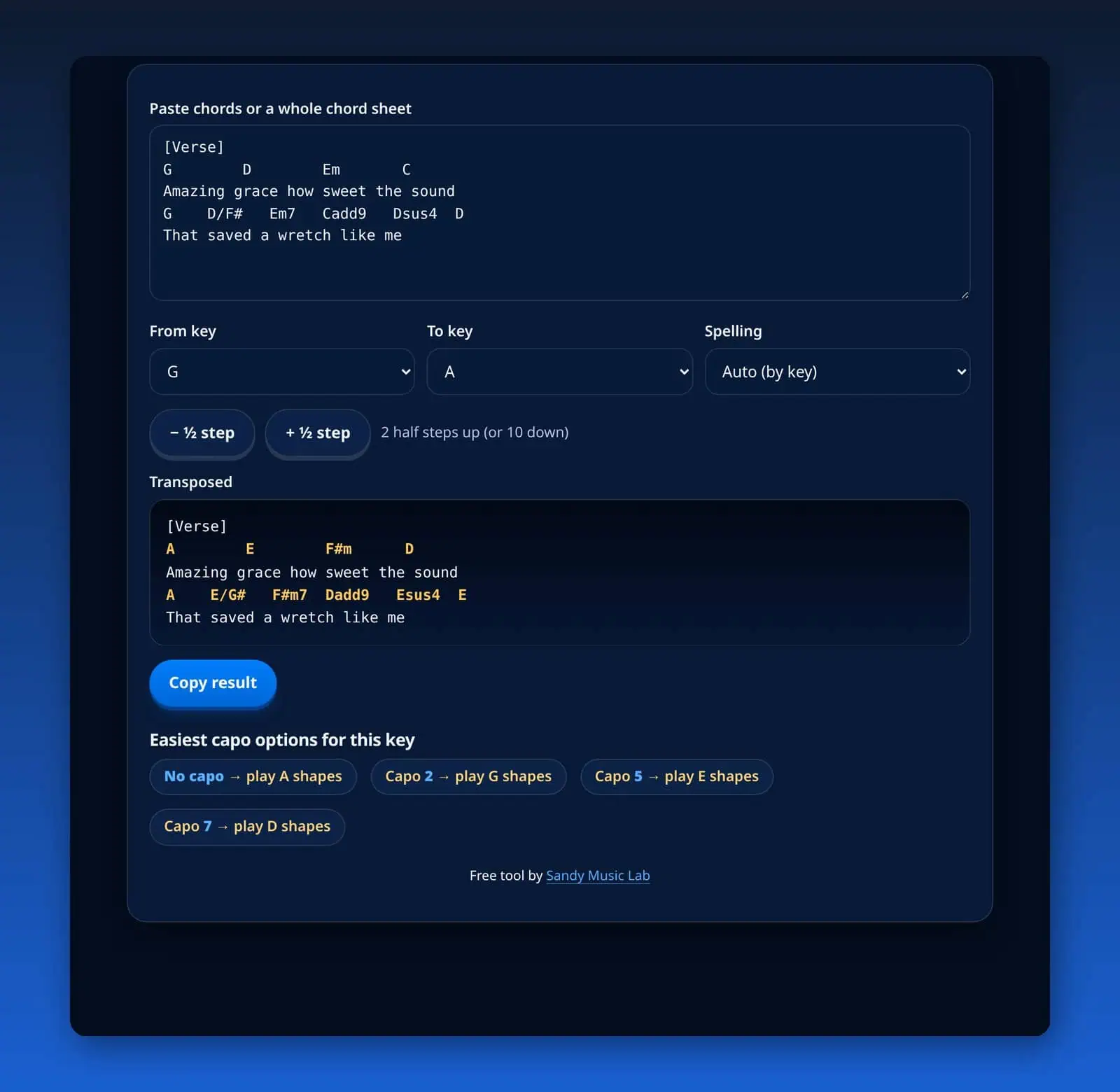
Paste chords, pick the key you need and the transposer suggests the capo fret and shapes.
Open the chord transposer →How this guide was checked
All tables follow the one-fret-equals-one-semitone rule and were cross-checked against the Sandy Music Lab capo calculator and chord transposer. Song shapes match widely used lessons. Written by David Sandy, a guitarist and songwriter; the editorial policy explains how guides are researched. Spotted a mistake? Let us know.
Capo on 4th fret FAQs
What does capo 4 mean?
Place a capo just behind the 4th fret and play the chord shapes written in the song. Every shape sounds four half steps higher.
What chord is C with a capo on the 4th fret?
A C shape at capo 4 sounds as E major.
What key is capo 4 with G shapes?
Key-of-G shapes at capo 4 put you in B major.
What is Am with a capo on 4?
An Am shape at capo 4 sounds as C# minor (C#m).
Is capo 2 or capo 4 better for a song in E?
Both work. Capo 2 with D shapes sounds fuller; capo 4 with C shapes sounds brighter. Two guitarists can use one each for a wider sound.
Does a capo on the 4th fret put guitars out of tune?
It can if it is too tight or not right behind the fret wire. Loosen it slightly and check with a tuner.