A worship guitarist needs four things to play well in a church band: a small set of reliable chord shapes, a capo and the Nashville Number System for changing keys, a tone that leaves room for vocals, and the discipline to serve the song rather than show off. Everything else in worship guitar builds on those four skills.
This worship guitar guide is the hub for every worship guitar lesson on Sandy Music Lab. Whether you are a beginner joining your first Sunday team or an electric player trying to get that wide ambient pad, start here, then follow the links to the deeper guides on worship guitar chords, the Nashville Number System for guitar, and worship pedalboard setup.
🎸 Free download
Not sure which guitar is right for you?
Get the free Guitar Gear Cheat Sheet: match your style, budget and hands to the right guitar in 2 minutes. You’ll also get my 30-Day Practice Plan as a bonus.
Send My Cheat Sheet →Worship guitar is not a separate genre of guitar playing. It uses the same open chords, the same strumming, and the same pedals you hear in pop and rock. What makes it different is the job. In a church band, your guitar supports a room full of people who are singing, many of whom are not musicians. That changes how you choose keys, how loud you play, how busy your parts are, and how you move between songs.
What Does a Worship Guitarist Need to Know?
If you only have a few weeks before your first rehearsal, focus on these skills in this order. Each one has its own detailed guide linked below.
- Chord shapes in the main worship keys. Most modern worship songs can be played with a handful of open shapes in G and D, moved into other keys with a capo.
- Numbers instead of letters. Bands talk in numbers (1, 4, 5, 6m) so the whole team can change key on the spot. Learn the basics before your first rehearsal.
- Steady rhythm. A simple, steady strum played in time with the drummer or click matters more than anything fancy.
- Dynamics. Worship sets rise and fall. Learn to play softly in verses, open up in choruses, and drop out completely when the leader is speaking or the room is singing on its own.
- Listening. Watch the worship leader, follow the cues, and leave space for the keys, bass, and vocals.
Notice that gear is not at the top of the list. A good tone helps, but a guitarist who plays the right chords in time and at the right volume will always fit a worship band better than one with a big pedalboard and shaky rhythm.
Worship Guitar Lessons: Where Should Beginners Start?
The best worship guitar lessons start with songs, not theory. Pick three or four songs your church already sings, learn their chords, and practice playing them all the way through without stopping. Our list of 25 easy Christian worship songs to play on guitar is a good place to find songs that use only beginner chords.
Step 1: Learn the core chord family in G
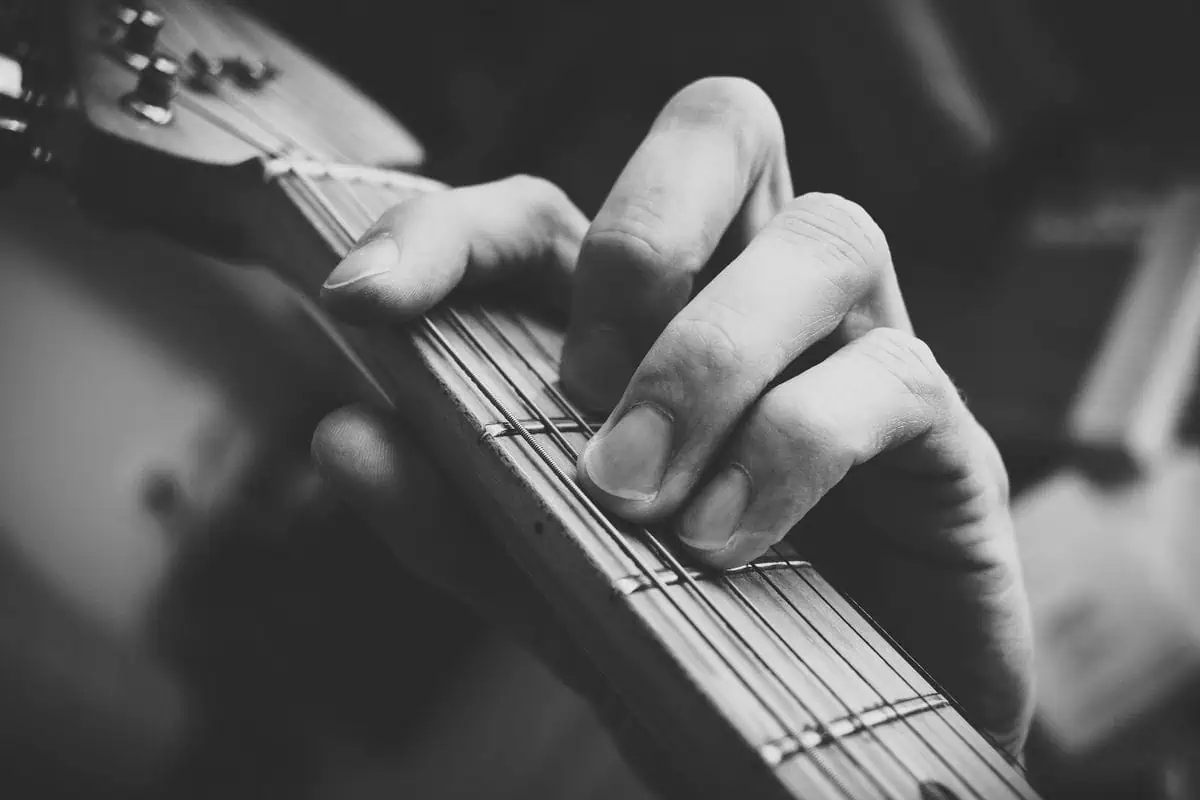
The chords G, Cadd9, D, and Em (often played as Em7) appear in a huge number of worship songs. Many worship players hold the ring and pinky fingers on the third fret of the B and high E strings across all four shapes, which keeps a ringing note common to each chord and makes changes faster. We break down all ten of the most common shapes in our guide to worship guitar chords. If you are brand new, our beginner guitar chords lesson covers the basic open shapes first.
Step 2: Use a capo to reach other keys
Worship leaders choose keys for the singers, not for the guitar. A capo lets you keep your easy G or D shapes while the band plays in A, B, or E. If you are new to the idea, read why guitarists use capos. For choosing the key itself, see our guide to the best key for congregational singing.
Step 3: Learn to read number charts
Many church teams write charts using the Nashville Number System, where the key’s home chord is 1, the next is 2, and so on. A chart reading 1–5–6m–4 works in any key. Our Nashville Number System guitar chart and cheat sheet explains it step by step and includes minor keys.
Step 4: Build simple strumming patterns
Start with steady eighth notes (down-up-down-up) and add accents later. Slow ballads often need only one strum per beat or a single strum per chord. We cover patterns for slow, mid-tempo, and fast songs in worship strumming patterns for acoustic guitar.
Step 5: Practise with recordings and a click
Play along with the version of the song your church uses,