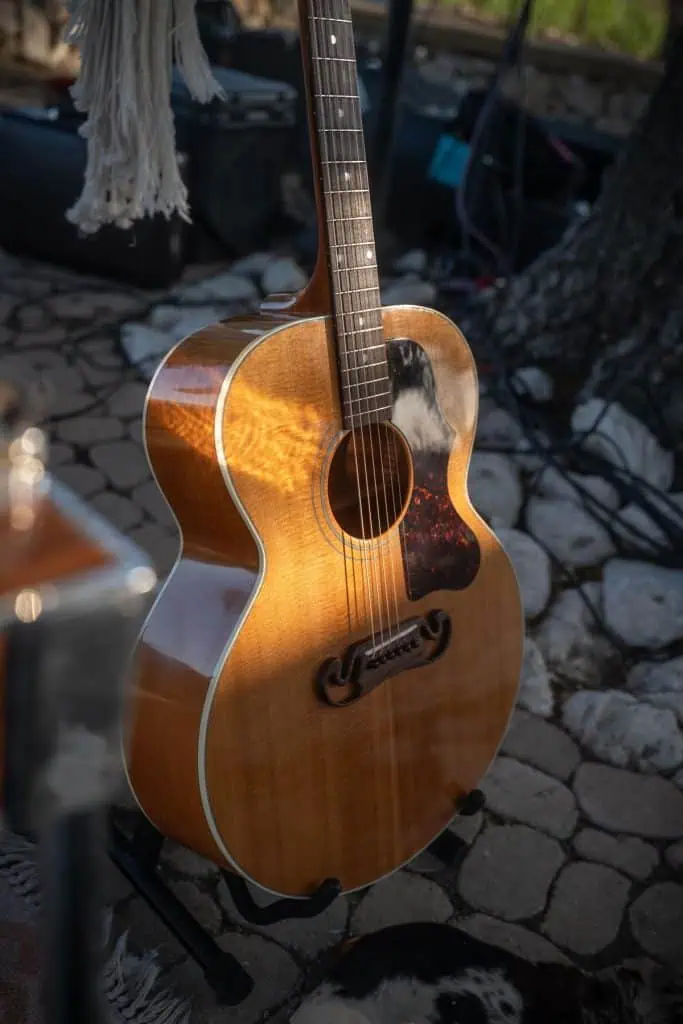
Most worship songs can be played with about ten chord shapes: G, Cadd9, D, Em7, Dsus4, A, Asus4, Bm7, E and C. Worship guitar chords lean on open “anchor” shapes that keep one or two fingers fixed on the third fret, so changes are fast and the chords share a ringing top note.
This lesson is part of our complete worship guitar guide, which covers tone, roles and leading from guitar. Here we focus only on worship guitar chords and the shapes behind them. If you want songs to practise them on, use our list of easy Christian worship songs on guitar, and when you need to read band charts, pair this with the Nashville Number System for guitar.
🎸 Free download
Not sure which guitar is right for you?
Get the free Guitar Gear Cheat Sheet: match your style, budget and hands to the right guitar in 2 minutes. You’ll also get my 30-Day Practice Plan as a bonus.
Send My Cheat Sheet →Why only ten worship guitar chords? Worship songs are written for congregations, so their chord progressions are usually simple and repetitive. Most songs use four chords from one key, and worship guitarists use a capo to move those same shapes into whatever key the singer needs. Learn these ten worship guitar chords well and you will be able to play the large majority of songs on a typical Sunday set list.
What Are the Most Common Worship Guitar Chords?
The table below lists the ten shapes, the fret numbers from the low E string to the high E string (x = don’t play, 0 = open), and where you’ll use each one. Fret numbers are given low to high.
| # | Chord | Frets (E A D G B e) | Number in key of G | Number in key of D | Why worship players use it |
|---|---|---|---|---|---|
| 1 | G | 3 2 0 0 3 3 | 1 | 4 | Full, bright home chord; ring and pinky anchor on the 3rd fret |
| 2 | Cadd9 | x 3 2 0 3 3 | 4 | — | Replaces C; same anchors as G, so the change is just two fingers |
| 3 | D | x x 0 2 3 2 | 5 | 1 | Home chord in D; the 3rd-fret B string note links to G and Cadd9 |
| 4 | Em7 | 0 2 2 0 3 3 | 6m | 2m | Minor chord with the same anchors; softer and more open than Em |
| 5 | Dsus4 | x x 0 2 3 3 | 5sus | 1sus | Adds movement on D and resolves back; very common in intros |
| 6 | A | x 0 2 2 2 0 | — | 5 | The 5 chord in D; often played as Asus4 or A with an open high E |
| 7 | Asus4 | x 0 2 2 3 0 | — | 5sus | Creates the suspended sound you hear in many worship choruses |
| 8 | Bm7 | x 2 0 2 3 2 | 3m | 6m | A barre-free Bm; keeps the 3rd-fret anchor on the B string |
| 9 | E (or Em) | 0 2 2 1 0 0 | 6 (major) | 2 | Needed for songs that move to a major 6 or for the key of E without a capo |
| 10 | C | x 3 2 0 1 0 | 4 | b7 | Standard C for hymns and songs that sound better without the add9 |
If any of these shapes are new, start with our beginner guitar chords lesson, which covers finger placement for the basic open chords step by step.
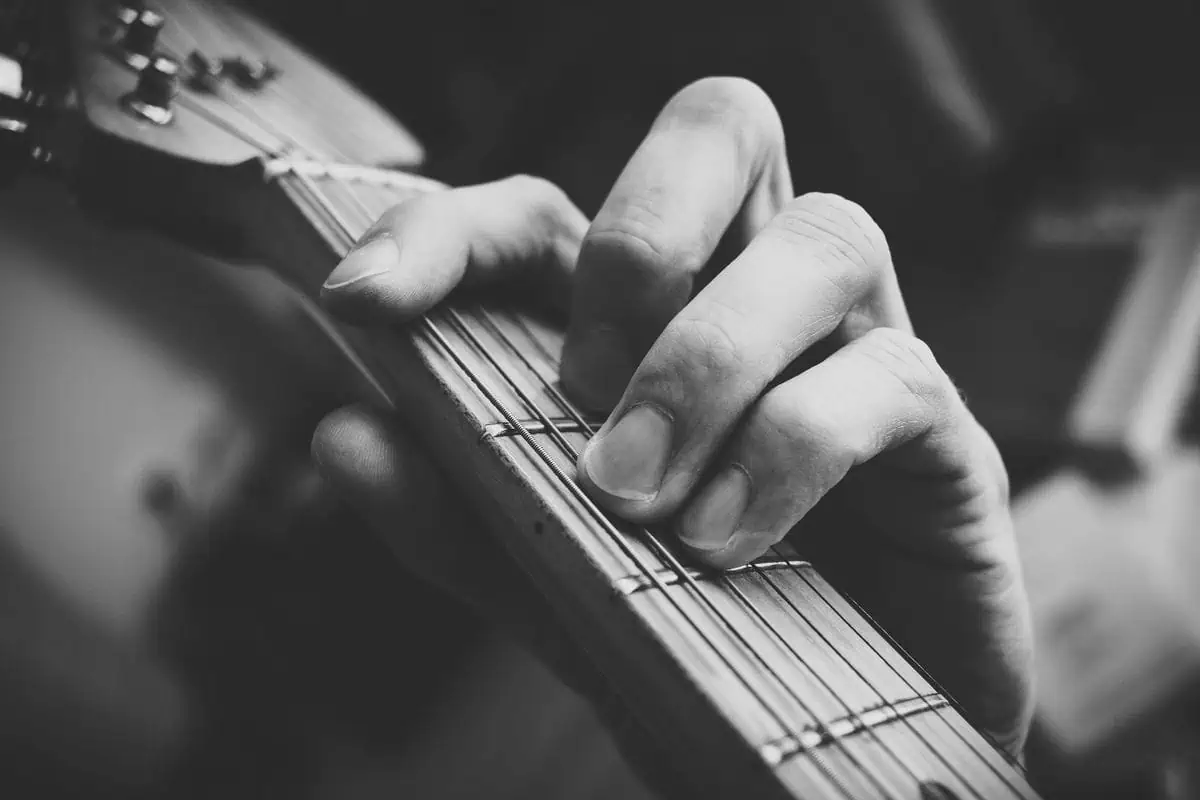
Cadd9, G, D, Em: The Classic Worship Progression
If one group of worship guitar chords defines the sound of acoustic worship guitar, it is G, Cadd9, D and Em7 in the key of G. In number terms that is the 1, 4, 5 and 6m chords. Countless songs use some order of these four, such as 1–5–6m–4 (G–D–Em7–Cadd9) or 4–1–5–6m (Cadd9–G–D–Em7).
Why the anchor fingers matter
Play G with your ring finger on the 3rd fret of the B string and your pinky on the 3rd fret of the high E. Now keep those two fingers in place. Move your other two fingers down a string each and you have Cadd9. Swap them to the 2nd fret of the A and D strings and you have Em7. Lift the bass notes, place your index on the 2nd fret of the G string, and you have a D-family shape (Dsus4 with the pinky still down, or D if you move it to the 2nd fret).
Because the top two strings barely move, the chords blend into each other. That shared high D and G ringing through every chord is a big part of why these shapes sound “worshipful” and modern compared with the textbook open chords.
How to practise the progression
- Set a metronome to a slow tempo, around 60 beats per minute.
- Strum each chord four times: G, Cadd9, Em7, D. Keep the anchors down the whole time.
- When the changes are clean, strum each chord twice, then once.
- Practise the most common orders: 1–5–6m–4 (G–D–Em7–Cadd9) and 1–4–6m–5 (G–Cadd9–Em7–D).
- Add a capo on the 2nd fret: the same shapes now give you the key of A, a very common worship key.