
To lead a band while playing guitar, keep your guitar part simple, give clear cues at least a bar before each change, and agree on a small set of hand signals with your team. These tips for leading worship from guitar cover the signals, verbal cues and song transitions that keep a set flowing.
This guide is part of our worship guitar guide. It builds on our existing guide on how to lead worship on guitar and focuses on band communication. If your team uses number charts, the Nashville Number System for guitar makes cues like “go to the 4” easy, and the shapes in worship guitar chords keep your playing simple while you lead.
🎸 Free download
Not sure which guitar is right for you?
Get the free Guitar Gear Cheat Sheet: match your style, budget and hands to the right guitar in 2 minutes. You’ll also get my 30-Day Practice Plan as a bonus.
Send My Cheat Sheet →Leading from guitar means doing three jobs at once: singing, playing and directing. The band is watching you for when to repeat a chorus, when to drop down, and when the song is ending. The congregation is following your voice. The most effective worship leaders make all of that look effortless, and it starts with simple, consistent communication that the team has practised together.

Leading Worship from Guitar: The Foundations
- Play less so you can lead more. Use chord shapes and strumming patterns you could play in your sleep. Your attention needs to be on the room and the band.
- Position yourself so the band can see you. Angle slightly toward the drummer and keys player, or make sure they have a clear line of sight.
- Cue early. Give signals one to two bars before the change, not on the downbeat.
- Be consistent. Use the same signals every week so they become automatic.
- Plan the set. Decide song order, keys and transitions in advance, and share them before rehearsal.
- Rehearse the transitions. Many bands rehearse songs but not the spaces between them, which is where things go wrong.
Worship Hand Signals Every Band Should Know
There’s no single official system, so agree on yours as a team. These are widely used in worship bands and are easy to give while holding a guitar, often with your fretting hand briefly lifted or a nod toward the neck.
| Signal | Meaning | How to give it |
|---|---|---|
| Index finger up (1) | Verse 1 (or the 1 chord, if using numbers) | Hold up one finger |
| Two fingers (2) | Verse 2 | Hold up two fingers |
| “C” shape with hand | Chorus | Curve your hand into a C |
| Pat the top of your head | Go back to the top / intro | Tap your head |
| Flat hand, palm down, lowering | Bring it down; play softer | Lower your palm slowly |
| Palm up, raising | Build; play louder | Raise your palm |
| Circular finger motion | Repeat this section | Draw a small circle in the air |
| Closed fist | Stop / final hit together | Raise a fist, then drop it on the cut-off |
| Pointing to an instrument | That instrument takes the lead or plays alone | Point at the player |
| Pinky up | Tag (repeat the last line) | Raise your little finger |
If you’ve seen big concert gestures, our post on hand signals used at rock concerts is a fun contrast. Worship signals are designed to be small and unobtrusive so the congregation isn’t distracted.
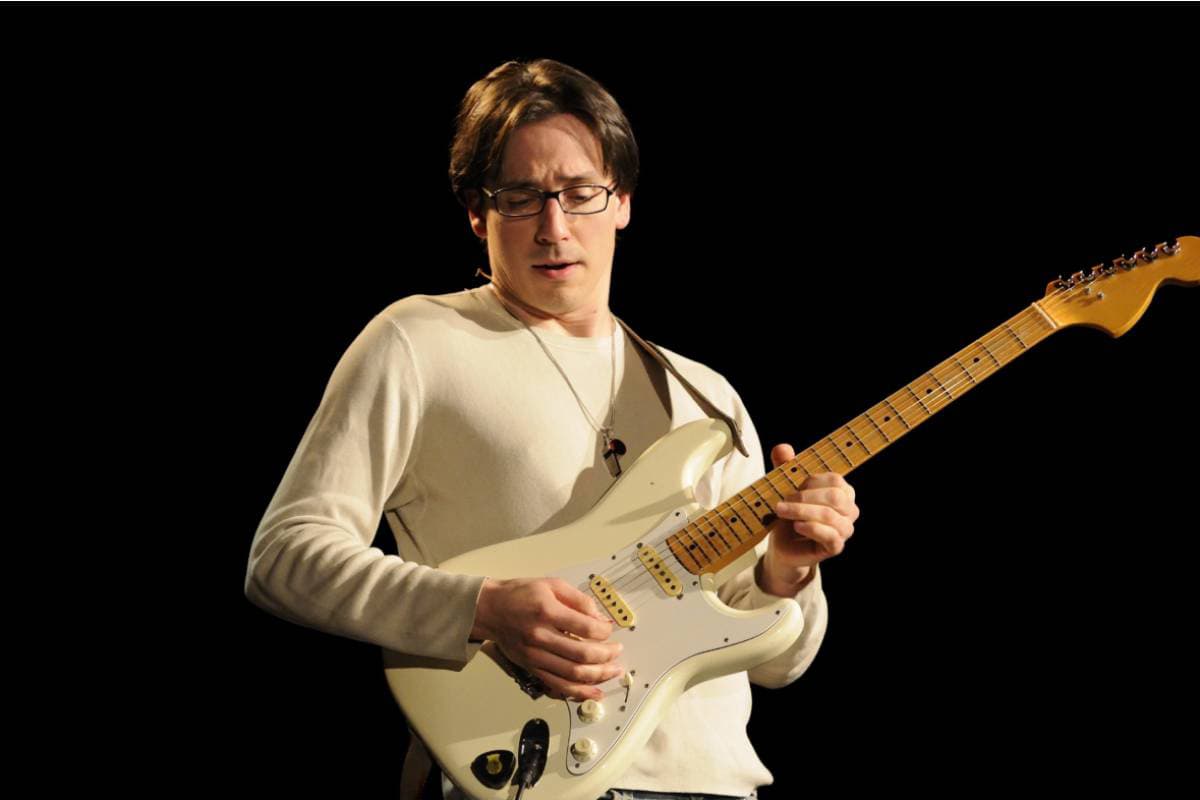
Verbal Cues: When Hand Signals Aren’t Enough
If your band uses in-ear monitors, a talkback microphone lets you speak cues only the band hears. Even without one, short spoken cues between lines can work. Keep them brief and use the same words each time:
- “Chorus” or “Again” for repeats
- “Bridge” for the bridge
- “Down” for a quiet section, “Build” for an increase
- “Last time” before the final repeat
- “Acapella” when the band should drop out and the congregation sings alone
- “Hold” to sustain the current chord
In-ear monitors make cues much clearer. See our guide to the best in-ear monitors for worship if your team is considering them.
Worship Transitions: How to Move Between Songs
Transitions are where a worship set either flows or stalls. Here are the most common transition types and how to lead them from guitar.
| Transition | How it works | Best when | Guitar tip |
|---|---|---|---|
| Same key | End one song and begin the next in the same key | Songs share a key | Hold the 1 chord and start the next song’s intro |
| Pad transition | Keys or ambient guitar hold a pad while you speak or pray | Changing key or mood | Let a pad ring, then strum the new key’s 1 chord |
| Common chord | Use a chord shared by both keys as a pivot | Keys a 4th or 5th apart (e.g. D to G) | End on the shared chord, then establish the new key |
| Direct key change | Stop, then count in the next song | Very different songs | Give a clear count-in; tell the band the new key on the set list |
| Medley | Move straight from one song’s chorus into another | Songs with related themes | Rehearse the exact bar where you switch |
A step-by-step pad transition
- End the song on its 1 chord and let it ring.
- Keys or electric guitar hold a pad in the next song’s key.
- Speak a short prayer or scripture, or let the room be quiet.
- Start strumming softly on the new song’s 1 chord.
- Nod to the drummer to bring in the count or groove.
- Begin the first verse.
For more on choosing keys that work together, see our guide to the best key for congregational singing.
Writing Cues Into Your Charts
Don’t rely on memory for every cue. Mark your chord charts with the arrangement and the signals you plan to use, so you and the band are reading the same plan. Simple notations work well: “V1, C, V2, C, B x3 (build), C x2, Tag.” Add notes like “drop to keys only” or “a cappella first line” where they apply. If your team uses a chart app, these notes can be shared so everyone sees them on their own tablet, which also helps new team members follow along on their first Sunday.
Practical Tips for Leading From Guitar
- Use a capo for consistency. Keeping the same shapes across keys frees up mental space.
- Keep your guitar secure. A strap and good posture help, especially if you sit; see how to keep a guitar from slipping off your legs.
- Tune between songs quietly. Use a muting pedal tuner during pads or prayers.
- Have a plan B. If a cue is missed, keep going confidently and repeat the section. The congregation rarely notices.
- Care for your gear. Fresh strings stay in tune better; if you play nylon strings, see what to do when nylon guitar strings keep stretching.
- Practise spontaneity. Many leaders extend a chorus or add a spontaneous moment. Practising improvising over simple progressions helps; our tips for improvising over chords are a good start.
Leading Spontaneous Moments From Guitar
Many worship services include unplanned moments: repeating a chorus while the congregation is engaged, singing a line a cappella, or holding a quiet chord while someone prays. These moments depend on trust between you and the band.
- Choose a home progression. Agree on a simple loop for each key, such as 1 – 5 – 6m – 4, that the band can play under any spontaneous moment.
- Signal the change clearly. A raised hand followed by a circular motion can mean “loop here until I cue.”
- Bring it down first. Lower the dynamics before you start singing something new, so the band can listen.
- Return with a clear landmark. Cue the chorus or tag again so everyone knows where you are.
Working With Your Sound Engineer
Your sound engineer is part of the team, even if they sit at the back. A few minutes of communication makes their job much easier:
- Give them the set list with song order, keys and any unusual moments (a cappella sections, spoken prayers, video clips).
- Tell them when you plan to speak between songs so your vocal mic is up.
- Agree on a simple signal, such as pointing at your ear and then up or down, for monitor changes during the service.
- Thank them afterwards and ask what they heard from the room.
Small Acoustic Team vs Full Band
| Setting | What changes | Leader tip |
|---|---|---|
| Solo guitar and voice | You set every tempo and dynamic yourself | Use clear intros and endings; vary strumming to create sections |
| Guitar plus one or two players | Cues can be eye contact and nods | Agree on endings before you start |
| Full band | More players to coordinate; louder stage | Use hand signals or talkback; cue earlier |
| Band with click and tracks | Arrangement is fixed by the track | Follow the track’s cues; signals mainly for dynamics and repeats |
Building Trust With Your Team
Clear cues matter, but trust matters more. Bands follow leaders they know and respect. Show up prepared, communicate plans early, give credit to your musicians, and handle mistakes with grace. Over time, your team will start anticipating your cues, and Sunday mornings will feel less like managing a band and more like worshipping together. Take a few minutes after each service to talk through what went well and whi