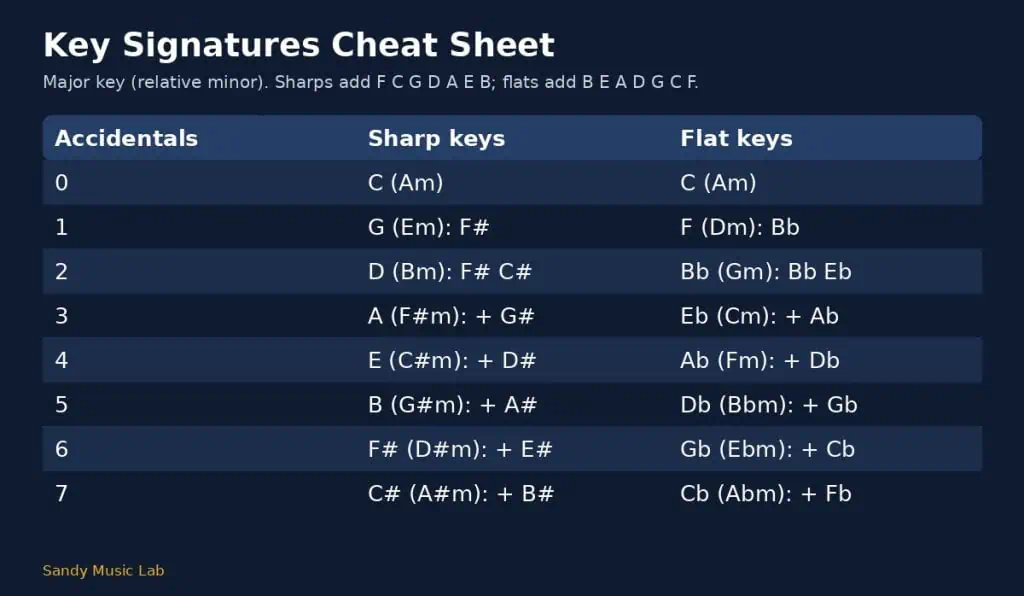
Key signatures look like a random cluster of sharps or flats at the start of a staff, but they follow a strict pattern. Once you know two short mnemonics and two rules, you can memorize key signatures for all 15 keys and name any key in a couple of seconds. This guide shows the order of sharps and flats, the tricks for naming major and minor keys, a one-page cheat sheet and a free quiz to practice with.
Quick answer: learn the order of sharps (F C G D A E B, “Father Charles Goes Down And Ends Battle”) and flats (the same letters backwards, B E A D G C F). For sharp keys, go up a half step from the last sharp. For flat keys, the second-to-last flat is the key name, and one flat is F major. The relative minor is three half steps below the major key.
What is a key signature?
A key signature is the set of sharps or flats written at the start of each staff. It tells you which notes are raised or lowered throughout the piece, and it points to the key. There are 15 major key signatures: C with no sharps or flats, seven sharp keys and seven flat keys, and each one is shared with a relative minor key.
Guitarists who read chord charts rarely see key signatures, but knowing them makes it far easier to work out which chords belong together, transpose songs and read lead sheets.
Step 1: learn the order of sharps
Sharps are always added in the same order:
F# C# G# D# A# E# B#
A common mnemonic: Father Charles Goes Down And Ends Battle. A key with two sharps always has F# and C#; a key with four sharps always has F#, C#, G# and D#.
Step 2: learn the order of flats
Flats are the same letters in reverse:
Bb Eb Ab Db Gb Cb Fb
The matching mnemonic: Battle Ends And Down Goes Charles’ Father. The first four flats also spell the word BEAD, which makes them easy to remember.
Step 3: name sharp keys with the half-step rule
Find the last sharp in the key signature and go up one half step. That note is the major key.
| Last sharp | Up a half step | Key |
|---|---|---|
| F# | G | G major (1 sharp) |
| C# | D | D major (2 sharps) |
| G# | A | A major (3 sharps) |
| D# | E | E major (4 sharps) |
| A# | B | B major (5 sharps) |
Step 4: name flat keys with the second-to-last flat
For flat keys, the second-to-last flat is the name of the key. Three flats (Bb Eb Ab)? The second-to-last is Eb, so the key is Eb major. The one exception to memorize: one flat (Bb) is F major.
| Flats | Second-to-last flat | Key |
|---|---|---|
| Bb | none | F major (memorize) |
| Bb Eb | Bb | Bb major |
| Bb Eb Ab | Eb | Eb major |
| Bb Eb Ab Db | Ab | Ab major |
| Bb Eb Ab Db Gb | Db | Db major |
Free tool
Quiz yourself on key signatures
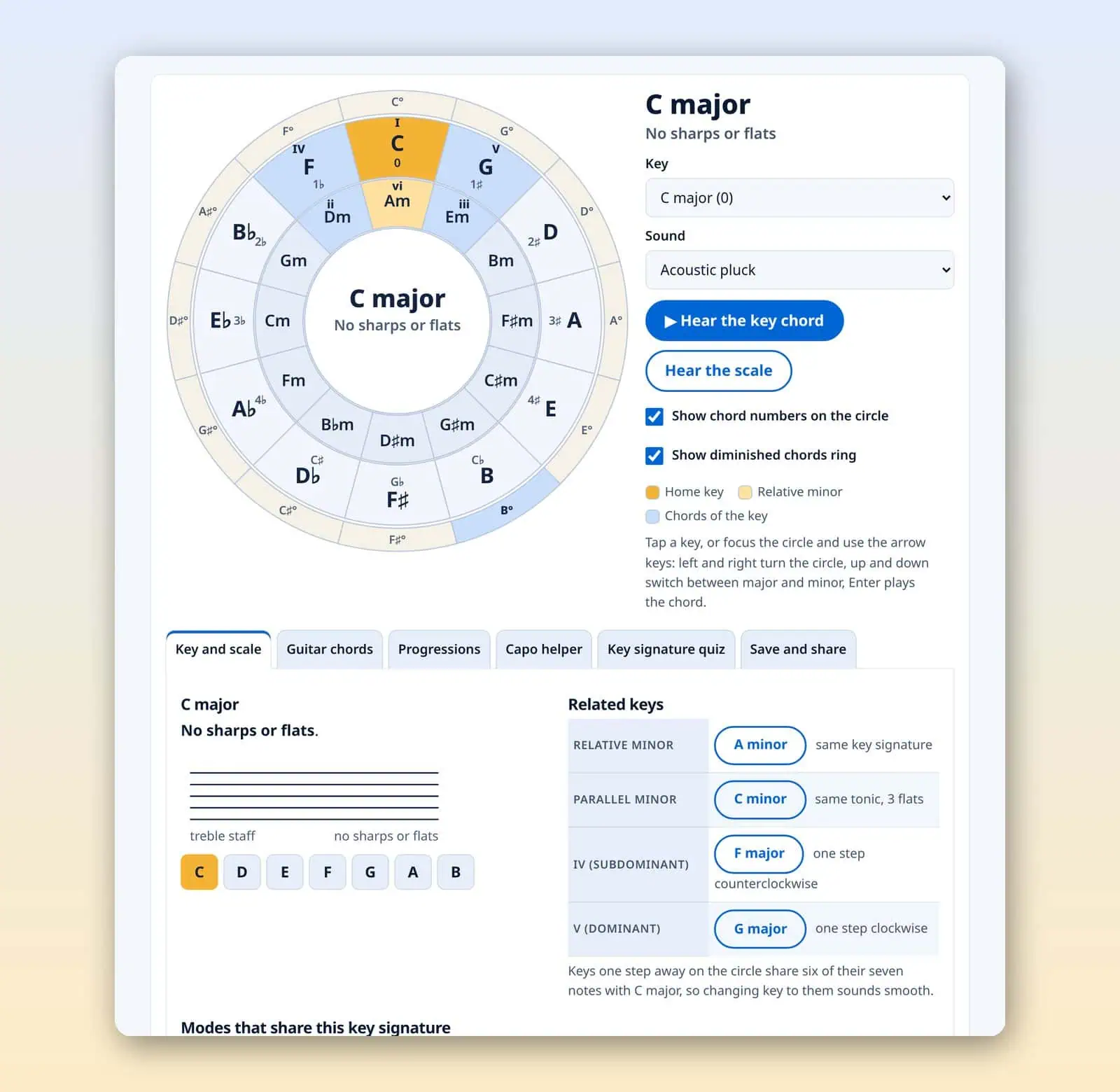
Ten quick questions at a time, plus an interactive circle of fifths with every key, scale and chord.
Open the circle of fifths →Step 5: find the relative minor
Every key signature is shared by a major key and its relative minor. To find the minor, count down three half steps (a minor third) from the major key, or take the 6th note of the major scale.
- C major and A minor: no sharps or flats
- G major and E minor: one sharp
- F major and D minor: one flat
- D major and B minor: two sharps
How do you know whether a piece is in the major or the minor key? Look at the first and last chords. A song in the key signature of G that starts and ends on Em is usually in E minor.
Use the circle of fifths to see the pattern
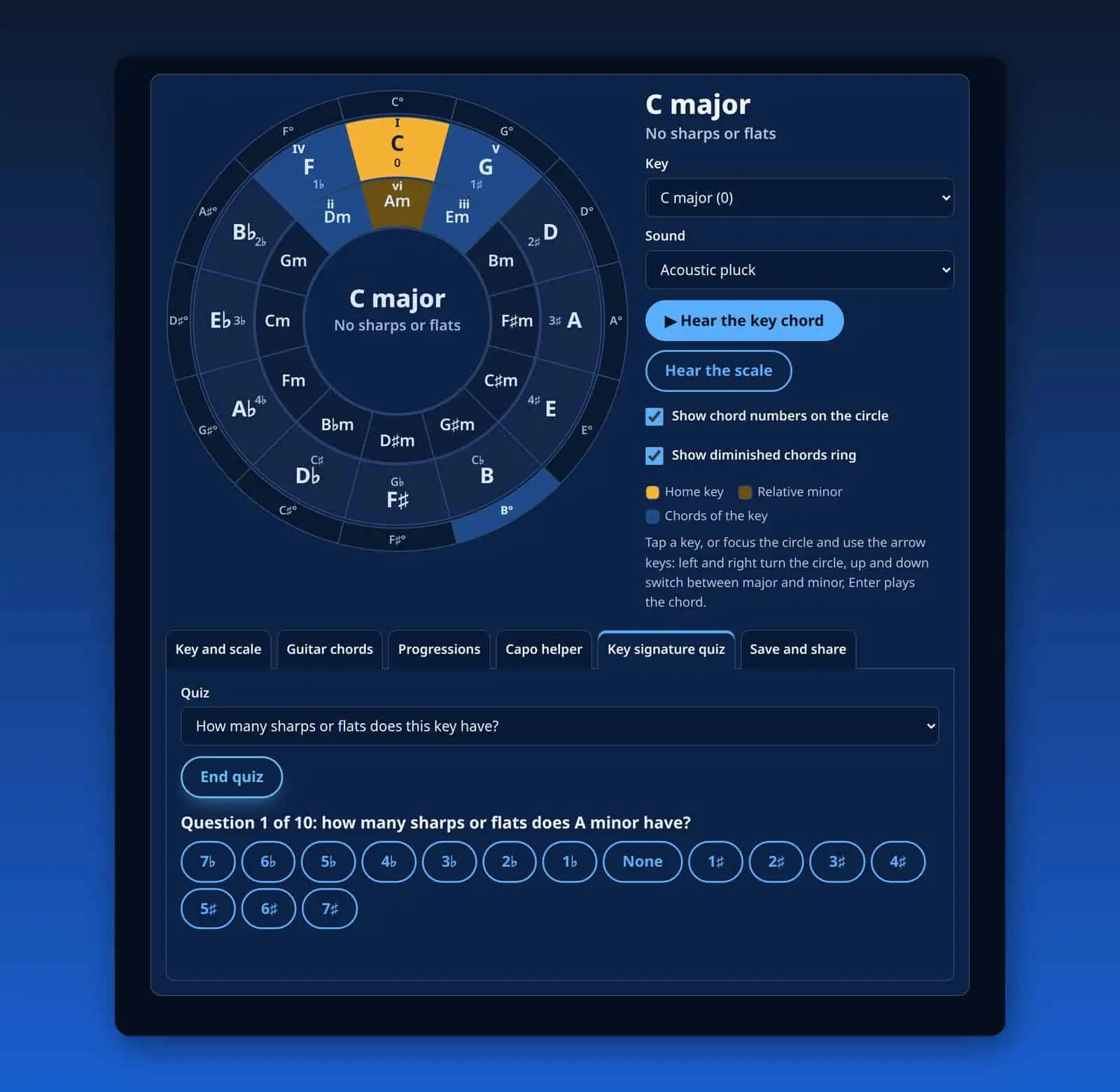
The circle of fifths puts all this on one picture. Going clockwise from C, each key is a fifth higher and adds one sharp. Going counterclockwise, each key is a fifth lower and adds one flat. The interactive circle of fifths shows every key signature, relative minor and set of chords, and our guide to the circle of fifths on guitar explains how to use it while playing.
A 7-day plan to memorize key signatures
| Day | Focus | Practice |
|---|---|---|
| 1 | Order of sharps | Say and write the mnemonic 10 times |
| 2 | Order of flats | Say and write it backwards and forwards |
| 3 | Sharp keys | Name the key from 1 to 7 sharps |
| 4 | Flat keys | Name the key from 1 to 7 flats |
| 5 | Relative minors | Pair every major key with its minor |
| 6 | Mixed quiz | 10-question quiz, twice |
| 7 | Speed round | Quiz until you get 10 out of 10 without hesitating |
Five minutes a day is enough. Spaced, short practice sticks far better than one long session.

Why guitarists should know key signatures
- Chords in a key: the key signature tells you which chords fit. The guitar keys guide lists the chords in every key.
- Transposing: if you know the key, moving a song is easy, especially with the chord transposer.
- Capo choices: sharp and flat keys are where a capo helps most.
- Reading charts: lead sheets and piano parts show the key signature, so you can follow along with keyboard players.
Free tool
Change a song to any key
Paste chords and move them to a new key, with the easiest capo position suggested.
Open the chord transposer →How this guide was checked
The key signatures and rules follow standard music theory and were checked against the Sandy Music Lab circle of fifths tool. Written by David Sandy, a guitarist and songwriter; see the editorial policy for how guides are researched.
Key signature FAQs
What is the easiest way to memorize key signatures?
Learn the order of sharps (F C G D A E B) and flats (B E A D G C F), then use two rules: go up a half step from the last sharp, and use the second-to-last flat as the key name.
What is the mnemonic for the order of sharps?
“Father Charles Goes Down And Ends Battle” gives F# C# G# D# A# E# B#.
What is the mnemonic for the order of flats?
“Battle Ends And Down Goes Charles’ Father” gives Bb Eb Ab Db Gb Cb Fb.
Which key has one flat?
F major, and its relative minor, D minor. It is the one flat key you have to memorize.
How many key signatures are there?
There are 15 major key signatures (0 to 7 sharps or flats), each shared with a relative minor key.
How do you tell a major key from its relative minor?
Look at the first and last chords and the overall feel. A song that starts and ends on the minor chord is usually in the minor key.