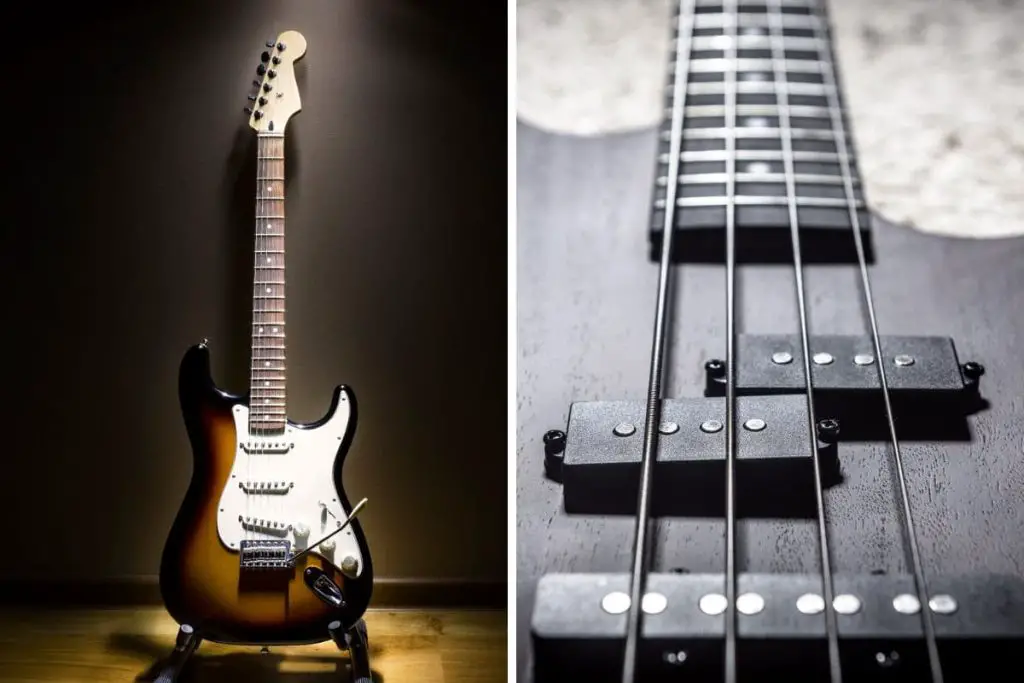
Is bass easier than guitar? It’s easier to start, because you usually play one note at a time and need no chord shapes, but it’s just as hard to master. A guitarist can play simple bass parts in a few days, since the bass’s E-A-D-G strings match the guitar’s lowest four. Groove, timing and muting take months.
So you play guitar and want to try bass, whether it’s for a band that needs a bassist, for home recording, or because you’ve fallen for a great groove. Good news: you’re starting far ahead of a true beginner, which tilts the answer to “is bass easier than guitar?” in your favour. Our bass guitar for beginners hub covers the basics, and this guide focuses on what a guitarist needs to unlearn and learn.
We’ll answer is bass easier than guitar honestly, compare the two instruments, and give you a four-week plan. You’ll get more out of it if your bass is set up properly first (see how to set up a bass guitar).
🎸 Free download
Not sure which guitar is right for you?
Get the free Guitar Gear Cheat Sheet: match your style, budget and hands to the right guitar in 2 minutes. You’ll also get my 30-Day Practice Plan as a bonus.
Send My Cheat Sheet →Table of Contents
Is Bass Easier Than Guitar? The Honest Answer
Is bass easier than guitar for the first month? Yes. Most beginner bass parts are single-note lines built on chord roots, so you skip the hardest early guitar hurdles: barre chords, chord changes and strumming patterns. That’s why many people can play along with a song on bass on their first day.
After that, it’s different rather than easier. Bass demands precise timing, consistent volume from every note, tight muting and the ability to lock in with a drummer. A guitarist who rushes slightly or lets notes ring gets away with it on guitar, but not on bass. The bass is what makes the band feel good or bad.
In short, the answer to “is bass easier than guitar?” depends on whether you mean the first month or the first decade.
| Skill | Guitar | Bass |
|---|---|---|
| Getting started | Harder (chords, strumming) | Easier (single notes) |
| Physical demand | Thin strings, fretting chords | Thicker strings, bigger stretches |
| Timing precision | Important | Critical; you and the drummer are the pulse |
| Harmony knowledge | Chords and voicings | Roots, chord tones and how chords connect |
| Soloing | Central to many styles | Less common; fills and grooves matter more |
| Mastery | Years | Years |
Guitarist Learning Bass: What Transfers
A guitarist learning bass already has several big advantages, and they’re a big reason the answer to “is bass easier than guitar?” is often yes for guitarists:
- The fretboard. The four bass strings are tuned E–A–D–G, the same as the guitar’s lowest four strings, but one octave lower. Every note name and shape you know on those strings works on bass. Our bass guitar notes chart will look very familiar.
- Scales and theory. Pentatonic and major scale shapes are identical. See bass scales for beginners.
- Ear and rhythm. You already know song forms and how chords move.
- Fretting-hand strength and coordination. These carry over immediately, though the stretches are wider.
What Guitarists Need to Unlearn
For a guitarist, the answer to “is bass easier than guitar?” depends largely on how quickly you drop these five habits:
- Playing too many notes. The most common guitarist-on-bass mistake is busyness. Start with roots, and add notes only when they serve the groove.
- Letting strings ring. Bass notes are long and loud, so unmuted strings muddy the whole mix. Learn fretting-hand and plucking-hand muting from day one.
- Ignoring the kick drum. On bass, your note starts should often line up with the kick drum. Listen to the drummer more than the singer.
- Using a guitar pick by default. Picks are a perfectly valid bass technique, but most bassists play fingerstyle for a rounder tone and better muting. Read why bass players play with their fingers.
- Fretting with guitar posture. Use one finger per fret in low positions, keep your thumb behind the neck, and shift rather than stretch.
Is Bass Easier Than Guitar Physically?
In the bass vs guitar comparison, the physical side surprises guitarists most, and it’s where “is bass easier than guitar?” gets a less flattering answer:
| Electric guitar | Bass guitar | |
|---|---|---|
| Typical scale length | 24.75–25.5 in. | 34 in. (long scale); 30 in. short scale |
| Typical string gauges | .009–.046 or .010–.046 | .045–.100 or .045–.105 |
| Number of strings | 6 | 4 (5 and 6 also common) |
| Lowest standard note | E2 (~82 Hz) | E1 (~41 Hz) |
| Fret spacing | Standard | Wider |
| Weight | ~6–9 lb | ~8–11 lb |
Bass necks are longer because the strings must vibrate at lower frequencies, a subject we explain in why bass guitar necks are longer. If the stretches feel tough, a 30-inch short-scale bass feels much closer to guitar. See short scale vs long scale bass.
For a history of the instrument, from Leo Fender’s 1951 Precision Bass onward, see the bass guitar entry on Wikipedia.
Is Bass Easier Than Guitar for a Fast Start? Typical Timelines
How fast can a guitarist learn bass? Timelines vary, but with 20–30 minutes of focused bass practice a day, a working guitarist can typically expect the following:
| Timeframe | What you can typically do |
|---|---|
| Day 1 | Play root notes along with simple songs |
| Week 1 | Play easy riffs and root-fifth patterns with clean muting |
| Month 1 | Hold down basic parts in a rock, pop or worship band |
| Months 3–6 | Play with confident groove, simple fills and walking lines |
| 1–2 years | Play convincingly across several styles and write your own parts |
These estimates assume steady practice with a metronome or drum tracks. The quickest way to improve is to play with real drummers as early as possible.
A 4-Week Plan for Guitarists Switching to Bass
Week 1: Technique and Muting
Alternate index and middle fingers on open strings to a metronome at 70 BPM. Practise the “floating thumb” or anchored-thumb muting method. Learn the root notes of a few chord progressions you already know on guitar.
Week 2: Root-Fifth-Octave
Play roots and fifths, then add octaves. These three notes are the basis of country, rock and pop bass. Use songs from easy bass songs for beginners, such as “With or Without You” and “Hey Joe”.
Week 3: Groove and the Kick Drum
Play along with drum loops or records, focusing on placing notes exactly with the kick drum. Try playing a part with half the notes, and notice how much stronger it sounds.
Week 4: Connecting Chords
Add passing notes between chords using scale steps or chromatic approach notes. It’s the first step toward walking bass lines.
Can You Just Use Your Guitar?
You can practise bass lines on a guitar’s low strings, and our article How to Play Bass on an Acoustic Guitar has 15 tips for doing so. Some guitarists use an octave pedal for demos too. But you can’t simply put bass strings on a guitar. Read can you put bass strings on a guitar? for why.
For real bass tone and feel, a cheap bass is far better than any workaround. Our best bass amps for beginners guide covers the amp side, because a guitar amp isn’t built for loud bass.
Famous Guitarists Who Switched to Bass
Plenty of legendary bassists started on guitar. Paul McCartney played guitar in the early Beatles and moved to bass when Stuart Sutcliffe left, and he went on to write some of the most melodic bass lines in pop. Noel Redding was a guitarist who auditioned for the Jimi Hendrix Experience and was offered the bass role instead. Ronnie Wood played bass in the Jeff Beck Group before he joined the Faces and later the Rolling Stones as a guitarist.