Key findings
- 7 chords is typical. The median song among 739 Billboard Hot 100 hits uses 7 different chords (mean 7.4); 22% use four or fewer and 10% use three or fewer.
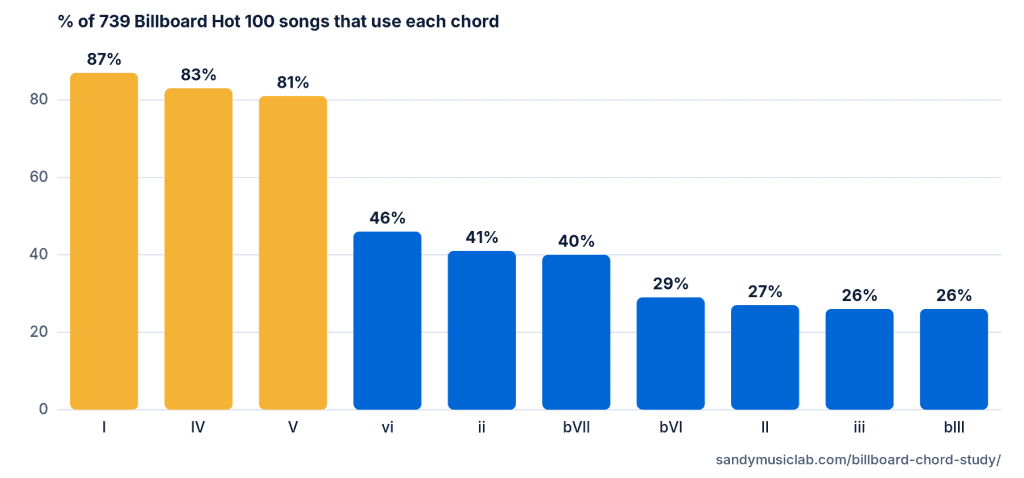
- I, IV and V rule. The I chord is in 87% of songs, IV in 83% and V in 81%; next come vi (46%), ii (41%) and the rock-flavored bVII (40%).
- The top 3-chord move is V–I–IV, found in 39% of songs, followed by IV–V–I (33%).
- The doo-wop loop leads. The I–vi–IV–V “50s progression” and its rotations (vi–IV–V–I, IV–V–I–vi, V–I–vi–IV) take four of the top five 4-chord spots; vi–IV–V–I alone is in 68 songs (9.2%).
- 4/4 is almost universal. 689 of 739 songs (93.2%) are in 4/4; only 15 are in 3/4 and 5 change time signature.
- Songs got more chords over time. The median rose from 6 chords per song in the 1960s to 7 in the 1970s, and the share of songs using bVII climbed from 29% in the 1960s to 48% in the 1980s.
- D is the most common key center (15% of songs), with C, E and G close behind; 67 songs (9%) change key.
Most common chords
| Chord (Roman numeral) | Songs using it | % of songs |
|---|---|---|
| I | 640 | 87% |
| IV | 612 | 83% |
| V | 598 | 81% |
| vi | 338 | 46% |
| ii | 302 | 41% |
| bVII | 294 | 40% |
| bVI | 213 | 29% |
| II | 198 | 27% |
| iii | 194 | 26% |
| bIII | 194 | 26% |
| i | 176 | 24% |
| Vsus | 171 | 23% |
| iv | 163 | 22% |
| v | 132 | 18% |
| I5 | 123 | 17% |
Want to hear these in your key? Type a progression into the chord transposer or sketch one in the Songwriter Suite.
How many chords are in a song?
Most common chord progressions
Counted as consecutive chord changes inside a song; each song counts once per progression.
| 4-chord progression | Songs containing it | % of songs |
|---|---|---|
| vi–IV–V–I | 68 | 9.2% |
| ii–V–I–IV | 63 | 8.5% |
| IV–V–I–vi | 56 | 7.6% |
| I–vi–IV–V | 54 | 7.3% |
| V–I–vi–IV | 54 | 7.3% |
| II–V–I–IV | 32 | 4.3% |
| vi–ii–V–I | 29 | 3.9% |
| IV–V–I–ii | 27 | 3.7% |
| vi–V–IV–I | 26 | 3.5% |
| I–vi–ii–V | 26 | 3.5% |
| 3-chord progression | Songs containing it | % of songs |
|---|---|---|
| V–I–IV | 288 | 39% |
| IV–V–I | 242 | 33% |
| IV–I–V | 218 | 29% |
| I–IV–V | 178 | 24% |
| V–IV–I | 164 | 22% |
| I–V–IV | 137 | 19% |
| ii–V–I | 124 | 17% |
| V–I–vi | 107 | 14% |
| I–vi–IV | 85 | 12% |
| vi–IV–V | 82 | 11% |
Time signatures
| Time signature | Songs | % of songs |
|---|---|---|
| 4/4 | 689 | 93.2% |
| 12/8 | 24 | 3.2% |
| 3/4 | 15 | 2.0% |
| 6/8 | 9 | 1.2% |
| 7/4 | 1 | 0.1% |
| 5/4 | 1 | 0.1% |
Most common keys
| Tonic (key center) | Songs | % of songs |
|---|---|---|
| D | 112 | 15% |
| C | 102 | 14% |
| E | 91 | 12% |
| G | 90 | 12% |
| A | 85 | 12% |
| F | 53 | 7% |
| Bb | 43 | 6% |
| Ab | 41 | 6% |
| B | 40 | 5% |
| Eb | 37 | 5% |
| Db | 31 | 4% |
| F# | 14 | 2% |
By decade
| Decade (chart date) | Songs | Median distinct chords | % using bVII |
|---|---|---|---|
| 1950s | 21 | 4 | 10% |
| 1960s | 216 | 6 | 29% |
| 1970s | 260 | 7 | 43% |
| 1980s | 213 | 7 | 48% |
| 1990s | 29 | 7 | 52% |
The 1950s (21 songs) and 1990s (29 songs) samples are small; read those rows with care.
Method
- Data: the McGill Billboard Project v2.0 “salami_chords” annotations: 890 expert transcriptions of songs randomly sampled from Billboard Hot 100 charts dated 1958–1991. Some songs were sampled twice; we kept one annotation per title and artist, leaving 739 unique songs (151 duplicates removed; no other songs excluded).
- Chords: each chord is reduced to its root and basic quality (major, minor, diminished, augmented, suspended or power chord) and written as a Roman numeral relative to the tonic annotated for that part of the song, so songs in different keys can be compared. Sevenths and extensions fold into their triad (G7 counts as V in C).
- “Distinct chords” counts the different Roman-numeral chords in a song. Progressions are runs of 3 or 4 different consecutive chords.
- Time signature and tonic are the first ones annotated; a song “changes key” or “changes time signature” if more than one is annotated.
- Limits: the sample covers 1958–1991 only, and the dataset names the tonic but not major or minor mode.
Download the per-song data as CSV (739 rows; each row names its McGill annotation ID).
Sources
- McGill Billboard Project, DDMAL, McGill University (CC0): ddmal.ca
- John Ashley Burgoyne, Jonathan Wild and Ichiro Fujinaga, “An Expert Ground Truth Set for Audio Chord Recognition and Music Analysis,” Proceedings of ISMIR 2011, pp. 633–38: PDF
Cite this study
Sandy Music Lab, “Billboard Chord Study: 739 Hot 100 Hits Analyzed,” https://sandymusiclab.com/billboard-chord-study/ (data: McGill Billboard Project, Burgoyne et al. 2011)
Use this chart on your site
Free to use under CC BY 4.0. Copy this code to embed the chart with a credit link:
Related tools and guides
- Chord transposer and capo finder
- Songwriter Suite
- Worship chord progressions
- Songwriting template
- Worship song key study
FAQ
How many chords are in a typical song?
The median Billboard Hot 100 song in this study uses 7 different chords (counting each chord by its root and major/minor quality). 22% use four or fewer and 10% use three or fewer.
What are the most common chords in pop music?
Measured in Roman numerals: I is used in 87% of songs, IV in 83%, V in 81%, vi in 46%, ii in 41% and bVII in 40%. In the key of G, those are G, C, D, Em, Am and F.
What is the most common chord progression?
Among three-chord moves, V–I–IV appears in 39% of songs. The most common four-chord sequence is vi–IV–V–I, in 68 songs (9.2%); it and three other rotations of the I–vi–IV–V “50s progression” fill four of the top five spots.
What is the most common time signature in popular music?
4/4. 689 of 739 songs (93.2%) are annotated in 4/4. Next are 12/8 (24), 3/4 (15) and 6/8 (9).
What key are most hit songs in?
By key center (tonic), D is the most common (112 songs, 15%), then C (102), E (91) and G (90). The dataset gives the tonic but not major or minor mode.
Where does this data come from?
From the McGill Billboard Project (version 2.0), a set of expert chord annotations of songs sampled from the Billboard Hot 100 between 1958 and 1991, released under CC0 by McGill University's DDMAL lab (Burgoyne, Wild and Fujinaga, ISMIR 2011).
Can I use this data?
Yes. Our summary data and charts are free under CC BY 4.0 (the underlying McGill annotations are CC0). Please credit and link to Sandy Music Lab's Billboard Chord Study.