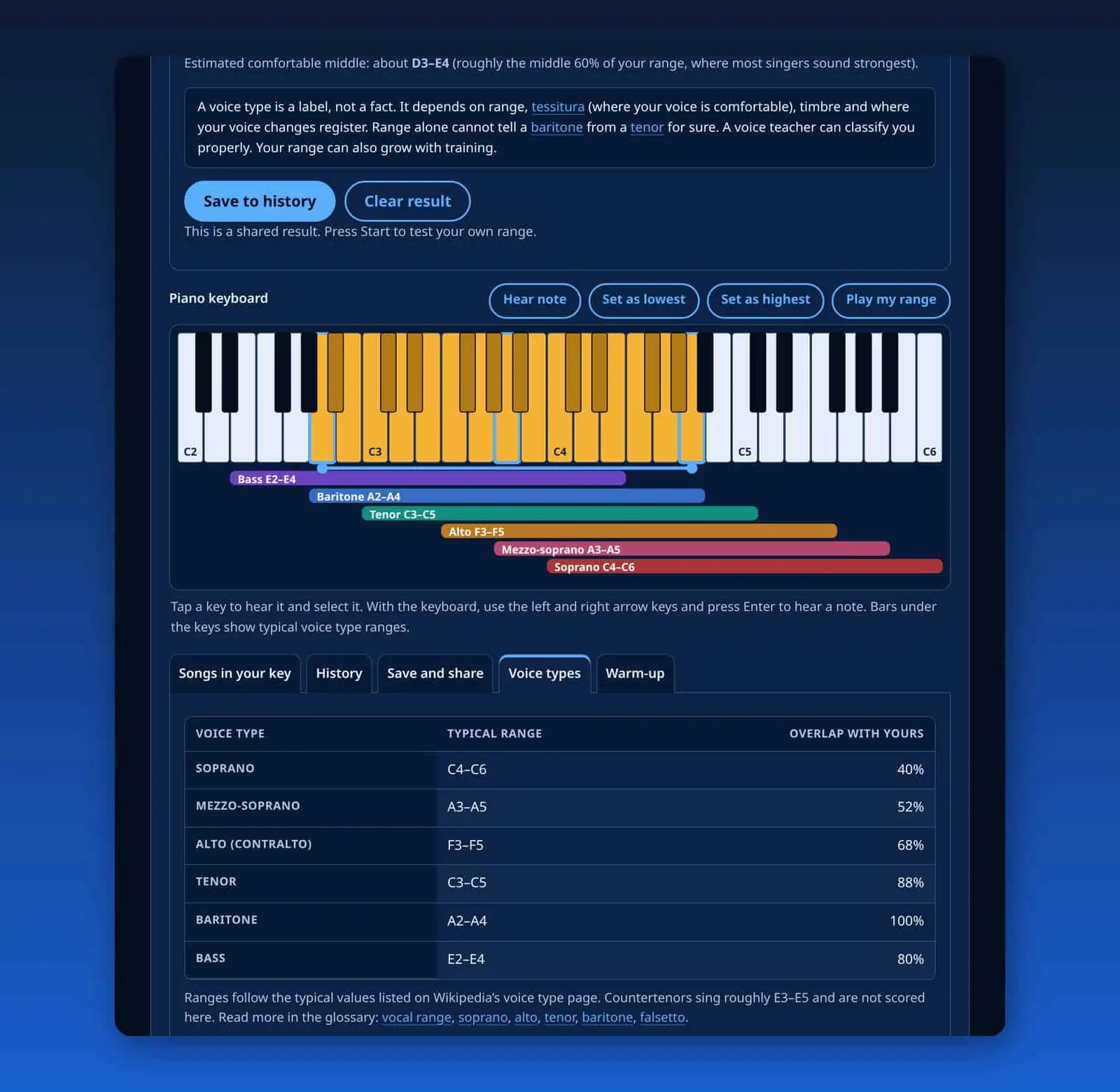
The baritone vocal range usually runs from about A2 to A4, which is 110 to 440 Hz. Baritone is the most common male voice type, sitting between bass and tenor, and many pop, rock and country singers fall into it. This guide covers the baritone range note by note, how to tell a baritone from a tenor or a bass, the main baritone types, famous baritone singers, and how to test your own range with a free vocal range test.
Quick answer: a typical baritone vocal range is A2 to A4 (110 to 440 Hz), about two octaves. Many baritones can sing a little lower (G2) or higher (around C5 with training or falsetto). Baritones usually sound strongest roughly between D3 and E4, and they feel a register shift a few notes lower than tenors do.
What is the baritone vocal range?
In standard voice classification, the baritone range is roughly from the second A below middle C (A2) to the A above middle C (A4). Some sources extend it from G2 up to C5.
| Point in the range | Note | Frequency |
|---|---|---|
| Typical low note | A2 | 110 Hz |
| Middle C | C4 | 261.63 Hz |
| Typical high note | A4 | 440 Hz |
| Extended low | G2 | 98 Hz |
| Extended high (trained, or falsetto) | About C5 | 523.25 Hz |
Range is only part of the story. Voice teachers also look at tessitura (where the voice is most comfortable), timbre (the color of the voice) and where the voice changes register. Two singers with the same range can be different voice types.
Baritone vs tenor vs bass
| Bass | Baritone | Tenor | |
|---|---|---|---|
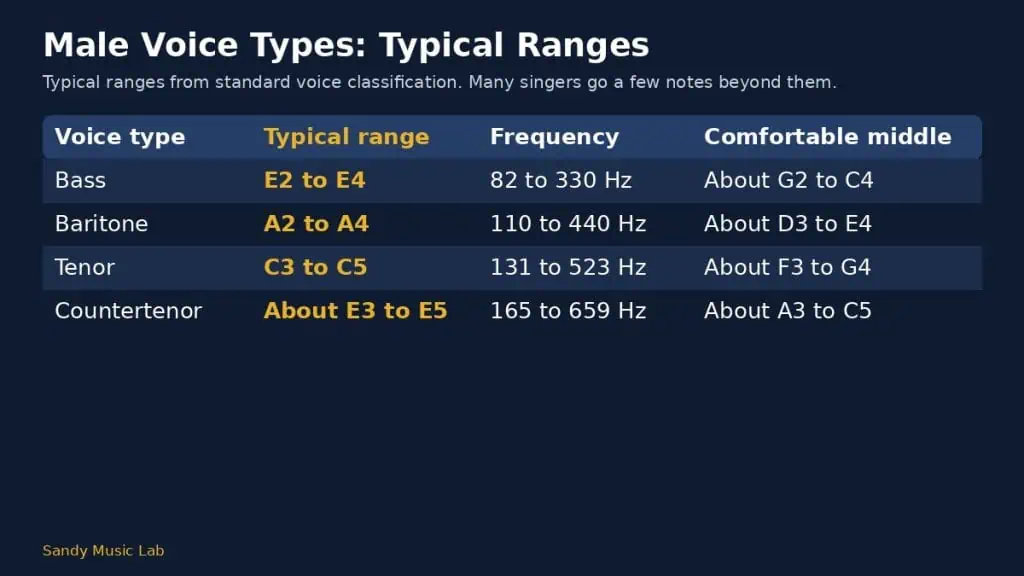
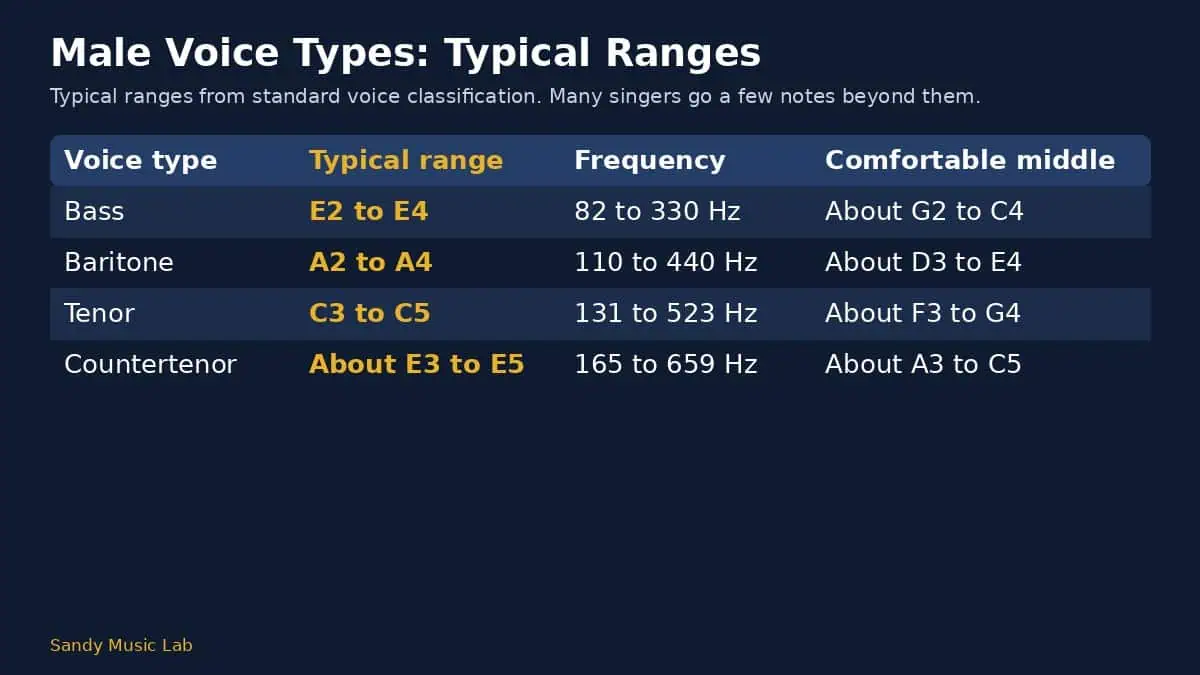
| Typical range | E2 to E4 | A2 to A4 | C3 to C5 |
| Sound | Deep, dark | Warm, full in the middle | Bright, ringing up high |
| Register shift (rough) | Lowest of the three | A few notes below a tenor’s | Highest of the three |
| How common | Less common | Most common male voice | Common |
The simplest test: compare where singing starts to feel like effort. If notes around E4 and F4 feel like a stretch but G2 and A2 are solid, you may be a baritone. If you can sing G4 and A4 with ease and your low notes fade around C3, you may be a tenor. The ranges overlap, which is why many singers are called baritenors or bass-baritones.
Free tool
Find your vocal range in a minute
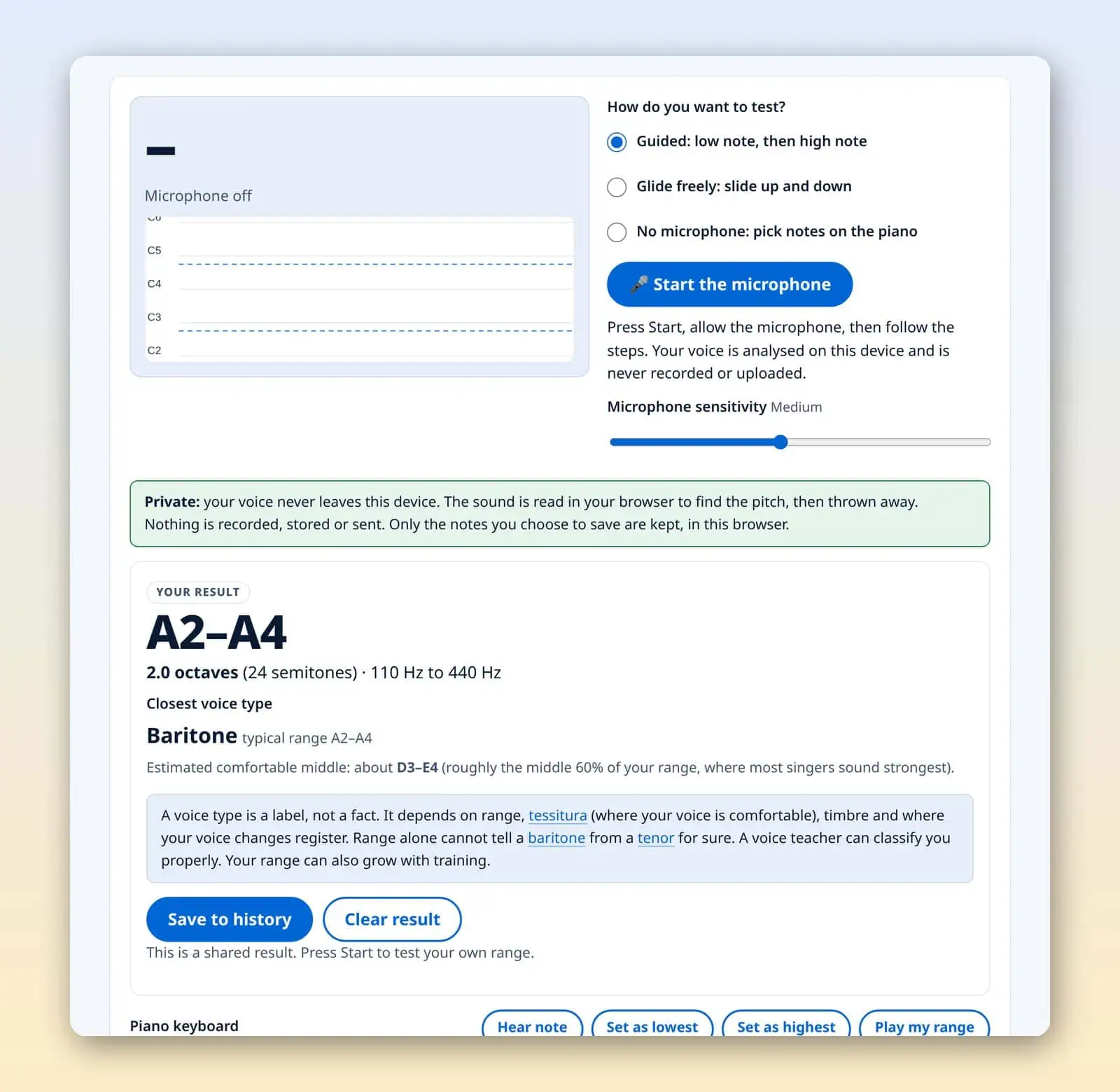
Sing your lowest and highest notes, or pick them on the piano, and see your range and closest voice type. Nothing is recorded.
Take the vocal range test →What are the types of baritone?
- Lyric baritone: a lighter, smoother voice with an easy top.
- Dramatic baritone: a darker, more powerful sound.
- Bass-baritone: a baritone with a strong, resonant low end that reaches toward bass territory.
- Baritenor: a popular term for a baritone with a strong high range that sings tenor material.
These labels come from classical singing, but they are useful in pop too. A bass-baritone often suits low, close-to-the-mic songs; a baritenor can handle rock songs written for tenors.
Famous baritone singers
Many popular singers are often described as baritones:
| Singer | Often described as | Known for |
|---|---|---|
| Frank Sinatra | Baritone | Warm, smooth crooning |
| Elvis Presley | Baritone | Wide range with a strong low end |
| Johnny Cash | Bass-baritone | Deep, steady low voice |
| Eddie Vedder | Baritone | Rich, dark rock vocals |
Voice types for pop singers are always estimates, since nobody classifies them formally. Use them as rough examples, not rules.
How to tell if you are a baritone
- Warm up gently for a few minutes with humming and slides.
- Find your lowest comfortable note. Sing down a scale until the note gets breathy or loses tone. Note the last clear one.
- Find your highest comfortable note in your normal chest voice, without straining or flipping into falsetto.
- Check your range with the vocal range test. It listens through your mic (nothing is recorded) or lets you pick notes on the piano.
- Compare the result. A range of roughly A2 to A4 with the strongest notes in the middle points toward baritone.
Do the test on a couple of different days. Range changes with warm-up, time of day and tiredness.

Best keys for baritone singers on guitar
Many popular songs are written in keys that sit high for baritones, often because they were sung by tenors. When a song feels too high, drop it 2 or 3 half steps:
| If the original key is | Try this key | On guitar |
|---|---|---|
| A | G or F# | G shapes, no capo, or tune down |
| E | D or C# | D shapes, no capo |
| D | C or B | C shapes, or A shapes at capo 2 |
| G | F or E | E shapes, or D shapes at capo 3 |
The vocal key finder works out the best key from your range, and the chord transposer changes a chord chart to that key.
Free tool
Find the best key for your voice
Enter your range and a song, and get the key that fits, with a capo suggestion for guitar.
Open the vocal key finder →How baritones can extend their range
- Warm up every time. Lip trills and gentle sirens loosen the voice before you push higher.
- Work on the register shift. Practice slides through the area around D4 to F4 at a soft volume, keeping the sound even.
- Don’t push volume to hit high notes. Volume makes high notes harder. Lighter is easier.
- Record yourself. A simple home recording setup shows you where your voice sounds best.
- Get lessons if you can. A voice teacher can classify your voice properly and keep your practice safe.

How this guide was made
The ranges follow standard voice classification sources, linked above, and were checked against the voice type data in the Sandy Music Lab vocal range test. Written by David Sandy, a guitarist and songwriter; see the editorial policy for how guides are researched.
Baritone vocal range FAQs
What is the range of a baritone?
About A2 to A4 (110 to 440 Hz). Some baritones reach G2 at the bottom and around C5 at the top.
Is baritone the most common male voice?
Yes. Baritone is generally considered the most common male voice type.
What is the highest note a baritone can sing?
A4 is the usual top of the range. With training, many baritones reach B4 or C5 in full voice, and higher in falsetto.
What is the difference between a baritone and a tenor?
Tenors sit about a third higher (roughly C3 to C5), have a brighter sound and shift registers on higher notes than baritones.
Can a baritone sing tenor songs?
Yes, often by lowering the key 2 or 3 half steps. A capo or chord transposer makes this easy on guitar.
How do you know if you are a baritone?
Test your range. If it is about A2 to A4 and your voice feels strongest between D3 and E4, you are probably a baritone.