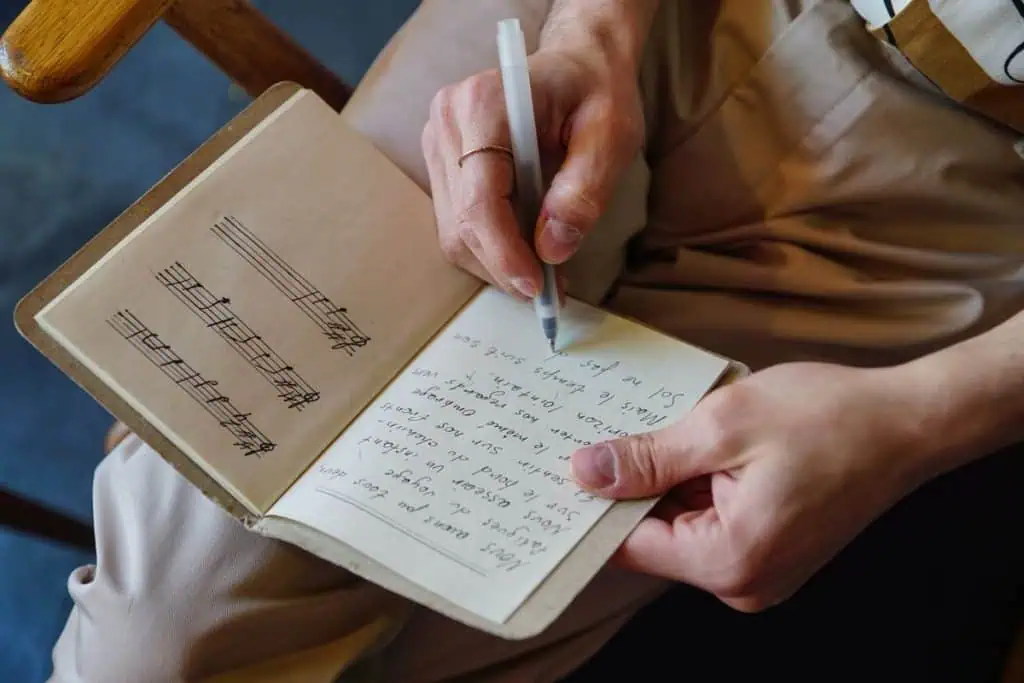
Some of the most loved songs in church history are simply Scripture set to music. If you’ve ever wanted to take a verse that’s meant a lot to you and turn it into something your church can sing, this guide walks you through how to write a song from scripture, one step at a time. It builds on our main guide, how to write a worship song, and focuses on the scripture-to-song method I use in our free Songwriter Suite.
To turn a Bible verse into a song, read the verse in its full context, write one sentence about what it means, and pull a short phrase from it as your hook. Build a chorus around that phrase, write verses that unpack the passage, choose a singable key and simple chords, then check every line against the text.
The goal isn’t to be clever. It’s to help people sing what God has said, faithfully and clearly.
Scripture Songs: Why Sing the Bible?
Christians have always sung Scripture. The Psalms were Israel’s songbook, and Paul tells the church to “Let the word of Christ dwell in you richly, teaching and admonishing one another in all wisdom, singing psalms and hymns and spiritual songs, with thankfulness in your hearts to God” (Colossians 3:16, ESV).
Scripture songs do a few things other songs can’t:
- They help people memorize the Bible. Melody makes words stick.
- They keep worship anchored to truth. When the lyric comes from the text, there’s less room to drift.
- They connect generations. A verse sung today is the same verse believers have read for centuries.
🎸 Free download
Not sure which guitar is right for you?
Get the free Guitar Gear Cheat Sheet: match your style, budget and hands to the right guitar in 2 minutes. You’ll also get my 30-Day Practice Plan as a bonus.
Send My Cheat Sheet →Bible Verse Songs: Choosing the Right Passage
Not every verse is easy to sing. The best candidates for Bible verse songs usually have:
- A short, memorable phrase that can become the hook. “Great is your faithfulness” (Lamentations 3:23, ESV) is a perfect example.
- A clear emotion: praise, lament, trust, thanksgiving.
- Natural rhythm when read aloud.
- Words that a congregation can sing as their own, like “I” and “we” statements or direct praise to God.
Psalms are the obvious starting point, but the prophets, the Gospels, the letters and Revelation are full of singable lines. Our list of 50 Bible verses for worship songs gives you a ready-made shortlist.
Step-by-Step: The Scripture-to-Song Method
Here’s the eight-step process. I’ll use Lamentations 3:22–23 as the example throughout:
“The steadfast love of the LORD never ceases; his mercies never come to an end; they are new every morning; great is your faithfulness.” (Lamentations 3:22–23, ESV)
- Read the passage in context. Read the whole chapter, not just the verse. Lamentations 3 is a lament written in suffering; the hope in verses 22–23 shines because it comes out of darkness. That context should shape your song.
- Write one sentence about what it means. Example: “Even in the worst seasons, God’s love and mercy never run out.”
- Find the hook. Look for the most memorable phrase. Here, “new every morning” or “great is your faithfulness.” Keep the Bible’s wording if you can.
- Write the chorus. Build two to four lines around the hook, staying close to the text. For example, a chorus can paraphrase verse 22 and land on “new every morning.”
- Write verses that unpack the passage. Verse one can describe the darkness of the earlier verses. Verse two can describe waking up to God’s mercy. Stay inside what the passage actually says.
- Choose a singable key. Songwriter Suite’s Congregation Key Finder aims for a melody range of about A3 to D5, from the A below middle C up to the second D above it. The Congregation Key Finder in Songwriter Suite suggests a key for you.
- Pick simple chords. Use a familiar progression like 1–5–6m–4. Our guide to worship chord progressions lists the most common ones in every key.
- Check every line against the text. Ask: does this line say what the passage says? Does it add anything the passage doesn’t support? Ask a pastor or a mature believer to read it too.
A worked example
Here’s a sample chorus written from Lamentations 3:22–23 using a close paraphrase. Notice that the hook is quoted directly and every line stays inside what the passage says:
Your love, O Lord, will never cease,
Your mercies never end,
They’re new every morning,
Great is your faithfulness.
Four lines, one idea, and a hook the whole room can sing by the second time through. For the full version, open the “New Every Morning” example in Songwriter Suite, which is charted with chords and Nashville numbers.
| Step | Question to ask | Songwriter Suite tool |
|---|---|---|
| 1. Context | What’s happening around this verse? | Look up (ESV) |
| 2. Meaning | What’s the one-sentence point? | Song notes |
| 3. Hook | Which phrase is most singable? | Scripture Library & Song Seeds |
| 4. Chorus | Does it state the main truth plainly? | Section editor |
| 5. Verses | Do they unpack the passage faithfully? | Rhyme & Word Finder |
| 6. Key | Can the whole room sing it? | Congregation Key Finder |
| 7. Chords | Is it easy for a volunteer band? | From chords / Key & Capo |
| 8. Check | Does every line match the text? | Faithfulness check |
The faithfulness check in Songwriter Suite compares your lyrics to the ESV passage and flags lines that might stretch the text. It’s a helper, not a pastor, so always get a real person’s review too.
Scripture Songs for Worship: Making It Congregational
Writing a scripture song for yourself is one thing. Writing one a whole church can sing takes a few extra steps.
Keep the melody in range. Avoid big leaps and very high notes. If the chorus climbs, let it climb gradually.
Use repetition. Repeating the hook helps people join in by the second chorus.
Write in the first person plural when it fits. “We will praise” invites everyone. “I” statements work too, as long as anyone in the room could sing them honestly.
Keep the rhythm simple. Syncopation that’s fun for a soloist can trip up a congregation.
Test it. Sing it with a few friends or your worship team before you bring it to Sunday. Our guide on how to lead worship on guitar has tips for introducing new songs.
Paraphrase or Quote Directly?
You have three options when you set a verse to music:
| Approach | What it means | Best for | Watch out for |
|---|---|---|---|
| Direct quote | Sing the verse word for word | Memory songs, kids’ songs, choruses | Awkward rhythm in some verses |
| Close paraphrase | Keep the key phrases, adjust wording to fit the melody | Most worship songs | Drifting from the meaning |
| Thematic | Write new lyrics inspired by the passage | Story songs, verses | Losing the anchor to the text |
Most worship writers use a close paraphrase, often quoting the hook directly. If you’re recording or publishing a song that quotes a translation word for word, check the publisher’s permission rules. For the ESV, Crossway publishes its standard permission guidelines on its website.
Common Mistakes When Writing from Scripture
Pulling a verse out of context. Always read the surrounding chapter.
Adding promises the text doesn’t make. If the verse is about Israel’s return from exile, don’t turn it into a personal guarantee it never offered without careful thought and pastoral guidance.
Making it about the singer instead of God. The best scripture songs keep God at the center.
Overcrowding the lyric. One passage, one main idea. Save the next verse for the next song.
Frequently Asked Questions
Can I use Bible verses in my song lyrics?
Yes. Christians have sung Scripture for thousands of years. If you quote a modern translation word for word in a recording or publication, check that translation’s permission guidelines. Crossway publishes guidelines for the ESV. This isn’t legal advice.
What’s the best Bible translation for songwriting?
Use a faithful translation you can read easily. We use the ESV at Sandy Music Lab because it’s accurate and reads well aloud. Comparing a few translations can help you find singable wording.
Which books of the Bible are best for songs?
Psalms is the classic choice, since it was written to be sung. Isaiah, Lamentations, the Gospels, Romans, Ephesians, Philippians and Revelation are also full of singable lines.
How long should a scripture song be?
Most congregational songs run three to five minutes with two verses, a chorus and sometimes a bridge. A short scripture chorus can be just one section repeated.
Do I need to know theology to write a scripture song?
You don’t need a seminary degree, but you do need to understand what the passage means. Read the context, use a good study Bible, and ask a pastor to review your lyrics.
Sources and Further Reading
- ESV.org – read any passage in the ESV with cross-references.
- Crossway permissions – official ESV quotation guidelines, including rules for music.
- CCLI – the licensing organization churches use to legally project and copy worship songs.
Scripture quotations are from the ESV® Bible (The Holy Bible, English Standard Version®), © 2001 by Crossway, a publishing ministry of Good News Publishers. Used by permission. All rights reserved.