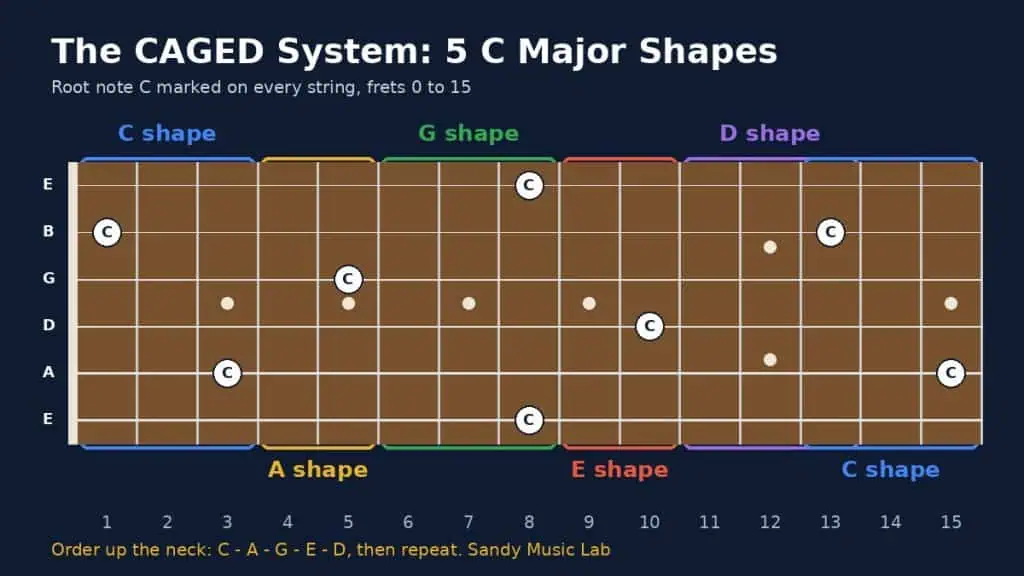
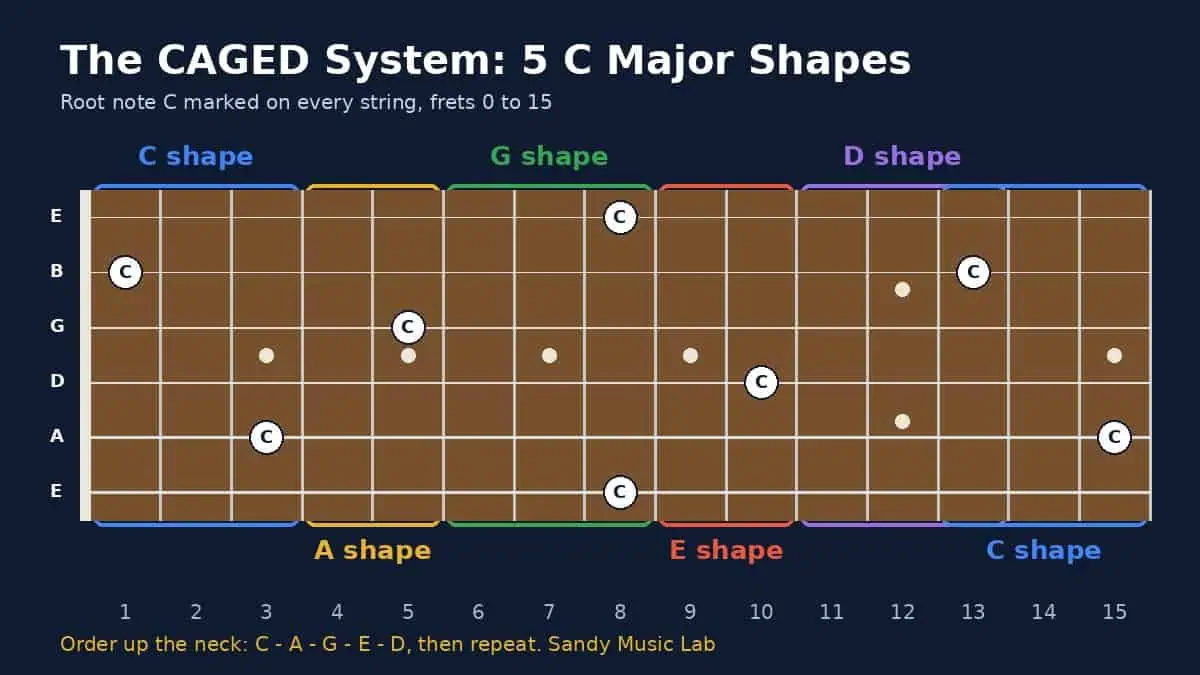
The CAGED system is a way to see the whole guitar neck as five connected chord shapes, named after the open chords C, A, G, E and D. Each shape can be moved up the neck, so any major chord can be played in five places, and the shapes always link in the same order: C, A, G, E, D, then back to C.
Quick answer: the CAGED system turns the five open chords C, A, G, E and D into movable shapes. For a C chord they sit at the open position (C shape), 3rd fret (A shape), 5th fret (G shape), 8th fret (E shape) and 10th fret (D shape). Learn where the root note sits in each shape, and you can find any chord, arpeggio or pentatonic box anywhere on the neck.
What is the CAGED system on guitar?
The CAGED system is a map of the fretboard built from five open major chord shapes: C, A, G, E and D. Slide any of those shapes up the neck with a barre or a partial barre, and it becomes a new chord. Because the five shapes overlap and connect, they divide the neck into five zones that repeat every 12 frets.
It is not a method of playing so much as a way of seeing. Once you know the five shapes, you know where every root note of a chord is, and that tells you where the scale, the arpeggio and the lead licks for that chord sit. D’Addario’s CAGED guide and Premier Guitar’s CAGED explainer describe it the same way: five shapes, one repeating order.
If chord theory itself is new, start with how guitar chords work and the music theory for guitar guide, then come back here.
What are the five CAGED chord shapes?
The five CAGED chord shapes are the open C, A, G, E and D major chords, each with a fixed spot for its root note. That root is what you move. In the table, frets are listed from the low E string to the high E string, and x means do not play the string.
| Shape | Open chord | Root note on | Moved up as | Example (C major) |
|---|---|---|---|---|
| C shape | x32010 | A string (and B string) | Partial barre with the index finger | Open: x32010 |
| A shape | x02220 | A string | Barre at the root fret | 3rd fret: x35553 |
| G shape | 320003 | Low E string (and G and high E) | Hard stretch, often played as a partial shape | 5th to 8th fret: 875558 |
| E shape | 022100 | Low E string | Full barre at the root fret | 8th fret: 8-10-10-9-8-8 |
| D shape | xx0232 | D string | Index on the root, top four strings | 10th fret: x-x-10-12-13-12 |
The A and E shapes are the barre chords most players already know. The C, G and D shapes are usually played as partial chords on four or five strings, which is normal: the full G shape is a big stretch, and most players only use part of it. For barre technique, see how to play barre chords.
What order do the CAGED shapes go in?
The CAGED shapes always go in the order C, A, G, E, D as you move up the neck, then start again. Whatever key you are in, find the open shape that matches the chord and keep going through the word. A G chord starts with the G shape, so its order up the neck is G, E, D, C, A.
| Key | Shape order up the neck | Fret where each shape starts (root position) |
|---|---|---|
| C | C, A, G, E, D | Open, 3, 5, 8, 10 |
| A | A, G, E, D, C | Open, 2, 5, 7, 9 |
| G | G, E, D, C, A | Open, 3, 5, 7, 10 |
| E | E, D, C, A, G | Open, 2, 4, 7, 9 |
| D | D, C, A, G, E | Open, 2, 5, 7, 10 |
Each starting fret above is where the shape’s lowest fretted note sits, and they repeat 12 frets higher. You can check any of these with the free interactive guitar fretboard, which shows the notes in each position.
How do you play one chord five ways with CAGED?
To play one chord five ways, find its root on the A, low E and D strings, then build the matching shape around each root. For G major, the five voicings below cover the neck from the open position to the 15th fret. Play them in order and listen for how the same chord changes color as it climbs.
| G major voicing | Frets (low E to high E) | Root on |
|---|---|---|
| G shape (open) | 320003 | Low E, 3rd fret |
| E shape | 3-5-5-4-3-3 | Low E, 3rd fret |
| D shape | x-x-5-7-8-7 | D string, 5th fret |
| C shape | x-10-9-7-8-7 | A string, 10th fret |
| A shape | x-10-12-12-12-10 | A string, 10th fret |
Notice how each voicing shares notes with the next one. The top of the E shape at the 3rd fret is the bottom of the D shape, and the C shape and A shape share the same root on the A string. That overlap is the whole idea: the shapes are puzzle pieces, not five separate things to memorize.
How does CAGED connect to scales and arpeggios?
CAGED connects to scales because every chord shape sits inside one position of the major scale and one box of the pentatonic scale. Learn the chord shape first, then add the scale notes around it. The root notes you already know become anchors, so you always know where the safe target notes are when soloing.
- Arpeggios: play the notes of each CAGED shape one at a time, root to root. This is the fastest way to hear chord tones in every position.
- Pentatonic boxes: each of the five pentatonic scale shapes wraps around one CAGED chord shape. Box 1 of A minor pentatonic (frets 5 to 8) wraps around the G-shape C major chord in the same frets, because C major and A minor share the same notes.
- Major scale: the major scale on guitar also splits into five CAGED positions, one per shape.
- Intervals: knowing the root in each shape makes the 3rd and 5th easy to find, which is covered in intervals on guitar.
Does the CAGED system work for minor chords?
Yes, the CAGED system works for minor chords, using the minor versions of the same five shapes. Am, Em and Dm are familiar open chords and move easily. The Cm and Gm shapes are awkward as full chords, so most players use them as partial shapes or as arpeggio guides rather than strummed chords.
| Minor shape | Open form | Moved example (A minor) |
|---|---|---|
| Am shape | x02210 | Open: x02210 |
| Gm shape | 310033 (partial) | Usually played as an arpeggio around the 2nd to 5th fret |
| Em shape | 022000 | 5th fret: 5-7-7-5-5-5 |
| Dm shape | xx0231 | 7th fret: x-x-7-9-10-8 |
| Cm shape | x31013 (partial) | 9th to 12th fret: x-12-10-9-10-x |
The order is the same: C, A, G, E, D. For A minor, start with the Am shape and keep going.
How long does it take to learn the CAGED system?
Most players can learn the five CAGED shapes in about four weeks with 10 to 15 minutes a day, if they already know open chords and one barre chord. Using CAGED fluently in solos takes longer. The plan below adds one idea a week and pairs well with a regular guitar practice routine.
| Week | Daily focus (10 to 15 minutes) | Goal by the end of the week |
|---|---|---|
| 1 | C major in all five shapes, slowly, saying the shape name | Play C, A, G, E, D shapes of C without stopping |
| 2 | Same five shapes for G and A major | Find the root on the A, E and D strings without counting frets |
| 3 | Arpeggios: play each shape one note at a time | Hear the root, 3rd and 5th in every position |
| 4 | Add the pentatonic box around each shape, then improvise over a drone | Move between two neighboring shapes mid-phrase |
Keep a slow, steady pulse. The free online metronome at 60 BPM, one chord change every four clicks, is a good start.
What are the most common CAGED mistakes?
The most common CAGED mistakes are memorizing shapes without the root, trying to play the full G shape as a strummed chord, and skipping the connections between shapes. Fix the first one and the others get easier, because the root is what tells you which shape you are in.
- Ignoring the root: always say or sing the root note as you play each shape. Without it, CAGED is just five random grips.
- Forcing the full G and C shapes: play three or four strings of them. Nobody expects a clean six-string G shape barre.
- Learning shapes in isolation: practise pairs of neighboring shapes (C to A, A to G) so the joins become automatic.
- Treating CAGED as the only system: some players prefer three-notes-per-string scale patterns for fast runs. CAGED is still the clearest map for chords and arpeggios, and the two work together.
Is the CAGED system worth learning?
Yes, the CAGED system is worth learning for any guitarist who wants to move past open chords and one barre shape. It gives you five places to play every chord, a clear link between chords and scales, and a way to find notes without memorizing every note on the neck one by one. It is less useful if you only play with a capo in open position.
| Pros | Cons |
|---|---|
| Works for every major and minor chord | The full G and C shapes are awkward to fret |
| Links chords, arpeggios and pentatonic boxes | Can feel abstract before you know barre chords |
| Repeats every 12 frets, so there is little to memorize | Less direct for very fast scale runs than 3-note-per-string patterns |
Want to hear the chord tones as well as see them? The free ear trainer drills major and minor chords and intervals.
How we wrote this guide
Every chord voicing in the tables was checked fret by fret against the standard tuning note layout, using the Sandy Music Lab fretboard tool. The shape order and root positions match the explanations from D’Addario and Premier Guitar linked above. Sandy Music Lab is written by David Sandy, and the editorial policy explains how lessons are checked and updated. Found a typo in a chord? Tell us.
CAGED system FAQs
What does CAGED stand for?
CAGED stands for the five open major chords C, A, G, E and D. Each one becomes a movable shape, and together they cover the whole neck.
What order do the CAGED shapes go in?
Always C, A, G, E, D going up the neck, then repeating. Start from whichever shape matches your chord: G major starts with the G shape, then E, D, C, A.
Should beginners learn the CAGED system?
Learn open chords and one barre chord first. After that, CAGED is a good next step, usually within the first year of playing.
Is CAGED better than three notes per string?
They do different jobs. CAGED is clearer for chords, arpeggios and finding roots; three-notes-per-string patterns suit fast scale runs. Many players use both.
Does the CAGED system work on bass?
Partly. Bass players use the root positions and arpeggio ideas, but the full chord shapes are a guitar idea. See bass guitar notes for the bass fretboard.
Does CAGED work in drop D or other tunings?
Not directly. CAGED assumes standard tuning. In drop D, only the low string changes, so the shapes rooted on the A and D strings still work.
How do I use CAGED for soloing?
Pick one chord shape, find its root, then play the pentatonic box around it. Aim for the chord tones (root, 3rd, 5th) on strong beats.