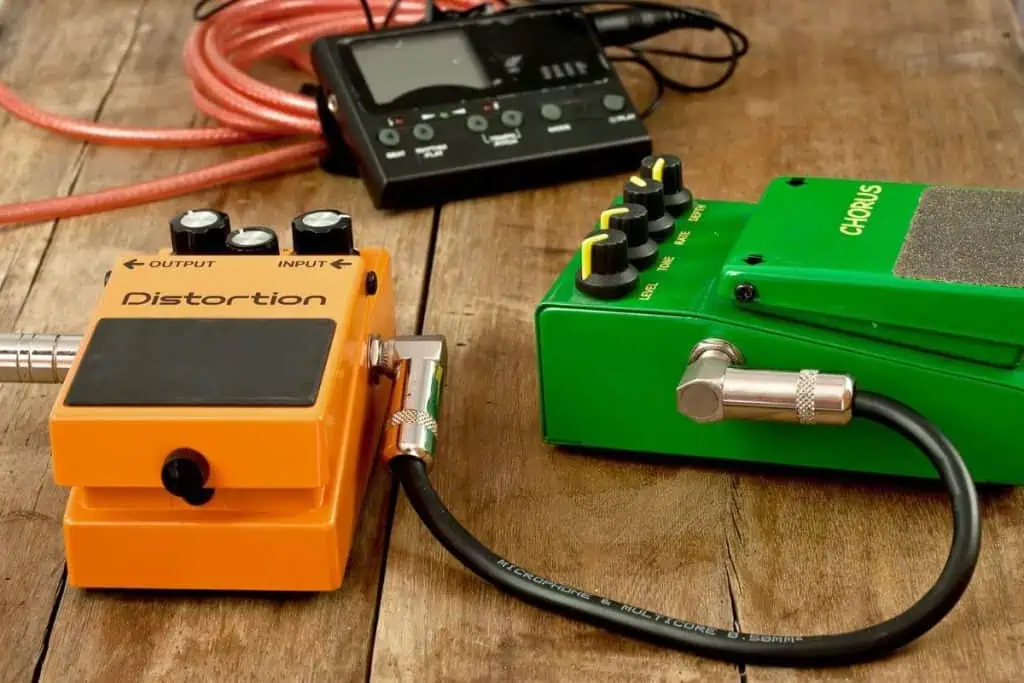
The standard guitar pedal order is tuner, wah and filters, compressor, overdrive and distortion, modulation, delay, then reverb. In short: fix and shape the signal first, add gain next, and put time-based effects last. Put a noise gate after your drives, and move delay and reverb into the effects loop if your amp’s preamp is dirty.
Pedal order is the first decision you make when you plan a board, and it’s step two in our how to build a pedalboard guide. Get it right and every pedal sounds the way it should. Get it wrong and a great delay turns to mush or a fuzz refuses to clean up.
This guide gives you the standard guitar pedal order, a simple diagram you can copy, and the reasons behind each position. You’ll also learn the pedal order with an effects loop, exactly where to put a noise gate, and when breaking the rules sounds better. If you’re still choosing drives, read overdrive vs distortion vs fuzz first. Power matters too, so see how to power guitar pedals and our best pedal power supplies before you wire anything.
🎸 Free download
Not sure which guitar is right for you?
Get the free Guitar Gear Cheat Sheet: match your style, budget and hands to the right guitar in 2 minutes. You’ll also get my 30-Day Practice Plan as a bonus.
Send My Cheat Sheet →Table of Contents
Guitar Pedal Order Diagram
Here’s the standard guitar pedal order diagram, read from left to right, starting at your guitar:
GUITAR
  -> 1. Tuner
  -> 2. Wah / envelope filter / pitch
  -> 3. Compressor
  -> 4. Boost / overdrive / distortion / fuzz
  -> 5. Noise gate
  -> 6. EQ (optional)
  -> 7. Modulation: chorus, phaser, flanger, tremolo
  -> 8. Delay
  -> 9. Reverb
  -> 10. Looper (optional)
  -> AMP
Think of it in three groups. The first group fixes and shapes your raw guitar signal (tuner, filters, compressor). The second adds gain (drives). The third adds movement and space (modulation, delay, reverb). This guitar pedal order works because each group feeds the next a signal it handles well.
Why Each Pedal Goes Where It Does
1. Tuner first
A tuner at the front sees your cleanest signal, so it tracks fastest. Most tuners also mute the output, which lets you tune silently. Many tuners are buffered, which can help drive long cables later in the chain.
2. Wah, filters and pitch effects
Wah and envelope filters respond to your raw pick attack, so they work best early. Pitch shifters and octave pedals also track better with a clean, uncompressed signal. Shopping for one? See our best wah pedals.
3. Compressor
A compressor evens out your dynamics and adds sustain. Before drives, it gives them a steady signal and smooths out clean parts. Our best compressor pedals guide has picks for every budget.
4. Drive pedals: boost, overdrive, distortion and fuzz
Gain pedals sit in the middle of the guitar pedal order. If you stack more than one, the usual rule is lower gain into higher gain, for example a clean boost into a overdrive pedal, then distortion. You can also reverse them: an overdrive after a distortion acts like a volume and EQ boost for solos.
5. Modulation
Chorus, phaser, flanger and vibrato sound smooth and defined after drive. Before drive, the distortion exaggerates the sweep, which can be a cool effect in its own right. Tremolo usually goes last among the modulation pedals, or even after delay for a choppy, rhythmic sound.
6. Delay and reverb
Time-based effects come last because they create echoes and ambience of everything in front of them. Putting a delay pedal before reverb mimics a real room: the echoes sit inside the reverb. Putting reverb before delay gives a washy, ambient sound that some players love.
Where to Put a Noise Gate
Where to put a noise gate depends on what’s making the noise. In most rigs, put it right after your drive pedals and before modulation, delay and reverb. That cuts the hiss your gain pedals create while leaving delay and reverb tails to fade naturally.
- After drives (most common): best for high-gain rigs with a clean amp.
- In the effects loop: best if your amp’s own preamp is the main noise source.
- Split gate (4-cable): pedals like the ISP Decimator G-String and BOSS NS-2 can sense your guitar at the front and gate the loop. This is the most effective method for metal players.
If your rig still hums with the gate off and every pedal bypassed, the problem is likely power or pickups. See our guides on how to power guitar pedals and noisy guitar pickups. You’ll find gates of every size in our best noise gate pedals roundup.
Pedal Order With Effects Loop
Many amps have an effects loop: a send and return between the preamp (where the amp’s distortion happens) and the power amp. The pedal order with effects loop splits your board in two:
| Location | Pedals | Why |
|---|---|---|
| Front of amp (guitar → amp input) | Tuner, wah, compressor, drives, fuzz | These shape the tone that hits the amp’s preamp |
| Effects loop (send → return) | Modulation, delay, reverb, EQ, noise gate | These stay clean even when the amp’s preamp is distorted |
If you play a clean amp, running everything into the front works fine. If you use the amp’s own distortion, the effects loop keeps delay and reverb clear. For the full walkthrough, including the 4-cable method with a multi-effects unit, read how to use your amp’s effects loop.
Guitar Pedal Order Reference Table
Use this table as a quick check when you set up a new board or add a pedal.
| Position | Pedal type | Place it… | Common exception |
|---|---|---|---|
| 1 | Tuner | First | After volume pedal if you want silent tuning |
| 2 | Fuzz (vintage) | Before wah and buffers | Modern buffered fuzzes can go anywhere |
| 3 | Wah / filter | Early | After drive for a more vocal, aggressive sound |
| 4 | Compressor | Before drives | After drives for squashed lead tones |
| 5 | Boost / overdrive / distortion | Middle | Boost last to raise solo volume |
| 6 | Noise gate | After drives | In the effects loop or 4-cable |
| 7 | Modulation | After drives | Before drives for wild, swirling sweeps |
| 8 | Volume pedal | After drives or at the end | At the front for swells into drive |
| 9 | Delay | Near the end | Before drive for a vintage tape-echo feel |
| 10 | Reverb | Last | Before delay for washy ambient sounds |
| 11 | Looper | Very end | Before time-based effects to change them live |
Where Volume Pedals and Loopers Go
A volume pedal’s position changes what it does. At the front of the chain it acts like your guitar’s volume knob, so turning it down cleans up your drives. After the drives it works as a master volume, cutting level without changing your tone, and it lets delay and reverb tails ring out when you fade. Our best volume pedals guide explains the low and high impedance types.
Loopers usually go last so they record your full sound, effects included. Put one before delay and reverb if you want to change those effects over a loop you’ve already recorded.
Sample Guitar Pedal Order for 3 Common Boards
Here’s how the guitar pedal order looks on real boards of different sizes. Copy the one closest to yours and adjust from there.
Beginner board (4 pedals)
Tuner → overdrive → chorus → delay. This simple chain covers clean, crunch and lead sounds. The overdrive gets a clean signal, the chorus adds width after the gain, and the delay sits at the end where its repeats stay clear.
Blues and classic rock board (7 pedals)
Tuner → wah → compressor → low-gain overdrive → higher-gain overdrive → tremolo → delay → reverb. Stacking two drives from low to high gain gives you rhythm and lead levels without touching the amp.