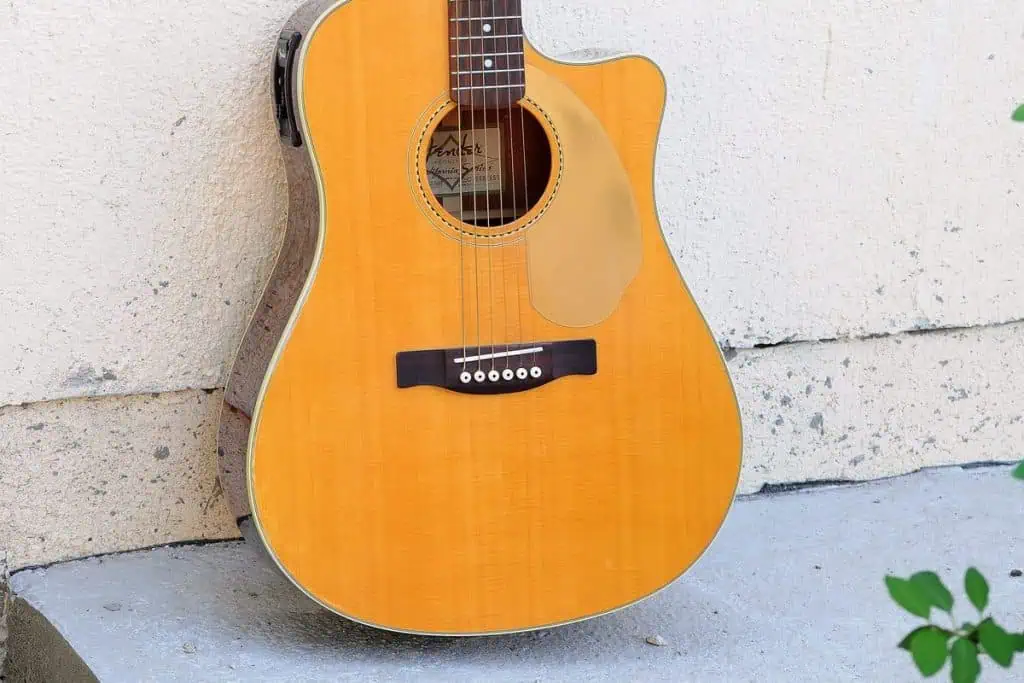
Quick answer: The best cheap acoustic guitar for most beginners is the Yamaha FG800: it has a solid spruce top, an easy neck and a full sound. For a smaller body, get the Yamaha FS800. For a warmer all-mahogany tone, the Fender CD-60S. If you want nylon strings, the Yamaha C40II.
A cheap acoustic doesn’t have to be a bad one. What matters most at this price is a top that resonates (solid wood if you can get it), a neck that stays straight, and tuners that hold pitch. All eight guitars here tick those boxes, and their specs come straight from Yamaha, Fender and the retailer listings.
New to buying? Read how to choose an acoustic guitar first, then come back here for the shortlist.
Our top picks at a glance
| Product | Best for | Key features | Price |
|---|---|---|---|
| Yamaha FG800 | Most beginners | Dreadnought, solid spruce top, nato/okoume back and sides, 650 mm (25 9/16″) scale, 43 mm nut, die-cast tuners | Check current price |
| Fender CD-60S | A warm, all-mahogany sound | Dreadnought, all-mahogany (top, back and sides), scalloped X bracing, die-cast tuners, 2-year warranty | Check current price |
| Yamaha FS800 | Smaller players and couch practice | Concert body, solid spruce top, nato/okoume back and sides, 634 mm (25″) scale, 43 mm nut | Check current price |
| Fender CC-60S | A small body with a mahogany voice | Concert body, solid mahogany top, mahogany back and sides, scalloped X bracing, rolled fingerboard edges | Check current price |
| Jasmine S35 | The lowest cost | Dreadnought, solid Sitka spruce top (per retailer listing), mahogany back and sides, 25.5″ scale, 43 mm synthetic bone nut, 12–53 phosphor bronze strings | Check current price |
| Yamaha FG830 | Stretching your budget a little | Dreadnought, solid spruce top, rosewood back and sides, 650 mm scale, abalone rosette | Check current price |
| Yamaha JR1 (3/4 size) | Kids and travel | 3/4-size FG-style body, spruce top, shorter neck, gig bag included | Check current price |
| Yamaha C40II (nylon string) | Nylon strings and classical | Full-size classical, spruce top, meranti back and sides, rosewood fingerboard and bridge, gloss finish | Check current price |
The picks, reviewed
1. Yamaha FG800 — best for most beginners
Key features: Dreadnought, solid spruce top, nato/okoume back and sides, 650 mm (25 9/16″) scale, 43 mm nut, die-cast tuners
The FG800 is the default answer to “what cheap acoustic should I buy?” for a reason. It has a solid spruce top, which is rare at this price, and Yamaha’s consistent build quality. Yamaha lists a 650 mm scale, a 43 mm nut and die-cast chrome tuners.
It’s a full dreadnought, so it’s loud and strong in the bass. That’s great for strumming chords, but smaller players may prefer the FS800 below.
Pros:
- Solid top at an entry price
- Consistent Yamaha build
- Big, full strumming sound
Cons:
- No pickup (FGX800C if you need one)
- Dreadnought body is large for small players
2. Fender CD-60S — best for a warm, all-mahogany sound
Key features: Dreadnought, all-mahogany (top, back and sides), scalloped X bracing, die-cast tuners, 2-year warranty
The CD-60S uses mahogany for the top, back and sides, which gives it a warmer, darker voice than spruce-top guitars. Fender lists scalloped X bracing and chrome die-cast tuners, and backs it with a 2-year limited warranty.
If you mostly play folk, country or singer-songwriter strumming, the warm tone sits nicely under a voice.
Pros:
- Warm, mellow tone
- 2-year warranty
- Easy to find in bundles
Cons:
- Less sparkle than spruce tops
- Dreadnought size
3. Yamaha FS800 — best for smaller players and couch practice
Key features: Concert body, solid spruce top, nato/okoume back and sides, 634 mm (25″) scale, 43 mm nut
The FS800 is the FG800’s smaller sibling: same solid spruce top and build, in a concert body. Yamaha lists a 634 mm (25″) scale and a body 380 mm wide, versus 412 mm on the FG800.
The shorter scale lowers string tension a little, so chords feel easier, and the smaller body is more comfortable to hold if you’re smaller or play sitting down.
Pros:
- Comfortable, smaller body
- Slightly easier to fret
- Solid spruce top
Cons:
- Less bass than a dreadnought
- No pickup
4. Fender CC-60S — best for a small body with a mahogany voice
Key features: Concert body, solid mahogany top, mahogany back and sides, scalloped X bracing, rolled fingerboard edges
The CC-60S is Fender’s concert-size option. Fender lists a solid mahogany top with scalloped X bracing and mahogany back and sides, plus rolled fingerboard edges that make the neck kinder on beginners’ hands.
Choose it over the FS800 if you prefer a warmer, rounder tone to spruce’s brightness.
Pros:
- Comfortable concert size
- Rolled fingerboard edges
- Warm tone
Cons:
- Quieter than a dreadnought
- No pickup
5. Jasmine S35 — best for the lowest cost
Key features: Dreadnought, solid Sitka spruce top (per retailer listing), mahogany back and sides, 25.5″ scale, 43 mm synthetic bone nut, 12–53 phosphor bronze strings
Jasmine is Takamine’s budget brand, and the S35 is often the cheapest full-size acoustic worth buying. The current retailer listing says it has a solid Sitka spruce top, mahogany back and sides, a 25.5″ scale and a synthetic bone nut. It ships with light 12–53 phosphor bronze strings.
At this price, a basic setup (lower action at the nut and saddle) makes the biggest difference to how it plays.
Pros:
- Very low cost
- Full-size dreadnought
- Synthetic bone nut and saddle
Cons:
- Fit and finish vary more
- Benefits from a setup
6. Yamaha FG830 — best for stretching your budget a little
Key features: Dreadnought, solid spruce top, rosewood back and sides, 650 mm scale, abalone rosette
If you can spend a bit more than the FG800, the FG830 adds rosewood back and sides (per Yamaha’s spec sheet). That gives a deeper, more complex tone. It has the same solid spruce top, neck shape and scale.
It’s a guitar you won’t outgrow quickly.
Pros:
- Rosewood back and sides
- Same easy Yamaha neck
- A real step up in tone
Cons:
- Costs more than the FG800
- No pickup
7. Yamaha JR1 (3/4 size) — best for kids and travel
Key features: 3/4-size FG-style body, spruce top, shorter neck, gig bag included
For kids, or as a travel guitar, the JR1 is a 3/4-size guitar modeled after Yamaha’s FG series. It has a smaller body and a shorter neck, and it comes with a gig bag.
It’s not for adults who want a main guitar, but it’s a proper instrument rather than a toy.
Pros:
- Right size for younger players
- Gig bag included
- Good travel guitar
Cons:
- Quieter, smaller sound
- Adults will outgrow it
8. Yamaha C40II (nylon string) — best for nylon strings and classical
Key features: Full-size classical, spruce top, meranti back and sides, rosewood fingerboard and bridge, gloss finish
If you want nylon strings, which are softer on the fingertips and suit classical, flamenco or fingerstyle, the C40II is the standard budget pick. Yamaha lists a spruce top, meranti back and sides, and a rosewood fingerboard and bridge.
Note that classical necks are wider and flatter than steel-string necks, which some beginners find harder for chords.
Pros:
- Gentle on fingers
- Very affordable
- Great for classical study
Cons:
- Wide classical neck
- Different sound from steel-string songs
How to choose a cheap acoustic guitar
- Solid top vs laminate: a solid top (FG800, FS800, CC-60S) usually sounds fuller and opens up as it ages. At this price the back and sides are laminate, and that’s fine.
- Body size: dreadnoughts (FG800, CD-60S, S35, FG830) are loud with strong bass. Concert bodies (FS800, CC-60S) are more comfortable. A 3/4 (JR1) suits kids.
- Steel or nylon: steel strings for pop, rock, folk and most songs. Nylon (C40II) for classical and gentler fingertips.
- Pickup: none of these has one. If you’ll play through a PA, look at the electro versions (Yamaha FGX800C or FSX800C, Fender CD-60SCE).
- Setup: a cheap guitar with a good setup plays better than an expensive one without. Ask the shop, or a tech, to check the action.
Once it arrives, start with the chords every song uses. Our free guitar chord charts include easier versions of barre chords like F and Bm. When a song sits too high for your voice, use the chord transposer and capo finder. Not sure which strings to buy next? Try the string gauge finder. Also see best parlor guitars for even smaller bodies.
Frequently asked questions
What is the best cheap acoustic guitar for beginners?
For most beginners, the Yamaha FG800. It has a solid spruce top, a comfortable neck and consistent quality. If you’re smaller, or prefer a smaller body, choose the Yamaha FS800.
Is a solid top worth it on a cheap guitar?
Usually, yes. A solid top tends to sound fuller and louder than a laminate top, and the FG800, FS800 and CC-60S offer one at entry prices.
Should a beginner start on nylon or steel strings?
Nylon is softer on the fingertips but has a wider neck. Steel strings suit most modern songs. Choose the sound you want to play, and your fingers will toughen up in a few weeks.
What size acoustic guitar should I get?
Most adults are fine with a dreadnought or concert body. Kids, roughly under 10, usually suit a 3/4 size such as the Yamaha JR1.
Do cheap acoustic guitars need a setup?
Often they benefit from one. Lowering the action at the nut and saddle makes chords easier to press and is one of the cheapest upgrades you can make.
Final thoughts
Start with the Yamaha FG800 unless you have a reason not to. Choose the FS800 or CC-60S for a smaller body, the CD-60S for a warmer tone, and the C40II if you want nylon strings. Whichever you pick, a basic setup and a clip-on tuner will make it far easier to keep playing.
As an Amazon Associate, Sandy Music Lab earns from qualifying purchases. Specs come from the manufacturers and retailers listed; check the product page for the current price.