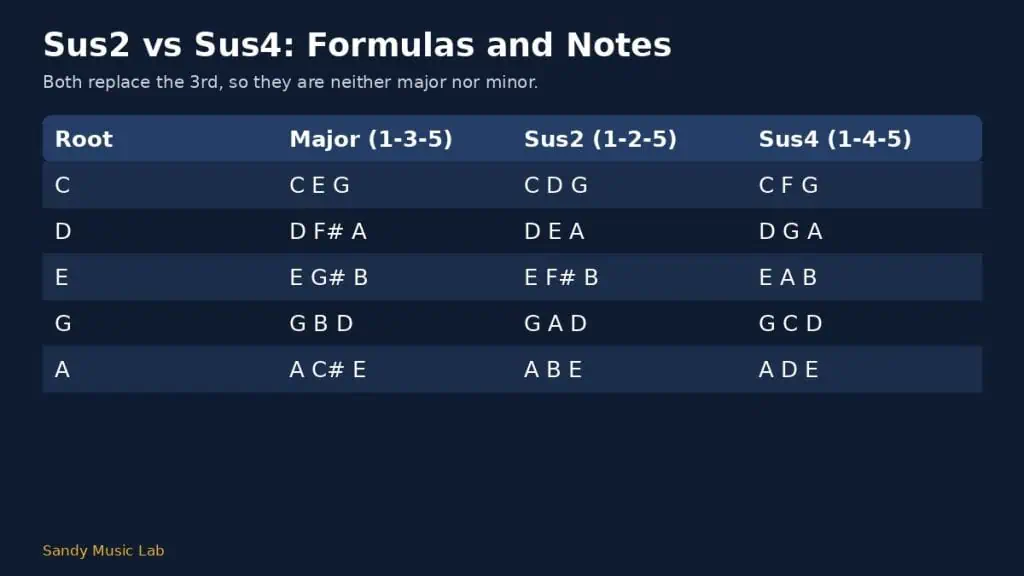
The difference in sus2 vs sus4 is one note. Both chords remove the 3rd of a major or minor chord: a sus2 chord replaces it with the 2nd, and a sus4 chord replaces it with the 4th. That missing 3rd gives suspended chords their open, unresolved sound. This guide explains the formulas, shows the open shapes for D, A, E, G and C, and covers when to use each one, with a free chord finder that names any shape you play.
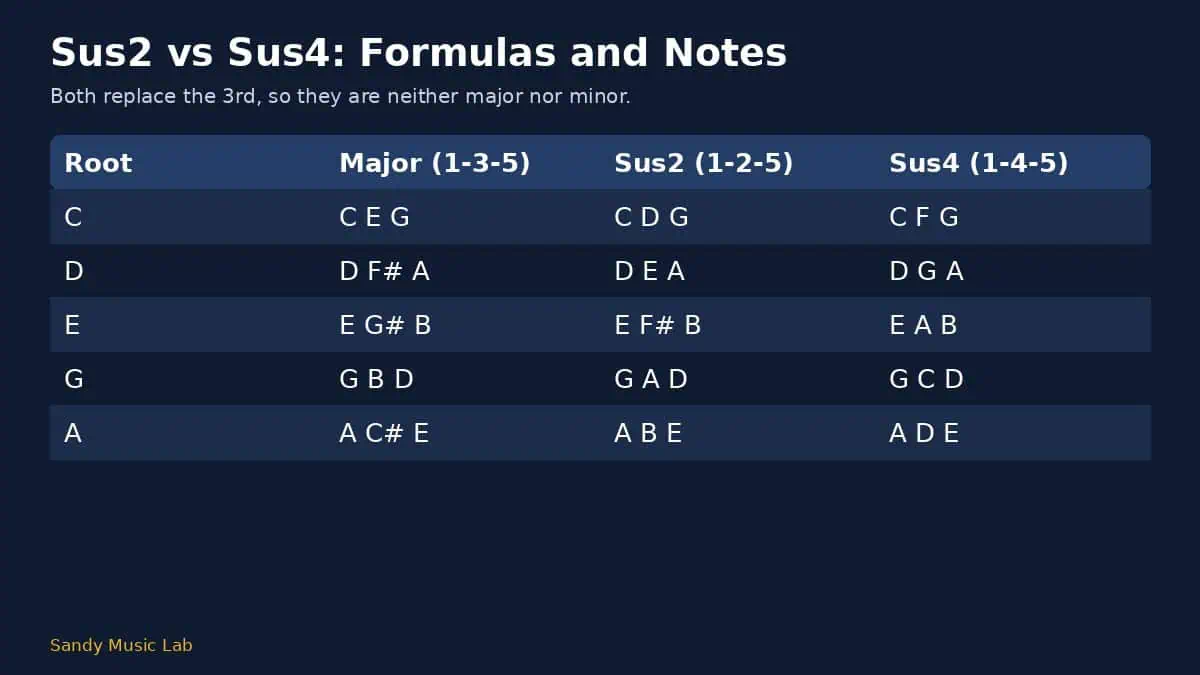
Quick answer: a sus2 chord is built 1-2-5 and a sus4 chord is built 1-4-5. Dsus2 is D-E-A and Dsus4 is D-G-A. Sus2 sounds open and airy; sus4 sounds tense and wants to resolve back to the major chord. Neither is major or minor, because both leave out the 3rd.
What is a suspended chord?
A normal triad has a root, a 3rd and a 5th. The 3rd decides whether the chord is major or minor. A suspended chord drops the 3rd and “suspends” another note in its place:
- Sus2 uses the 2nd: root, 2nd, 5th (1-2-5)
- Sus4 uses the 4th: root, 4th, 5th (1-4-5)
Because there is no 3rd, a sus chord can sit in a major or a minor song. A chord written as plain “Dsus” usually means Dsus4.
Sus2 vs sus4: the key differences
| Sus2 | Sus4 | |
|---|---|---|
| Formula | 1-2-5 | 1-4-5 |
| Replaces the 3rd with | The 2nd (a whole step above the root) | The 4th (a perfect 4th above the root) |
| Sound | Open, airy, floating | Tense, unresolved, wants to move |
| Usual resolution | Can rest as it is | Often resolves down to the 3rd |
| Example (D) | Dsus2: D E A | Dsus4: D G A |
A neat fact: sus2 and sus4 chords share notes with each other. Dsus2 (D E A) has the same notes as Asus4 (A D E). The name depends on which note is the root, usually the bass note.