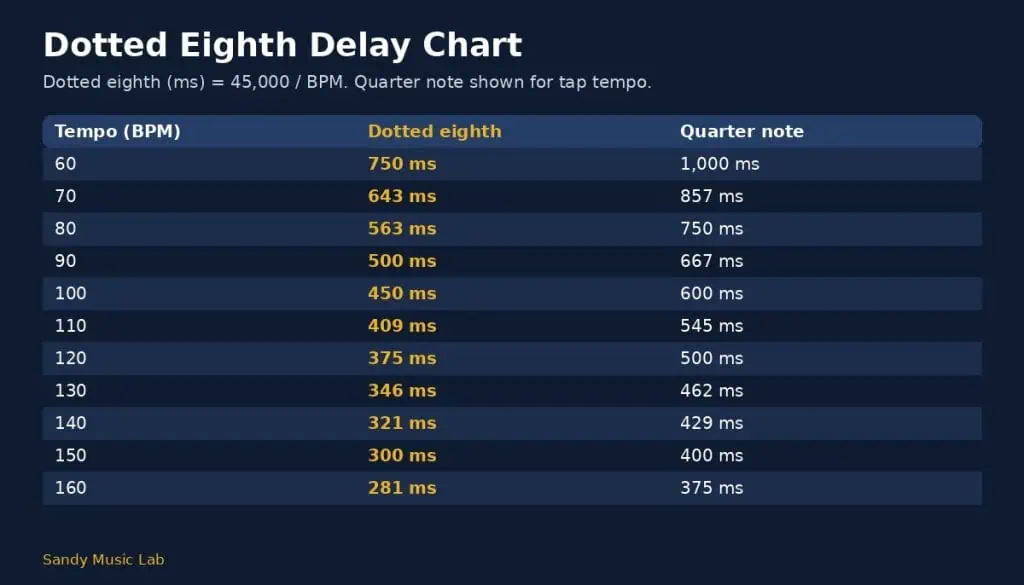
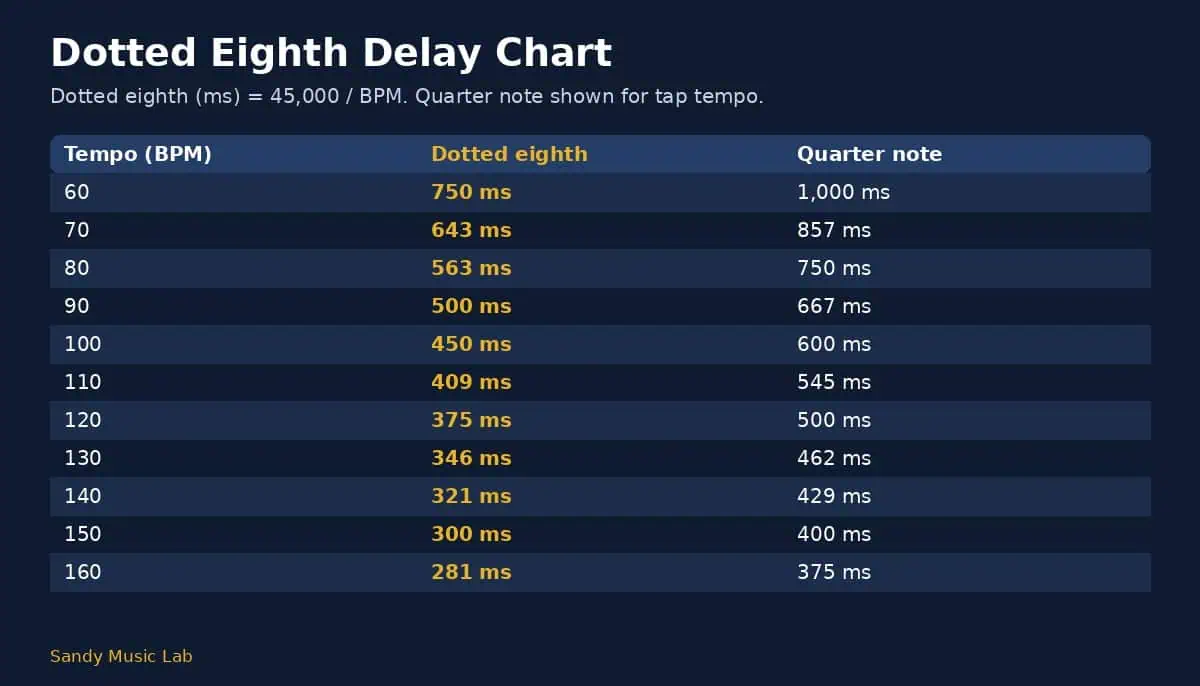
A dotted eighth delay repeats each note three sixteenth notes later, so the echoes fall between the notes you play and turn simple eighth-note picking into a rolling sixteenth-note pattern. To set it, divide 45,000 by the song’s tempo: at 120 BPM a dotted eighth delay is 375 ms. This guide gives you a full chart, the mix and feedback settings that work, how to set it on any delay pedal, and how to practice it with a free delay time calculator.
Quick answer: dotted eighth delay time in milliseconds = 45,000 / BPM. At 100 BPM it is 450 ms, at 120 BPM 375 ms and at 140 BPM about 321 ms. Start with the mix around 40 to 50%, feedback low (2 to 3 repeats), and pick steady eighth notes so the repeats fill in the sixteenths.
What is a dotted eighth delay?
A delay repeats what you play after a set time. A dotted eighth note lasts one and a half eighth notes, or three sixteenth notes. When the delay time matches that, each repeat lands exactly between the eighth notes you pick:
- You play: notes on 1, &, 2, &…
- The delay answers three sixteenths later, on the “a” of each beat and the “e” of the next.
- Together you hear a continuous stream of sixteenth notes.
It is the classic sound behind The Edge’s guitar parts with U2 and countless modern pop, rock and ambient tones.
The dotted eighth delay formula
One beat (a quarter note) lasts 60,000 / BPM milliseconds. A dotted eighth is three quarters of a beat:
Dotted eig